
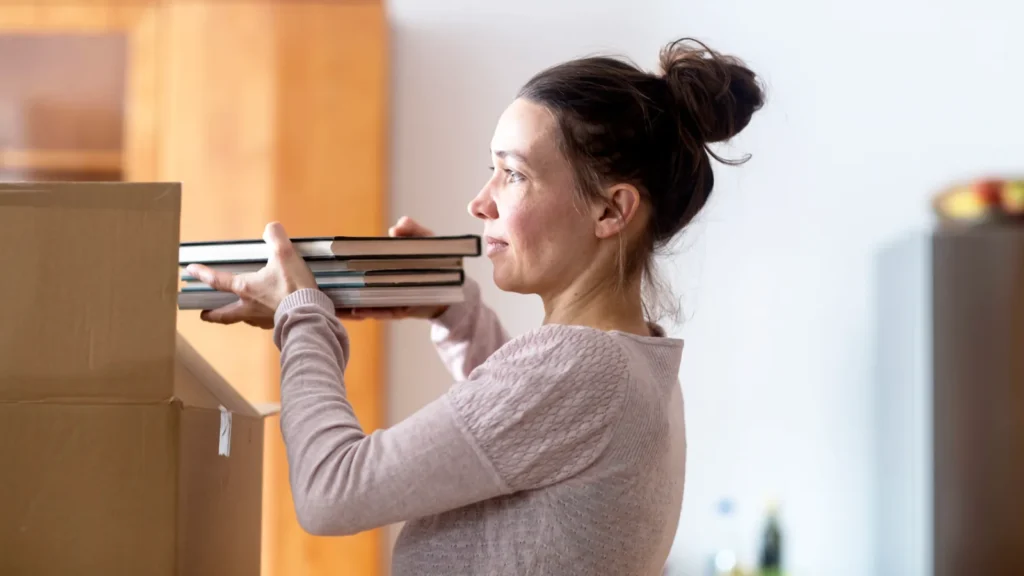
A large box full of books is one of the more reliable ways to injure someone on moving day. It can be too heavy for one person to lift safely, heavy enough to split a standard cardboard base, and too heavy for a removalist to carry alone up a flight of stairs.
Two things cause almost every book-packing problem: using a box that is too big, and not setting a weight limit before filling it.
Cull the collection before you reach for boxes
Books are one of the few things you can sort and pack weeks in advance, because most are not needed day to day. Spend a short session with the collection and decide what is worth keeping, what can be donated, and whether anything belongs to someone else.
This is not about getting rid of a cherished collection. It is about not paying to move textbooks from a degree finished years ago, or duplicate cookbooks that have not been opened since. Books in good condition can usually be donated to charity shops or community book exchanges.
Use the right box and prepare it properly
Use small boxes for books. This applies whether you are packing everything yourself or getting help from independent local removalists available through Urgent Pro. Books are dense, so a small box gets heavy long before it looks full, and a large box loaded with books is the one most likely to be too heavy to carry.
Reinforce the base before loading anything. Tape along the flap seam and then lengthways across the centre of the base, so the tape forms an H-shape. A box base that gives way mid-carry is a common cause of breakage.
Set a weight limit before the box is filled, not after. The test is simple: you should be able to lift the box from the floor with a straight back and a secure grip. If you cannot, take the top layer out. Keep the limit lower if stairs are involved, or if anyone helping has a back condition. Removalists can decline or modify part of a job where they see a hazard or unreasonable risk, and a box that is too heavy to carry safely can fall into that category.
Fill any gaps with crumpled packing paper, or rolled towels and clothing, so the books cannot shift in transit. Close the lid fully before sealing. If the lid bows upward the box is overfull, and the top layer needs to come out.
How the rest of the house is packed is covered step by step in the room-by-room packing guide.
Special and valuable books
Most books are quick to pack, but family heirlooms, first editions, signed copies and art books need extra care.
Do not use newspaper, because ink can transfer onto covers. Pack these books individually in clean packing paper, in small boxes, with the heavier volumes on the bottom. Put folded paper between books so the covers do not rub together. Keep receipts or other proof of value for any book worth more than $500, since a damage claim above that value needs it. If a book is irreplaceable, carry it in your own vehicle rather than loading it on the truck.
Labels that help on moving day
Write HEAVY on all four sides and the top of every book box, not only the top. A removalist carrying a box by the long face cannot see a label on the lid. Add BOOKS below HEAVY on each side so the weight is explained, not just flagged.

A label that says only “BOOKS” does not tell the crew which room the box goes to. A label such as “BOOKS: Living Room, Fiction A to M” also tells you which box to open first at the other end. For a large collection, number the boxes (“Living Room Books 2 of 5”) so you can see at a glance that nothing was left behind. A quick photo of each shelf before packing helps you recreate the arrangement at the new address.
If rain is forecast for moving day, cover the book boxes with large garbage bags as they are carried from the house to the truck. Wet cardboard loses strength, and a wet base under a heavy box is a failure waiting to happen.
Owner-packed boxes and your damage claim
Damage to goods inside a box you packed yourself is excluded from a removalist damage claim under the AFRA-standard Owner Packed rule, unless negligent handling by the removalist can be proved. The exclusion exists because the removalist cannot verify what is inside an owner-packed box or how it was packed, so packing well does not remove it. How owner-packed boxes affect a claim is covered in the transit cover guide.
Photograph the contents of each box before sealing it. That is the evidence that can support a claim if a box is handled badly.
Book boxes are part of your wider moving plan. The week-by-week moving plan covers what to do eight weeks out and on moving day itself. For removalists in Perth, Melbourne, Sydney, Brisbane and the Gold Coast, see Urgent Pro removalist services.
FAQs
What size box is best for books?
Small boxes. Books are dense, so a small box reaches a heavy weight before it looks full, and a large box of books can be too heavy to lift safely or split its base. Tape the base in an H-shape whatever size you use.
How many books fit in a box?
As many as leave the box liftable by one person with a straight back. Hardcovers are heavier than paperbacks and reach that limit sooner. If you cannot lift the box from the floor, take the top layer out.
Should books be stacked flat?
Pack them flat or with the spines facing down. Books packed with the spines facing outward can buckle while the box is carried. Fill any gaps with packing paper so nothing shifts.
Do removalists charge for heavy boxes?
Removals are quoted on volume, access and distance, and stairs and specialist items such as pianos add surcharges. Confirm what your quote includes. A removalist can also decline a box that looks unsafe to carry, so keep each one at a weight you can lift comfortably.