
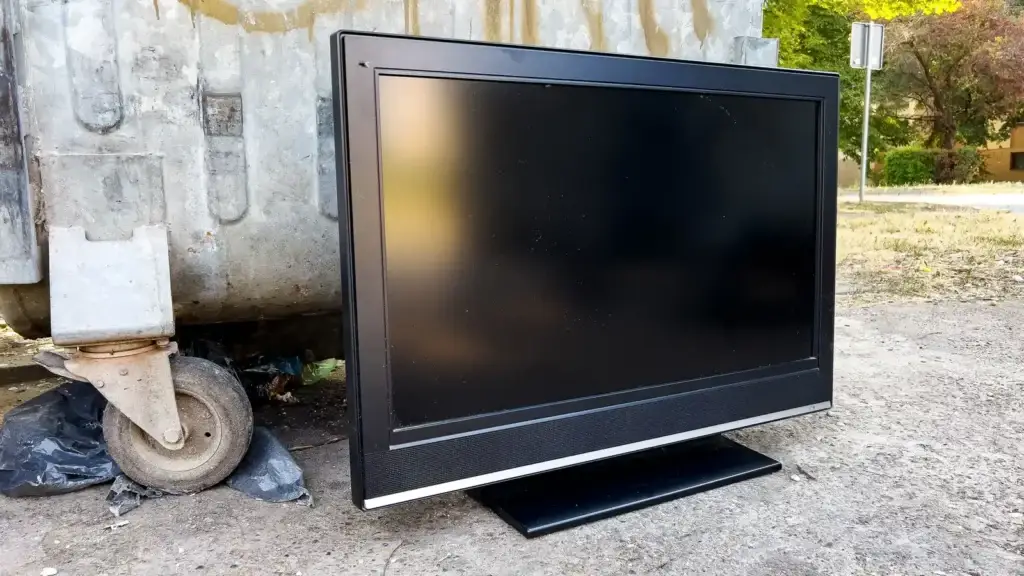
Old TVs contain lead and mercury and should not be placed in the general waste stream. Many of the components of a TV are hazardous and, when landfilled, can mix with organics and become very difficult to extract. A national scheme facilitates a free drop-off option for the disposal of TVs and other e-waste at hundreds of drop-off points throughout Australia. The scheme is not well-known. If you cannot transport the TV yourself, a booked rubbish removal collection can dispose of it for you.
Why Old TVs Can’t Go in the Bin
Televisions, as well as many other electronics, contain heavy metals and other toxic chemicals. A television is often one of the largest single-item requests for rubbish removal along with a couch, fridge or mattress.
A standard CRT television can contain as much as four kilograms of lead in its glass. Mercury can be found in the backlighting of LCD and LED televisions.
Several states, including South Australia, Victoria and Western Australia, ban e-waste from landfill. Western Australia’s ban started on 1 July 2024 under the Waste Avoidance and Resource Recovery (E-waste) Regulations 2024. It applies to e-waste service providers, large business and public entities and landfill operators, not to households, but households are asked to use drop-off points instead of the bin. Rules differ elsewhere, so check your state environment authority. Many councils do not collect TVs from the kerb; councils differ, so check yours.
Disposing of television sets or computers with household waste may result in the refuse collection being refused or a notice being served on the household, according to the state and local government regulations.
The National Television and Computer Recycling Scheme
The National Television and Computer Recycling Scheme (NTCRS) was established in 2011 and is now regulated under the Recycling and Waste Reduction Act 2020 and the Recycling and Waste Reduction (Product stewardship, televisions and computers) Rules 2021. Under this Scheme, manufacturers and importers of televisions and computers fund the collection and recycling of these electronic waste (e-waste) products from designated collection sites. There is no charge to the public for using this service.
There are hundreds of drop-off points funded under the Scheme across the country, and the Scheme is designed to give around 98 per cent of the population reasonable access to a drop-off point.
Use the locator at recyclingnearyou.com.au with your postcode to find your nearest drop-off site. The scheme is now administered by the National Environmental Protection Agency.
The NTCRS accepts most TVs regardless of their age or brand, including CRT, LCD, Plasma and LED screens. The scheme is for TVs and computers only. Other small household appliances and microwaves are not accepted by the NTCRS.
Do Retailers Take Old TVs?
Some retailers run take-back programs for old TVs, so check with the store before you buy a new one. Large electronics and office supply stores are the usual places to ask.
This call-ahead advice applies to every drop-off location. Each sets its own limits on large items and its own collection hours, and the collection point may be at the store entrance or at the warehouse entrance. A call to the collection point confirms your TV will be accepted, and saves you a trip.
Council Collection
Many councils do not collect TVs from the kerb, because e-waste has to be handled in a controlled way and can’t be put with the rest of the waste. Some do let you put TVs out for hard rubbish or a scheduled bulk waste collection. Councils differ; check yours.
The council’s waste guide sets out the rules. Putting out e-waste when it isn’t allowed can result in a notice, and also means your TV won’t get collected.
Some councils also run e-waste collection days, a few times each year, which accept more items than the NTCRS drop-off sites, like small appliances, electric tools, and other small electronics. Check your council’s site for more info.
Transfer Stations
Most transfer stations have a specific area for e-waste. At some facilities, e-waste has to be dropped off with hard waste to be accepted for free. At others, there is a small fee for each item you want to get rid of.
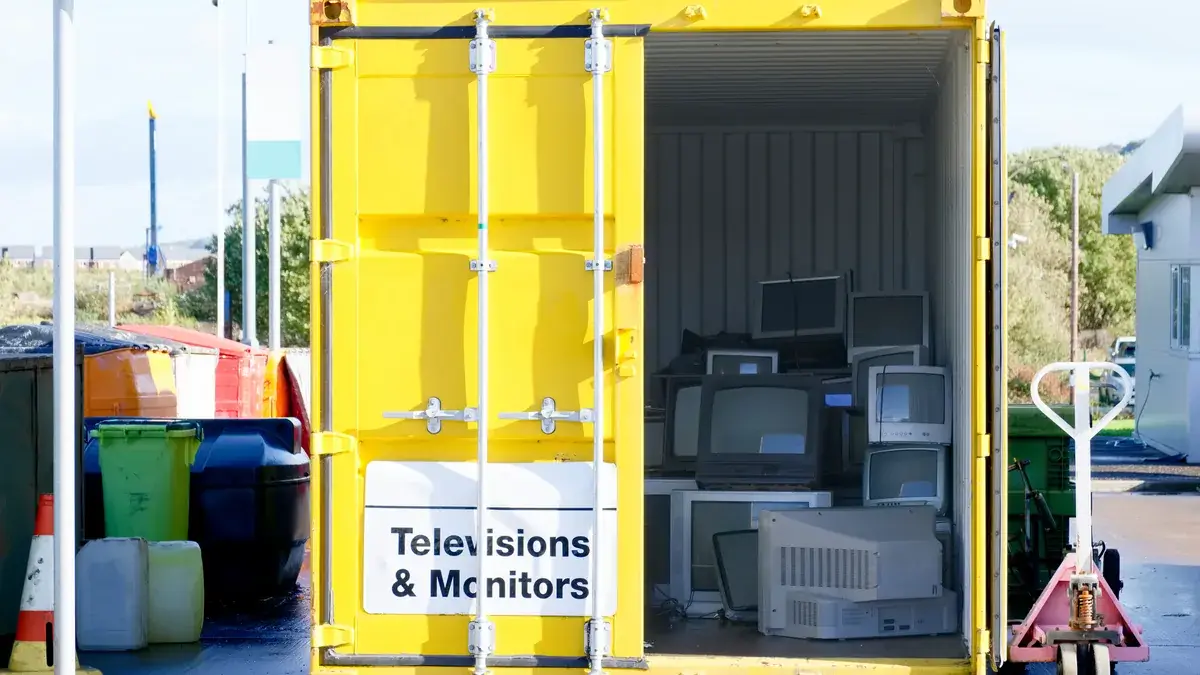
If you are going to the tip with other household waste, ask the weighbridge operator if the e-waste area is included in the general entry fee, or if there is a separate charge. Most transfer stations allow large screens in the e-waste cage, no booking required. It’s a good idea to give them a call to check the cage is available on the day you are planning to go.
Before You Drop Off a Smart TV
Before you drop off your smart TV, be aware that televisions are dismantled and shredded so the metals can be recovered, which leaves virtually no chance of data recovery once it happens. The key window is the time between when you drop the TV off, and when it is processed.
Smart TVs store a lot more data than what is stored on a typical PC. Most people are surprised to learn that modern TVs store login information to streaming services like Netflix and Disney+, logged-in accounts to Google and Amazon, WiFi passwords, voice assistant commands, and even in some TVs, the TV’s browser history. All of this data is erased with a factory reset, which should be done before the TV leaves your home.
Factory reset steps vary by brand; follow your TV’s manual or the manufacturer’s support page.
What Actually Happens to a TV After Being Dropped Off?
Upon arrival at an NTCRS-licensed recycling facility, televisions are assessed to determine if there are any components that can be refurbished and resold. Most televisions are sent for material recovery and processing. The television set is dismantled. The glass is removed, and the plastic is shredded to be processed for manufacturing. Metals, including copper and aluminium, as well as small amounts of gold and silver, are then recovered.
Each television delivered to a recycler, rather than landfill, keeps hazardous materials contained and lets its glass, plastic and metals be recovered.
When to Opt for Rubbish Removal Instead
In most cases, the NTCRS and retailer drop-off schemes are the most effective means of disposal for families with a functioning vehicle, and the capacity to transport a television to a recycling facility. Using a booked rubbish removal service is more practical in a number of different situations.
Removing a television set is most frequently booked when the TV is in an upstairs location, or when it is too heavy, too large, or too awkward to move with just one person, or when it is removed along with other bulky items as part of a house or garage clear-out. Old TVs are among the most popular single-item requests in Urgent Pro rubbish removal bookings, and adding a TV to a larger removal job is usually cheaper per item than organising a separate collection.
Ask the provider where the TV will be recycled; it should go to an e-waste recycler, not landfill. Rubbish removal prices start from $220. A large TV collected as a single-item removal is at the lower end of this price range. For a cost breakdown by job size and location, the rubbish removal pricing by service and city outlines the confirmed ranges.
The rubbish removal service warranty applies to bookings where items are missed or not removed as agreed.
To find out what e-waste disposal requirements apply in your state, refer to the e-waste disposal rules in Australia.
FAQs
Can I put an old TV in the bin?
No. Televisions are e-waste and can’t go in the bin. Several states, including South Australia, Victoria and Western Australia, ban e-waste from landfill. Western Australia’s ban started on 1 July 2024 under the Waste Avoidance and Resource Recovery (E-waste) Regulations 2024. It applies to e-waste service providers, large business and public entities and landfill operators, not to households, but households are asked to use drop-off points instead of the bin. Rules differ elsewhere, so check your state environment authority. Many councils do not collect TVs from the kerb; councils differ, so check yours. A TV put in the bin can be left uncollected and can draw a council notice.
Where can I dispose of an old TV for free in Australia?
The National Television and Computer Recycling Scheme (NTCRS) offers hundreds of drop-off points throughout Australia. Use the recyclingnearyou.com.au site to find the nearest location, and use your postcode to get the most accurate results. Most locations will accept any TV, regardless of condition or age.
Which retail stores accept old TVs for recycling?
Some retailers run take-back programs for old TVs, so check with the store before you buy a new one. Acceptance and limits vary by store, so call ahead, and once you get there, ask staff where the collection point is.
Do I need to factory reset a smart TV before recycling it?
You should reset a smart TV before getting rid of it if it has ever been connected to the internet to stream shows or if it has been synced to a personal account. This will clear all logins, passwords, connected accounts, and browsing history. Factory reset steps vary by brand; follow your TV’s manual or the manufacturer’s support page. It is important to do this before the TV leaves your house.
Does the council collect TVs with hard rubbish?
Some councils will accept TVs as part of their hard rubbish collection, but many councils do not collect TVs from the kerb. Councils differ; check yours before putting a TV out for hard rubbish collection. If e-waste is not collected, the TV will be left on the nature strip, and you will have to dispose of it yourself. Some councils also run e-waste collection events that will accept a wider range of items than standard hard rubbish collection events.
Can a rubbish removal service take a TV?
Yes. A booked rubbish removal service will collect from your property. The service will collect from upstairs and other areas you cannot get the TV to yourself. Ask the provider where the TV will be recycled; it should go to an e-waste recycler, not landfill. Book a rubbish removal collection from $220 per job. This makes the most sense when the TV is large and heavy and is being removed along with other items.