
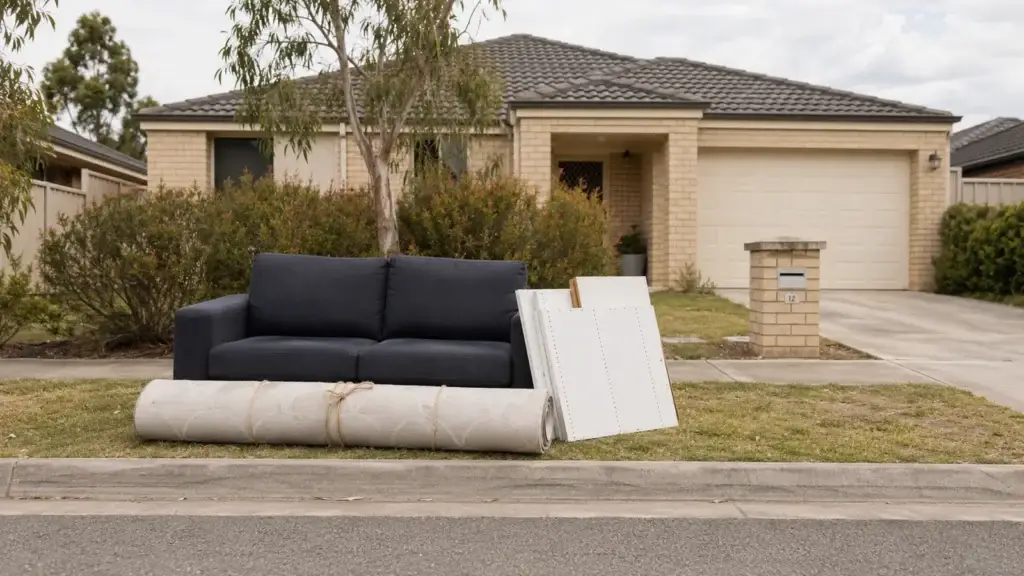
Hard rubbish collection systems across Australia vary significantly from city to city. Queensland and New South Wales run similar programs, while Victoria leaves almost everything to individual councils. Perth does not use the term hard rubbish at all: bulk waste collection there is called verge collection and operates under different placement and scheduling rules. Each council in greater Melbourne sets its own rules and schedule. Sydney runs on-request programs where residents can book a set number of council clean-ups per year. The Gold Coast runs a suburb-rotation schedule similar to other Queensland councils.
Hard rubbish collection systems are easy to misread, and the consequences of getting it wrong include items being left at the kerb uncollected. If council will not collect what you need removed, book a rubbish removal service to have items collected and disposed of at a licensed facility the same day.
What Is Hard Rubbish?
Hard rubbish refers to large household items that are too large to go into the standard weekly council waste collection. Hard rubbish collection programs run across Queensland, New South Wales, Victoria, and the Gold Coast. They help residents dispose of large household items that cannot fit into a wheelie bin. White goods, mattresses, furniture, and carpet are among the items most commonly collected by these programs.
For situations where mattress disposal falls outside the council’s accepted limits or collection window, how to arrange mattress disposal in Australia covers private and council options by city.
In Western Australia, bulk waste collection is handled through a different model. Items are placed on the grass verge between the road and the footpath, which is council-owned land. The collection is known as verge collection, not hard rubbish, and it is important to use the correct term when searching for your local council’s schedule or rules.
Items such as furniture, household appliances, and various household items are generally accepted across most council programs. Children’s outdoor play equipment and bicycles are also commonly accepted.
What all council collection programs refuse:
| Item | Reason not collected | Legal alternative |
|---|---|---|
| Construction waste (bricks, tiles, timber framing) | Can damage collection vehicles | Hire a skip or use a licensed waste transporter |
| Suspected asbestos | Serious health risk requiring licensed handling | Licensed asbestos removalist only |
| Aerosols and gas cylinders | May explode if crushed in vehicle | Return to supplier or take to a hazardous waste facility |
| Batteries of all types | Fire risk from thermal runaway if punctured | B-cycle drop-off at Woolworths, Aldi, Bunnings, Officeworks |
| Chemicals, pesticides, cleaning products | Risk of environmental contamination | Household chemicals program or council drop-off events |
| Medical waste and sharps | Can injure collection workers | Pharmacy disposal or sharps container programs |
| Televisions, computers, and other e-waste | Illegal in Victorian kerbside collections; regulated stream elsewhere | NTCRS drop-off, MobileMuster, B-cycle, or council e-waste events |
Knowing which items fall outside the standard program means you can plan disposal in advance rather than finding items left behind on collection day. In Victoria, placing e-waste in any kerbside collection breaches the Environment Protection Act 2017. In other states, most councils decline it as a program-scope decision. The guide to e-waste disposal rules in Australia covers which items are free to drop off and where.
Brisbane: Brisbane City Council’s Annual Bulk Collection
Brisbane City Council (BCC) provides a free annual bulk waste collection for residential properties across the city. BCC schedules this service by suburb: each suburb has one collection week per financial year, and different suburbs have different weeks. The rotation changes year to year, so the week assigned to your suburb is worth checking each year.
During the scheduled collection week, household items are to be placed at the kerbside. BCC collects from the kerbside only and requires items to be on the kerbside by 6am on the first day of the collection period. To find your collection week, see the Brisbane City Council kerbside collection calendar.
Items BCC collects include household furnishings, bicycles, lawnmowers with fuel drained, small household appliances, mattresses, and rolled carpet.
Items BCC will not collect include household food waste, large appliances such as fridges and air conditioners, building materials, asbestos, tyres, gas cylinders, paint, batteries, and all e-waste.
For collection of waste outside the BCC program, including items on the refused list or volumes beyond what one collection covers, book a rubbish removal job in Brisbane through Urgent Pro for same-day collection by a verified local provider.
Melbourne: No Citywide Program, Every Council Runs Its Own
There is no consistent bulk waste collection program for the City of Melbourne. Every municipal council that makes up the greater Melbourne area runs its own bulk waste collection with its own schedule, volume limits, and booking process.
Brimbank City Council gives each household one free hard rubbish collection and one free green waste collection per financial year (July to June). The allowance is 4 cubic metres of hard rubbish and 2 cubic metres of green waste per booking. Residents can combine both into a single booking, but they must be booked at the same time. Items should be placed at the front property line, no more than 2 metres into the property. Items must not be placed against fences or hedges. Cancellations must be lodged by 5pm on the Thursday before the collection week. Full details are on the Brimbank hard rubbish collection page.
Other Melbourne councils allow one free hard rubbish collection per year but differ in how they schedule it. Port Phillip Council assigns each zone a scheduled collection period in rotation. Yarra City Council lets residents request a collection date from an available window. The City of Melbourne services its residential properties directly, though its inner-CBD LGA has a smaller residential population than surrounding councils. To find the current schedule and booking process for any Melbourne council, search the council name with “hard rubbish collection” to find the current page, as dates and processes are updated annually.
E-waste is prohibited across the state of Victoria. Melbourne hard rubbish collections do not accept any electronic waste regardless of which council area you are in.
For the complete picture of how Melbourne handles rubbish disposal across council programs, transfer stations, and private services, the full guide to rubbish disposal in Melbourne covers every option in detail.
Sydney
There is no citywide hard rubbish program in Sydney. Each local council runs its own program and they vary significantly across the metropolitan area.
The City of Sydney offers a residential clean-up program. Residents can book an online request to have their rubbish removed, with items placed at the kerbside on the collection date. Each eligible property receives a set number of free bookings per year. Surrounding councils follow different models: northern beaches and inner-western councils have historically run scheduled street clean-ups, while many have recently switched to on-request systems where each household receives an annual allocation of bookings.
Programs and accepted item lists vary by LGA, so checking your specific council’s website before placing anything at the kerb is the only reliable approach.
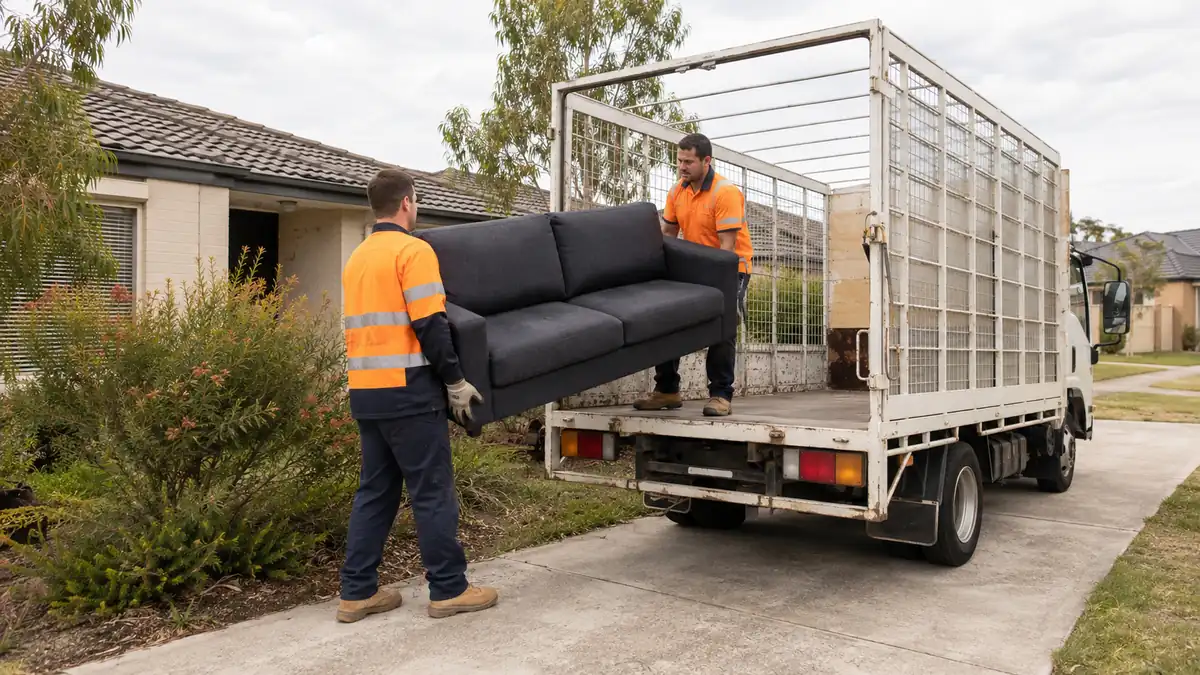
If you need rubbish removed and your council will not collect it, verified providers through the Sydney rubbish removal service collect the same day and confirm disposal routes for regulated items at the time of booking.
Perth: Verge Collection, Not Hard Rubbish
Bulk waste collection in Perth is known as verge collection. Items are placed on the grass verge between the road and the footpath rather than against the fence or in the driveway. The collection schedule in most metropolitan councils is an annual rotation where each property is allocated a collection period once per year.
Verge collection schedules differ between the City of Perth and surrounding councils including Stirling, Joondalup, Wanneroo, Swan, and Canning. The Waste Authority WA’s WasteSorted program provides a postcode search tool to find your council’s current schedule. Find your local collection date and the accepted item list at wastesorted.wa.gov.au.
During the collection period, it is the property owner’s responsibility to ensure items do not obstruct the footpath, flow onto the road, or block stormwater drains. Most Perth councils restrict how far in advance of the collection date items can be placed on the verge, to reduce the risk of illegal additions to the pile.
Construction waste, asbestos, gas bottles, tyres, chemicals, batteries, and e-waste are not accepted on the verge in any Perth council area.
For items the verge collection will not take, verified providers through the Perth rubbish removal service collect and dispose of all material at licensed facilities.
Gold Coast: GCCC’s Annual Suburb-Rotation Collection
Gold Coast City Council (GCCC) conducts an annual hard rubbish collection program that rotates through suburbs on a scheduled basis. Each residence has one collection opportunity per year within its suburb’s allocated window. GCCC collection windows change annually. Check the GCCC website at goldcoast.qld.gov.au to find the window for your suburb.
Collection items must be placed in a single accessible pile at the edge of the road. Items must not obstruct the footpath or driveway, and must not be spread across multiple positions on the same property. GCCC will not collect from a property where items are not presented in accordance with these rules.
When the volume of hard rubbish exceeds what the GCCC program allows, or when the timing of a clear-out does not align with the suburb’s collection window, verified providers through rubbish removal on the Gold Coast collect the same day without requiring an annual booking.
Placement. Items go at the kerbside or on the verge in Perth, at or near the front property boundary. In Victorian councils including Brimbank, items must be placed within
2 metres of the front property boundary and must not be placed against fences, hedges, or walls. Collection crews approach from the footpath side and will not move obstructions to reach the pile.
Timing. Most councils restrict how many days before the collection date items can be placed. Placing items too far in advance can attract illegal additions to the pile and may result in a council notice in some areas. Contact your council to confirm the maximum advance placement period before putting anything at the kerb.
Volume. Most councils cap how much can be collected in a single service. Brimbank and similar Melbourne councils typically allow 4 cubic metres of hard rubbish per collection. Items above the cap are left behind, and most councils will not return for a second pickup without a separate booking.
Batteries and e-waste. Remove all batteries from items before placing them at the kerb. A battery inside an old power tool or children’s toy creates a fire risk if crushed during collection. Electronics must be disposed of through a separate stream entirely.
Single accessible pile. Items must not be spread across multiple positions along the property boundary. Collection crews work to a schedule and will not collect from multiple piles at the one property.
Large appliances. Fridges, freezers, and air conditioners require refrigerant removal by a licensed technician before disposal. Check with your council before placing these items at the kerb, as most programs will not collect them through kerbside pickup.
Items No Council Collection Takes, Regardless of City
During a household or property clear-out, several categories come up that no council program accepts.
Fridges and air conditioners. These contain refrigerant that must be removed by a licensed technician before disposal. Most council programs will not collect them through kerbside pickup. Resource recovery centres with the right equipment accept them for degassing and disposal. When replacing a large appliance, the retailer delivering the new unit will often arrange collection and disposal of the old one.
Construction debris. Drywall, timber framing, bricks, tiles, and masonry are refused everywhere. A skip bin is the most cost-effective option for renovation debris.
Electronic items. Council programs do not collect e-waste through bulk collection. For the correct disposal route per device type, the article on the correct stream for each type of electronic waste covers what is free, where each item goes, and what each stream accepts.
Asbestos. Any suspected asbestos-containing material must be handled by a licensed removalist. Do not move it, break it apart, or place it near a bulk waste pile.
Household chemicals, paints, and solvents. These go to council household hazardous waste programs or approved drop-off events, not into any kerbside collection.
When It Makes Sense to Use a Private Rubbish Removal Service
Council bulk collections are designed for large household items placed once a year within the accepted categories. There are several situations where they are not the right tool.
The timing does not work. Council collections are of no help when a resident is moving out and the annual collection week passed months ago. The guide to getting a rental property cleared before the handover deadline covers what must come out, what it costs to leave it behind, and the order to do it in.
The volume is too large. A full renovation or estate clear-out produces far more than a single annual collection handles. Items above the volume cap are left at the kerb, and most councils charge for additional collections even when they allow them.
The council will not collect it. Construction waste, refrigerant-charged appliances, chemicals, and all the categories above need a different disposal route regardless of city.
The items cannot be moved to the kerb. Council collections require items at the kerbside. Getting a wardrobe from a second-floor unit or a fridge from a back shed to the verge is the property owner’s responsibility. Private providers bring the labour and equipment to wherever items are located.
Same-day rubbish removal across all five cities is available through Urgent Pro. Verified independent providers collect from the property, not just the kerb, confirm the disposal route for regulated items at booking, and do not require an annual collection window.
Frequently Asked Questions
Does Brisbane City Council offer more than one bulk rubbish collection per year?
BCC provides one free collection per residential property per year on a suburb-by-suburb schedule. Additional material can be taken to a council resource recovery centre or collected by a private provider outside the annual window.
How much hard rubbish can be placed out in Melbourne?
It varies by council. Brimbank, for example, limits hard rubbish to 4 cubic metres and green waste to 2 cubic metres per free annual collection. Other Melbourne councils use similar caps. Check your specific council before placing items, as material above the cap will be left at the kerb.
Why is hard rubbish collection in Perth called verge collection?
The term reflects where items are placed: the grass verge between the footpath and the road, which is council-owned land. The function is the same as hard rubbish programs in the eastern states, but the name, placement rules, and scheduling approach are different. Searching “hard rubbish Perth” will not return the right council information.
Can I put a fridge in my hard rubbish or verge collection pile?
In most cities, fridges are refused from kerbside collection because the refrigerant inside must be removed by a licensed technician before the appliance can be safely disposed of. Many councils accept fridges at resource recovery centres that have degassing equipment on site. Contact your council before placing a fridge at the kerb.
What happens if I include e-waste or batteries in my hard rubbish pile?
Most councils will leave the pile uncollected or remove the offending items and leave everything else. In Victoria, including e-waste in any kerbside collection breaches the Environment Protection Act 2017. Remove batteries from all items and take electronics to the correct collection stream before anything goes to the kerb.