
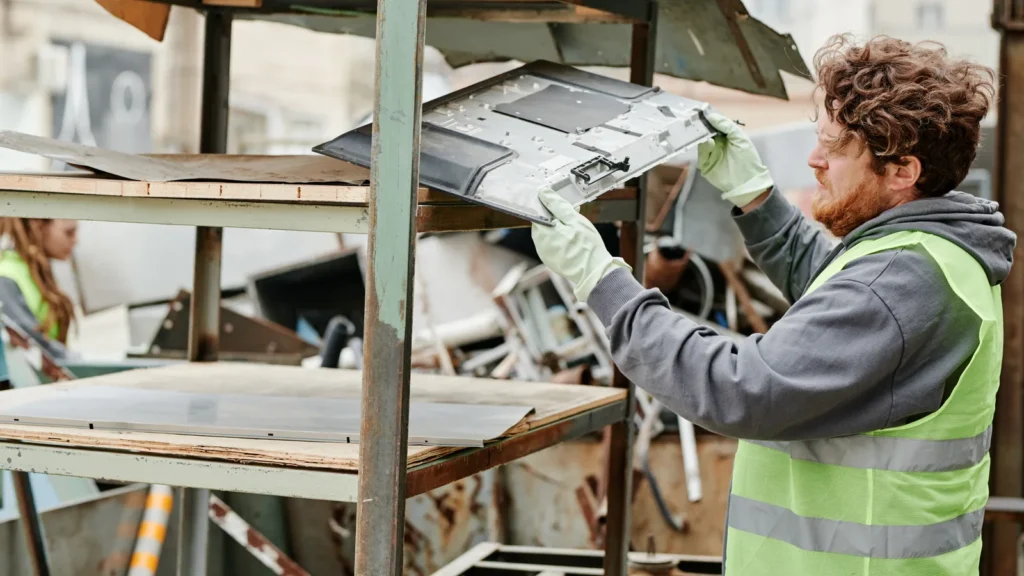
Australians are generally aware of the national e-waste management scheme. Most assume it covers the majority of their old electronics. The scheme covers more categories than people expect in some areas, and fewer in others. Televisions, laptops, and tablets are in. Mobile phones are not. Neither are household appliances like toasters or standalone chargers. In certain states, the scheme also restricts how devices outside its scope can be disposed of.
If you need to clear a large quantity of household items including electronic devices, arrange a rubbish removal pickup through Urgent Pro. Providers on the network dispose of e-waste at licensed facilities rather than to landfill. Understanding which stream applies to which item is the practical knowledge most disposal guides skip over.
Why It Matters Where Electronics End Up
Mercury, lead, cadmium, and brominated flame retardants are among the hazardous substances found in consumer electronics. When these materials end up in landfill, they break down over time and leach into soil and groundwater, where they can affect ecosystems and, at sufficient concentrations, human health.
Responsible disposal is not just about avoiding harm. It is also about recovering what is still valuable. Once electronics reach a licensed facility, metals are smelted and returned to manufacturing, plastics are ground down for remanufacturing, and glass from screens is cleaned and repurposed. Recycling electronics is genuinely a loop, not a cleaner form of disposal.
The Three Streams Australians Confuse
Australia handles e-waste through three distinct systems. No single one of them covers everything, and they are not interchangeable.
Stream one: The National Television and Computer Recycling Scheme (NTCRS). This is the free federal drop-off program. It covers televisions, computers, tablets, monitors, printers, and computer peripherals. It does not cover mobile phones, batteries, chargers, or small kitchen appliances.
Stream two: The B-cycle battery scheme. Batteries are handled by a completely separate national program. Loose portable batteries, from AA cells to small rechargeable packs, go to B-cycle drop-off points at major retailers. They never go in any household bin.
Stream three: Council programs and transfer stations. Most items outside the first two streams, including phones, small appliances, and cables, are managed through local council resource recovery centres, periodic household drop-off events, or manufacturer take-back programs. Note that council hard rubbish (bulk waste) collections generally exclude e-waste entirely, even though both are council-run; see hard rubbish rules for e-waste for what each city’s bulk collection actually accepts.
The distinction matters for a practical reason. A lithium-ion battery that is crushed inside a garbage truck or recycling-facility sorting machine can go into thermal runaway, a self-sustaining heat reaction that causes fire. Battery-related fires at waste facilities are a growing problem reported consistently by state fire services and waste industry bodies.
What the NTCRS Actually Covers
The National Television and Computer Recycling Scheme was established by the Australian Government in 2011 and now operates under the Recycling and Waste Reduction Act 2020. It is administered by the Department of Climate Change, Energy, the Environment and Water (DCCEEW). Drop-off is free for households and small businesses. The cost of running the scheme is built into the retail price of covered products and recovered from manufacturers and importers under a levy arrangement, so there is no charge at the collection point.
As of January 2025, the three organisations approved to collect under the NTCRS are TechCollect, E-Cycle Solutions, and Activ Group. To find the nearest drop-off point, search your postcode via the DCCEEW e-waste page, Recycle Mate, or Planet Ark’s RecyclingNearYou. For questions about the scheme, contact ewaste@dcceew.gov.au.
Products covered under the NTCRS:
| Category | What is included |
|---|---|
| Televisions | Colour and black-and-white televisions |
| Computers | Laptops, notebooks, tablets, personal computers, CPUs |
| Monitors and projectors | CRT monitors, flat screens, projectors |
| Printers | Single-function and multi-function (print, copy, fax) |
| Peripherals | Keyboards, mice, scanners, CD and DVD drives, hard drives, memory cards, motherboards, web cameras, electrical transformers |
Not covered by the NTCRS: mobile phones, standalone chargers and cables, small kitchen appliances (toasters, blenders, kettles), hair dryers, power tools, gaming consoles, batteries, and vapes.
Some drop-off points may also accept items outside the formal NTCRS list, including phones and batteries. Contact the specific location to confirm before making the trip.
Mobile Phones: Their Own Program, Not the NTCRS
Mobile phones are one of the most commonly discarded electronics and one of the items people most expect the NTCRS to cover. It does not. A phone contains recoverable materials including lithium, cobalt, and rare earth elements, but it sits entirely outside the legislated product scope of the scheme.
The dedicated program for phones in Australia is MobileMuster, a government-accredited scheme that accepts handsets and accessories free of charge. Drop-off is available at major phone carriers, electronics retailers, and some council sites. If no drop-off point is nearby, devices can also be mailed to MobileMuster through Australia Post at no cost.
Before handing in or posting any phone, remove personal data and the SIM card.
Batteries: A Separate Stream With a Fire Reason
The B-cycle scheme, run by the Battery Stewardship Council, covers loose portable batteries at a network that includes Woolworths, Aldi, Bunnings, and Officeworks locations, as well as many councils and libraries. Search for B-cycle drop-off locations near you by postcode on the B-cycle website.
Batteries should never be placed in any kerbside bin or yellow-lid recycling bin. Where a battery cannot be removed from a device, such as in many modern smartphones and laptops, the whole device should go to a council e-waste collection point or a manufacturer take-back program rather than any bin.
Remove batteries from all devices before disposal wherever they can be removed. This applies to remote controls, power banks, cordless power tools, electric scooters, toys, and bike batteries. The increase in battery-powered products entering the household waste stream is one of the main reasons waste-facility fire incidents are rising.
State Rules: Victoria and WA Have Landfill Bans, QLD and NSW Do Not
This is the distinction that matters most when deciding what to do with an item outside the NTCRS. Most general disposal guides treat Australia as though it has a single set of rules. It does not.
| State | Legal ban on e-waste in kerbside bins or landfill | Where to take it |
|---|---|---|
| Victoria | Yes, since 1 July 2019, for everyone including households | Council drop-off, transfer stations, NTCRS points, retailers |
| Western Australia | Yes, since 1 July 2024, for businesses and the waste industry (see below) | Council transfer stations, NTCRS points, Recycle Right drop-off locations |
| Queensland | No landfill ban | Brisbane and Gold Coast council resource recovery centres, NTCRS points |
| New South Wales | No landfill ban | NSW EPA Community Recycling Centres, council drop-offs, NTCRS points |
Victoria in detail. Under the Environment Protection Act 2017, all e-waste is banned from landfill and from kerbside garbage and recycling bins, with the prohibition in effect since
1 July 2019. EPA Victoria defines e-waste broadly: anything involving an electric current or an electromagnetic field, including batteries, computers, kitchen appliances, mobile phones, photovoltaic panels, televisions, whitegoods, and products with only minor electrical components. This is a legal prohibition on everyone, households included, not a recommendation. For current guidelines and enforcement details, visit EPA Victoria’s electronic waste page.
For Melbourne residents working through a property clear-out, the guide to rubbish disposal options available in Melbourne covers what each major council program accepts and when a private removal service makes more sense. To book a rubbish removal service available in Melbourne that disposes of items at licensed facilities, providers on the Urgent Pro network handle collection and confirm the disposal route for regulated items at booking.
Western Australia in detail. Since 1 July 2024, the Waste Avoidance and Resource Recovery (e-waste) Regulations 2024 prohibit sending regulated e-waste to landfill, but the obligation falls on the waste industry, not on households directly. It binds e-waste service providers, landfill operators, and “significant entities”: a business or public entity with 200 or more full-time-equivalent employees, or one that generated 5 or more tonnes of regulated e-waste in the previous financial year. Households are not legally required to keep e-waste out of the bin in WA, but the state government encourages it and lists drop-off points through Recycle Right. In practice this closes most of the gap with Victoria: any WA business or council waste contractor handling e-waste is bound by the ban, even where the household that discarded the item was not.
QLD and NSW. Neither state has a landfill ban, so the obligation is practical rather than statutory. Council programs in both states are free and well-established. In Brisbane, Brisbane City Council’s resource recovery centres accept a broad range of e-waste. In Sydney, the NSW EPA supports the national scheme and funds a permanent network of Community Recycling Centres, plus periodic Household Chemical CleanOut events that accept e-waste. In both cities, the Recycle Mate app or Planet Ark’s RecyclingNearYou will locate the nearest drop-off option for any specific item. Queensland’s state waste strategy lists e-waste as one of seven “priority wastes” under active work, but as of this writing that work has not produced a landfill ban.
Items No Bin Accepts, Regardless of State
Several categories have specific hazards that take them outside every standard collection channel. These come up regularly in household and rental property clear-outs.
CRT monitors and televisions. The glass in cathode-ray tube screens contains lead. Crushing or landfilling them releases it into the surrounding environment. Most NTCRS collection points accept CRTs, but call ahead for large quantities or very old units, as some facilities have limits.
Gas-containing white goods. Fridges, freezers, air-conditioning units, and some dehumidifiers contain refrigerant that must be removed by a licensed technician before disposal. No standard rubbish removal provider and no council collection accepts these with refrigerant still charged. When you replace a white good, the retailer delivering the new appliance will typically arrange collection and degassing of the old one.
Fluorescent tubes and compact fluorescent lamps. These contain mercury. Some retailers and councils accept them; none accept them in a kerbside bin. Check your council or the nearest Recycle Mate drop-off.
Lithium-ion batteries. Covered in the section above. No state, no bin, no circumstances.
What Private Rubbish Removal Can and Cannot Do
Private rubbish removal providers can legally collect e-waste. The requirement is where it goes: a licensed facility, whether that is an NTCRS collection point, a council transfer station, or a licensed e-waste recycler. In Victoria, taking e-waste to landfill is a breach of the Environment Protection Act 2017. In other states it is an environmental failure, and an increasingly visible one as waste tracking improves.
When you book a rubbish removal job that includes electronics, ask where the e-waste goes, not just whether the provider takes it. A credible answer names a destination: a council transfer station, an NTCRS-affiliated recycler, or a licensed processing facility. If the answer does not name a destination, follow up before confirming the booking.
Items that reputable providers typically decline or surcharge include CRT monitors and televisions, all batteries including lithium-ion, refrigerant-containing white goods, and fluorescent tubes. Under Urgent Pro’s rubbish removal warranty, providers are required to ask customers to disclose regulated items including e-waste at the time of booking. Providers who handle these items properly will ask upfront.
If you are clearing a larger volume and weighing your options, when a skip bin makes more sense than a booked pickup covers the cost differences and practical cases where each option works better. If the clear-out is at the end of a tenancy, the full property clearout sequence before handover covers what needs to come out, what it costs if you leave it, and the order to do it in.
To schedule a rubbish removal through Urgent Pro across Perth, Melbourne, Sydney, Brisbane and the Gold Coast, verified independent providers handle collection and confirm their disposal route for regulated items at the time of booking.
Frequently Asked Questions
What does the national NTCRS e-waste scheme cover?
The scheme covers televisions, computers, laptops, tablets, monitors, printers, and peripherals such as keyboards and mice. Mobile phones, chargers, batteries, and small kitchen appliances are not included. Drop-off is free for households and small businesses.
Why can batteries not go in the yellow-lid recycling bin?
Lithium-ion and other batteries can cause thermal runaway if crushed during sorting, triggering a fire inside the vehicle or facility. Take loose batteries to a B-cycle drop-off location at Woolworths, Aldi, Bunnings, or Officeworks instead.
Which states ban e-waste from landfill?
Victoria and Western Australia. Victoria’s ban (Environment Protection Act 2017) has applied to everyone, households included, since 1 July 2019. WA’s ban (Waste Avoidance and Resource Recovery (e-waste) Regulations 2024) started 1 July 2024 but binds e-waste service providers, large businesses and landfill operators, not households directly. Queensland and NSW have no equivalent landfill ban, though both run council drop-off programs. Check the current position in your state before disposal, as legislation can change.
Where do I take an old mobile phone in Australia?
Mobile phones are not covered by the NTCRS. The government-accredited scheme for phones is MobileMuster, with drop-off at major carriers and retailers or a free mail-in option via Australia Post. Wipe the device and remove the SIM card before handing it in.
Can a private rubbish removal provider take e-waste?
Yes. Providers can collect e-waste but must dispose of it at a licensed facility, not to landfill. Before booking, ask where the e-waste goes, not just whether they accept it.