
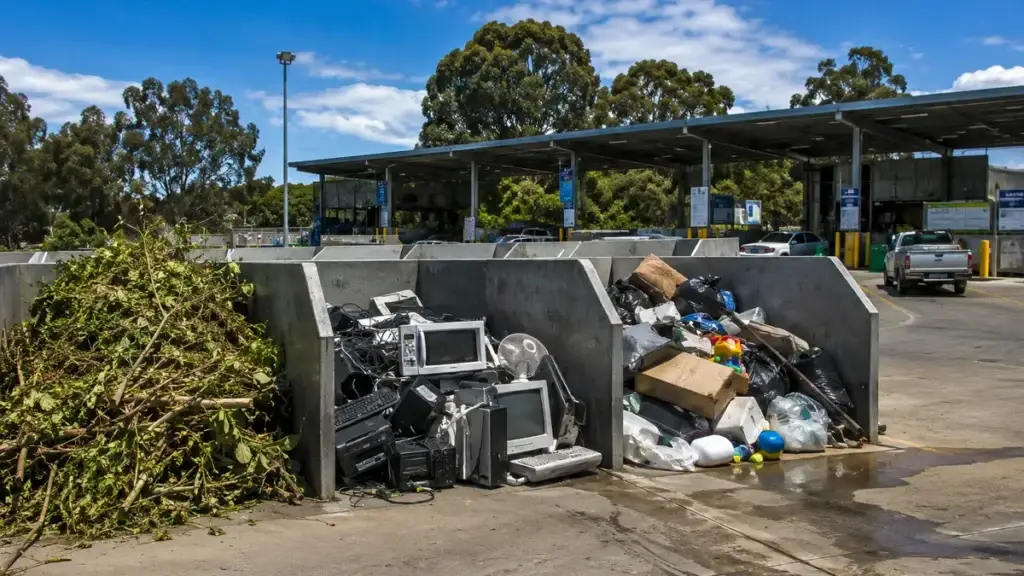
Mixing waste types in Melbourne causes problems at the tip, and some of them follow you home. It can push the disposal cost up, get your load rejected entirely, and in some cases put you in breach of Victoria’s environmental laws. Knowing which stream each item belongs to before you load is the practical starting point.
This guide covers how Melbourne council hard waste collection actually works, what Melbourne transfer stations accept and charge, Victoria’s e-waste landfill ban, hazardous items that must never go in a general rubbish pile, and when booking a private rubbish removal service in Melbourne makes more sense than doing it yourself.
How Melbourne Council Hard Waste Collection Works
Melbourne councils do not all run a scheduled annual “hard rubbish week.” Collection systems differ considerably across the metropolitan area. Putting bulk waste on the kerb without a booking at the wrong council can mean the waste sits uncollected, and in some cases is treated as illegal dumping.
Current models across inner and middle-ring councils:
City of Melbourne: Residents can book one free hard waste collection per financial year, up to 1 cubic metre. Booking is required before any waste is placed out.
City of Yarra: Up to two free booked collections per household per calendar year. Waste should not be placed out more than 24 hours before the scheduled pickup date. Yarra flags earlier placement as potentially constituting illegal dumping.
City of Port Phillip: Booked collection only. Residents select an available pickup date for their area when booking online.
Merri-bek: An annual 2 cubic metre allocation, split into two 1 cubic metre bookings or used as one. Items cannot be left on the nature strip outside a confirmed booking window.
City of Stonnington: Still operates two scheduled municipality-wide collections per year, in autumn and spring. Residents can pay for a booked collection outside those periods.
The practical rule: check your specific council before putting anything on the kerb. What applies in Stonnington does not apply in Yarra.
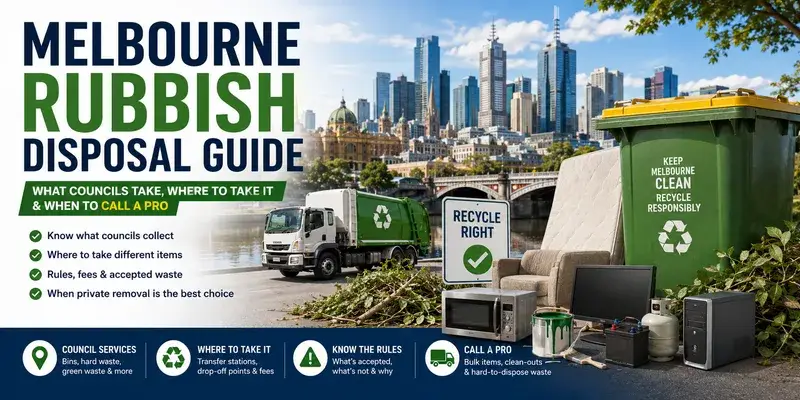
Melbourne Transfer Stations: What They Accept and What They Charge
If your council collection is months away, your volume exceeds the free allocation, or you have item types the kerbside service will not take, driving directly to a transfer station is often the most practical option.
Fees and accepted items differ between facilities. Arriving with the wrong waste type can mean a wasted trip. The examples below show current fees and key acceptance rules across five councils. Treat all figures as examples current at the time of writing and check the relevant council page before travelling, as rates change.
| Transfer station | Mattress fee (resident) | Green waste | General rubbish (car boot) | Construction waste | Key exclusions |
|---|---|---|---|---|---|
| Port Phillip Resource Recovery Centre, South Melbourne | $21 first / $31 subsequent | Accepted: leaves, clippings, pruning, small branches, palm fronds | $34 | Not accepted | Soil, bricks, concrete, rubble, asbestos, household chemicals |
| Stonnington Waste Transfer Station | $47 | Car boot $12 / station wagon $21 / single-axle trailer $32 | $32 | Accepted: dirt, bricks, concrete and rubble at $305/tonne | Asbestos, gas cylinders, hazardous chemicals, medical waste |
| Darebin Resource Recovery Centre, Reservoir | $37 | $77/m³ | $162.50/m³ | Clean concrete and bricks accepted; no mixed rubble or soil | Asbestos, chemicals, medical and liquid waste |
| Monash Recycling and Waste Centre | $40 residents / $44 non-residents | Accepted; charges vary by vehicle type and fill | Varies by vehicle and fill percentage | Accepted: confirm specific stream on arrival | Check council page for current exclusions |
| Moonee Valley Transfer Station | Accepted | Free for Moonee Valley residents with proof of residence | Standard charge applies | Separate from green and general waste | Vehicles over 2.5 GVM not accepted |
Sorting before you arrive affects what you pay. Moonee Valley notes that separating loads reduces fees, with metals, e-waste, batteries and paint accepted free for residents as separate drops. Port Phillip gives the same advice.
A $21 mattress fee at Port Phillip versus $47 at Stonnington matters if you have multiple mattresses. Knowing the right facility for your waste types before loading is worth checking.
Victoria’s E-Waste Landfill Ban
Victoria bans e-waste from landfill, and the rule is broader than most people expect. EPA Victoria defines e-waste as discarded electrical or electronic equipment, covering batteries, computers, kitchen appliances, mobile phones, solar panels, televisions, whitegoods, and products with minor electrical components such as some toys.
A separate federal program, the National Television and Computer Recycling Scheme (NTCRS), provides free recycling for a specific subset: televisions; desktop, laptop and tablet computers; monitors and projectors; printers and multifunction devices; and peripherals such as keyboards, mice and scanners.
Mobile phones, batteries, kitchen appliances, whitegoods and power tools are not covered by the NTCRS. They still fall under Victoria’s landfill ban and need a council transfer station or specific take-back program.
| Item | Victorian landfill ban | NTCRS free recycling |
|---|---|---|
| Television | Yes | Yes |
| Desktop or laptop computer | Yes | Yes |
| Computer monitor | Yes | Yes |
| Printer or multifunction device | Yes | Yes |
| Keyboard, mouse, scanner, hard drive | Yes | Yes |
| Mobile phone | Yes | No. Use MobileMuster or a similar program |
| Loose battery | Yes | No. Separate battery recycling required |
| Microwave or kettle | Yes | No |
| Vacuum cleaner | Yes | No |
| Washing machine or dryer | Yes | No |
| Refrigerator | Yes | No |
| Electric power tool | Yes | Generally no |
| Solar panel | Yes | No |
For NTCRS items, Melbourne drop-off points include Harvey Norman at 210 Lonsdale Street (CBD), Harvey Norman Richmond Warehouse at 158 Murphy Street, and Monash Waste Transfer Station at 380 Ferntree Gully Road in Notting Hill, all listed by Ecycle Solutions as participating locations. TechCollect also operates through Officeworks stores. Check the specific location before travelling, as item limits and hours change.
Hazardous Items: What Can Never Go in a General Rubbish Pile
Some materials require specialist handling regardless of disposal method. A standard rubbish removal provider will refuse these at the Walk-Through, and transfer stations either reject them or require a separate stream.
Asbestos: Licensed asbestos removalist only, in every Australian state. Never place asbestos or asbestos-suspect materials in any rubbish pile, skip bin, or general transfer station load under any circumstances.
Paint, solvents and oils: Council hazardous waste drop-off programs. Port Phillip accepts household paint within its stated quantity limit. Darebin accepts appropriately labelled paint within its limit. Neither accepts pesticides, solvents or general cleaning chemicals in the waste stream.
Gas bottles: Darebin accepts small BBQ gas bottles up to 9 kg for a $12 fee. Stonnington excludes gas cylinders entirely. Check your facility. Gas retailers also typically accept cylinders for exchange or disposal.
Batteries: All types, including lithium, lead-acid and household alkaline, are e-waste under Victoria’s landfill ban. Most transfer stations have a dedicated battery drop-off point. Do not place batteries in general rubbish or recycling bins.
Fluorescent tubes and mercury lamps: Specialist recycling. Some transfer stations accept these separately. Confirm before arriving.
Pool chemicals and pesticides: Council hazardous waste programs only.
Medical waste and sharps: Return to a pharmacy or contact your council for the relevant program.
Tyres: Transfer stations typically charge separately for tyres and apply quantity limits. Tyre retailers accept them for a fee in most cases.
If you are unsure whether an item is hazardous, call the transfer station before loading. Arriving with an unacceptable load wastes a trip and can result in the entire load being refused.
Sort Before You Load: The Step That Saves Money
A trailer with branches, scrap metal, broken furniture and general rubbish may look like one job. Those materials belong to different waste streams at different rates.
Separating recyclable metal from general rubbish before arriving at Moonee Valley or Stonnington means the metal goes in free for residents rather than at the general rubbish rate. Green waste, e-waste and cardboard work the same way at facilities that accept them separately.
Use this table before loading:
| You have… | Do not put it with… | Correct disposal route |
|---|---|---|
| Old mattress | General rubbish | Transfer station mattress stream (separate fee applies) |
| Couch or furniture | Recycling bin | Council hard waste booking or transfer station general |
| Grass clippings and leaves | General rubbish | Green waste bin or transfer station green waste stream |
| Tree branches | General rubbish | Green waste: confirm diameter limit with your facility |
| Soil | Green waste | Inert or soil waste facility. Most councils do not accept soil in green waste |
| Bricks and concrete | General rubbish | Construction or inert waste stream. Separate fee applies; not accepted at all facilities |
| Scrap metal | General rubbish | Separate metal drop-off, free at several Melbourne transfer stations |
| TV or computer | General rubbish | NTCRS participating drop-off, free for eligible items |
| Battery | Any bin | Battery recycling point at transfer station or retail |
| Paint | General rubbish | Council hazardous waste program or transfer station paint drop-off within quantity limit |
| Gas bottle | General rubbish | Approved cylinder drop-off or gas retailer |
| Asbestos | Any rubbish pile | Licensed asbestos removalist only |
When Private Rubbish Removal Makes More Sense
Council hard waste allocations cover household-scale clearance once or twice a year. They do not cover estate clear-outs, renovation debris, the aftermath of a flooded room, or volumes that exceed the annual allocation. Moving out at the end of a lease is another common case council allocations don’t cover — see what to clear before the final inspection for the order to do it in.
Verified independent providers booked through Urgent Pro’s rubbish removal network collect furniture, white goods, green waste and general household rubbish, disposing of all waste at licensed facilities. Providers retain disposal dockets for 12 months under the platform’s service agreement.
Private removal is also practical when access rules out a transfer station trip: apartments with no driveway, laneway-only access, or items too heavy for one person. Those same access limits usually rule out a skip bin too, which the skip bin and removal service comparison works through case by case.
Hazardous items are excluded. Asbestos, chemicals, paint, batteries, gas bottles and medical waste cannot be collected by a rubbish removal provider. Use the council or specialist pathways above.
Victoria’s Environment Protection Act 2017 places a general environmental duty on waste transporters. Illegal dumping is a serious offence. The Victorian EPA’s pollution hotline at 1300 372 842 is the primary reporting channel.
FAQs
Does Melbourne have an annual hard rubbish week?
Not universally. City of Melbourne, Yarra, Port Phillip and Merri-bek operate booked on-demand systems rather than scheduled kerbside dates for the whole municipality. Stonnington still runs two scheduled collections per year. Check your specific council before placing anything on the kerb.
What e-waste can I recycle for free in Melbourne?
The NTCRS covers televisions, computers, monitors, printers and peripherals such as keyboards and mice. Mobile phones, batteries, kitchen appliances and whitegoods are not covered by the NTCRS but are still banned from Victorian landfill. They need a council transfer station or a specific take-back program.
Can I take soil to a Melbourne transfer station?
Generally no. Port Phillip, Darebin and Stonnington all exclude soil. It is classified separately from green waste. Contact your council for inert waste disposal options.
What does Victoria’s e-waste landfill ban cover?
All discarded electrical or electronic equipment. EPA Victoria’s examples include batteries, computers, kitchen appliances, mobile phones, solar panels, televisions, whitegoods and products with minor electrical components such as some toys. If it runs on electricity or contains a battery, assume the ban applies.
Can a rubbish removal provider take paint, batteries or gas bottles?
No. These are hazardous materials that must go through council programs or specialist disposal pathways. A provider will refuse them before collection starts.
How is private rubbish removal priced in Melbourne?
Most providers price by cubic metre or truck-load size. Heavy items attract higher disposal rates. Items needing disassembly or a two-person carry may attract a surcharge. Access restrictions such as stairs or no driveway can affect the price. A quote confirms the cost before work starts.
What happens if a Melbourne council hard waste collection is delayed?
Contact your council to reschedule. Do not leave items on the nature strip beyond the confirmed collection window. Extended kerbside stockpiles can result in a compliance notice.