
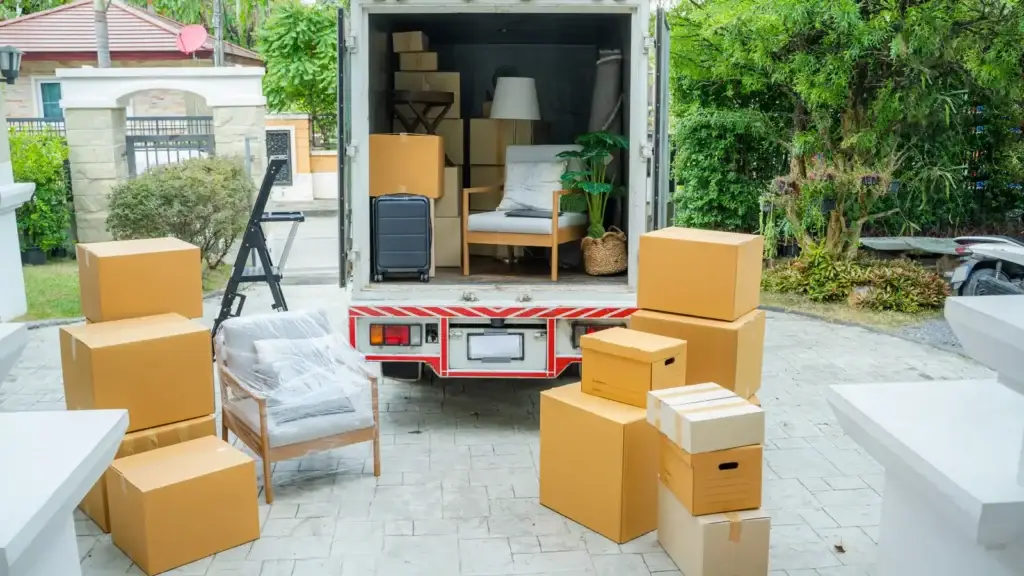
When you move interstate, a number of things change. The pricing model works differently from a local move, the route you take significantly affects your total cost, and there is a fair amount of admin to sort out once you arrive in your new state. Here is a breakdown of each.
Pricing model
Local jobs are charged by the hour, meaning the distance the truck travels is not the main cost driver. Interstate moves are calculated on the volume of your goods and the distance between cities, meaning the time the crew spends on site is less relevant to the final price. As a general rule, the further the distance, the higher the total cost. A move from Perth to Sydney, for example, would be priced considerably higher than a Sydney-to-Melbourne move, because the Perth route covers more than three times the distance.
Routes
Certain routes carry greater costs than others, as both the distance and truck availability on each corridor affect the price. Backloading is a common option on interstate routes, particularly for smaller loads or when move dates are flexible.
The first step towards any decision on an interstate move is to find out the real cost by getting a quote from a removalist. Only then can you properly decide whether to keep, sell, or leave behind each item.
Why interstate removalists price by volume, not by the hour
Local moves are charged by the hour because time is the unknown. While an experienced crew can estimate the hours required for a local move, packing and access conditions can take longer than anticipated and push the final invoice up.
Interstate moves work differently. A truck has to reach its destination on a set schedule. The volume of your goods and the distance between cities determine the cost, not how long the crew spends on site.
What this means practically: the time it takes to load and access conditions at either end of the journey have less impact on the base price than they do on an hourly local job. However, access conditions can still attract a surcharge on top of the volume and distance base.
The more cubic metres you are moving, the higher your removal cost will be. Decluttering before you request a quote is one of the most practical ways to reduce an interstate removal cost, because every cubic metre you remove from the load directly reduces the price.
Some of the factors that contribute to your interstate removals quote:
- Volume. Studio: 10-15 m3. 1 bedroom: 15-20 m3. 2 bedroom: 20-28 m3. 3 bedroom: 30-40 m3. 4 bedroom+: 45 m3 and above.
- Distance between cities. The further the route, the higher the total cost, as more fuel is used and the provider must also account for mandatory driver rest periods.
- Access. Ground-level access with a truck parked close to the door is the baseline. Stairs, lifts, long carries from the street, and parking restrictions each attract a surcharge.
- Season. Peak season runs from December through February. The best rates are typically found on mid-week, mid-month bookings during the winter months.
- Storage. A gap between your move-out and move-in dates means storage is required, which is quoted separately.
- Specialist items. Pianos, pool tables, large safes, and ride-on mowers each attract defined surcharges and require advance notice so the right equipment is allocated.
- Packing service. A full pack-and-unpack service adds to the total quote. Owner-packed-only is the baseline.
The minimum rate for a removals booking on the Urgent Pro network starts from $220. For an interstate whole-property move, the actual quote sits well above that figure. Whole-property interstate moves typically quote in the hundreds to low thousands, scaled by the factors above.
Providers on the Urgent Pro network are held to AFRA-aligned operational standards, including $10M public liability insurance per occurrence and goods-in-transit insurance. If you are comparing quotes from different providers, the Australian Furniture Removers Association publishes the operational benchmarks that professional removalists work to, and their member directory lets you verify a provider’s accreditation status before you book.
What interstate moves cost by route
The table below shows approximate current market ranges for a standard three-bedroom home on the major interstate corridors that Urgent Pro serves. These are planning estimates based on current market data across the Australian removalist industry. The confirmed written quote from your provider is the only accurate figure for your specific job.

| Route | Approx. distance | Indicative range (3-bed home) | Transit time |
|---|---|---|---|
| Sydney to Melbourne | 870 km | $3,000 to $5,500 | 1-2 days |
| Sydney to Brisbane | 910 km | $3,500 to $5,500 | 1-3 days |
| Gold Coast to Sydney | 860 km | $3,000 to $5,000 | 1-2 days |
| Melbourne to Brisbane | 1,670 km | $4,500 to $7,000 | 3-6 days |
| Perth to Melbourne | 3,400 km | $5,000 to $8,500 | 7-14 days |
| Brisbane to Perth | 4,300 km | $6,500 to $10,000+ | 10-16 days |
Volume above or below a standard three-bedroom home can significantly adjust these ranges. A one-bedroom apartment on the Sydney-Melbourne corridor typically quotes between $1,800 and $3,500. A four-bedroom home on the same corridor sits closer to $5,500 to $9,000. Access and timing variables, covered in the section above, can move the final number up or down from those midpoints.
Perth-to-east-coast routes consistently quote at the higher end for two reasons. The distance is considerably greater, and fewer trucks run on that corridor in the reverse direction, which limits backload availability and reduces pricing competition on the route.
Trade-off of backloading
A backload is when your furniture travels in spare capacity on a truck that is already heading to your destination city. You pay for the cubic metres your belongings occupy, not the full freight cost of a dedicated vehicle.
A backload can save you 30 to 50 per cent compared to a dedicated truck. A Sydney-to-Melbourne job that quotes at $4,000 for a dedicated truck might come in at $2,000 to $2,800 as a backload, depending on available space and how your volume fits alongside the truck’s existing load.
The trade-off is timing. You are not booking a dedicated truck and therefore do not have a fixed arrival date. The delivery window is typically 3 to 7 days rather than a specific date. On longer routes like Perth to Melbourne, that window can extend to two weeks.
Backloading works best when:
- You do not have a fixed, immovable ready-date at the destination
- You can manage for a few days without the majority of your belongings (a suitcase, air mattress, and kitchen basics cover most people)
- The route runs frequently in both directions, such as Sydney-Melbourne, where trucks move daily and backload slots are genuinely available
- You have at least 6 weeks of notice, giving enough lead time to find a slot that fits the route’s schedule
It is a poorer fit when you have a fixed settlement date, a school start, or a lease that begins on a specific day you cannot move. On those moves, a dedicated vehicle with a confirmed delivery date is the more predictable option, even at a higher price.
Bookings made within one to two weeks of your moving date can cost 15 to 30 per cent more.
Work backwards from your settlement or lease-end date. Once the removalist booking is confirmed, you can lock in the other services that depend on it, including your vacate clean, rubbish removal, and utility disconnections. The minimum lead time that gives you real choice on most corridors is 4 weeks. For December and January moves, 8 weeks in advance gives you the best access to rates and provider availability. For a full rundown of the booking sequence, see the moving house planning checklist.
What to have ready before you get a quote
Vague quotes are subject to change. If the actual volume of your goods on the day is greater than what you declared, the price will be revised. Specialist items and access conditions also need to be declared in advance so the right equipment and crew size are allocated.
Before contacting a removalist:
- Make a room-by-room inventory of everything you are moving, including the garage, shed, outdoor furniture, and anything stored off-site
- List all large or heavy specialist items separately: piano, pool table, ride-on mower, large safe, or oversized appliances
- Note the access conditions at both locations: stairs, lifts, long carries from the street, narrow corridors, and body-corporate parking restrictions
- Know your preferred move dates and how much flexibility you have around them
- Decide how much packing help you need: full pack, part-pack for fragile items only, or no pack
Certain items cannot be transported under any circumstances, and removalists are not permitted to load them regardless of the distance involved. Review items the truck won’t take regardless of distance before finalising your inventory, so you can arrange alternative transport for those items well ahead of moving day.
Packing for an interstate move
On transit damage claims, a removalist is generally not liable for owner-packed boxes. Damage to items inside those boxes will not typically be covered unless it can be proved that the crew handled them negligently.
This is particularly relevant to an interstate move, where a truck can be on the road for several days and travel hundreds or thousands of kilometres.
For high-value or fragile items, the practical options are: pay the removalist to professionally pack those specific items while you handle everything else, or use double-walled boxes with generous internal cushioning and understand that a transit damage claim for owner-packed goods depends on the specific warranty terms agreed at booking.
See the guide on packing for an interstate move for a room-by-room breakdown of what professional packing standards require. Ovens, glass-fronted furniture, and items with compressors are the categories most frequently damaged in transit, and in most cases the damage is a result of inadequate preparation rather than anything that happened on the road.
If you are moving high-value items such as artwork, a piano, or antiques, disclose these before booking. Items with individual replacement values above $1,000 have specific evidence requirements under the Removalists Service Warranty, including a pre-move condition photograph and an inventory note made at uplift.
What changes when you arrive in a new state
There are a number of changes you need to make after moving to a different state. The requirements vary by state and are managed by multiple agencies that do not communicate with each other automatically.
Vehicle registration. Each state has its own rules on when you need to re-register your vehicle after establishing residency. Penalties apply for missing the deadline, and a late re-registration may trigger a roadworthiness inspection. Check with your new state’s transport authority before you move so you know the specific deadline.
Driver’s licence. Most states require you to exchange your licence for a local one within a set period of establishing residency. Your existing licence remains valid for driving in your new state until that deadline passes. Contact your new state’s licensing authority for current requirements.
Electoral roll. Federal law requires you to update your address with the Australian Electoral Commission within 8 weeks of moving, whether the move is interstate or within the same state. The AEC’s online portal handles the update in a few minutes and is the authoritative source for this requirement.
Medicare and tax. Update your Medicare address through myGov and notify the ATO of your new address at the same time. Neither has a strict deadline for address changes, but correspondence going to your old address creates practical problems quickly, particularly if you have a tax return or Medicare refund pending.
Utilities and energy. Arrange for utilities to be disconnected the day after you leave, and connected at the new address the day before you arrive. An overlap of one day on each end means you will not arrive to an empty property with no power. You cannot transfer an energy account across state borders, so you will need to open a new account with a retailer licensed in your new state.
The full scope of removalist services available through the network covers Perth, Melbourne, Sydney, Brisbane, and the Gold Coast. Moves involving Adelaide, Canberra, Hobart, Darwin, or regional Australia are not currently covered. When you are ready to confirm your dates, you can engage an interstate removalist service and receive a written quote before committing.
FAQs
What is a backload removalist and is it worth it?
A backload uses spare capacity on a truck already heading to your destination city, and typically costs 30 to 50 per cent less than a dedicated vehicle. The trade-off is a wider delivery window, usually 3 to 7 days rather than a fixed date, and sometimes longer on cross-country routes. Backloading is a good option if your dates are flexible. It is generally not suited to moves tied to a fixed school start, settlement date, or lease that begins on a specific day you cannot change.
How far in advance should I book an interstate removalist?
On busy corridors like Sydney to Melbourne, 4 to 6 weeks is a realistic minimum. During peak periods (December through January and end of financial year), allow 8 weeks. Bookings made within two weeks of the moving date typically carry a premium of 15 to 30 per cent and offer less choice of provider.
Do removalists move between all Australian states?
Most removalists cover the main capital-city corridors. Urgent Pro covers Perth, Melbourne, Sydney, Brisbane, and the Gold Coast. Moving to or from Tasmania involves a ferry crossing from Melbourne to Devonport, which adds to both the time and cost. Remote areas and the Northern Territory often involve different providers and higher prices. Always confirm coverage with the removalist before you book.
What do I need to change when I move to a different state?
The main categories are vehicle registration, driver’s licence, electoral roll, Medicare address, and utility accounts. Each is managed by a different agency with its own deadline. Vehicle registration and driver’s licence carry the most immediate consequences for missing the deadline. The AEC’s 8-week electoral roll rule applies nationally. Start the process as soon as you arrive rather than waiting until you are fully settled in.