
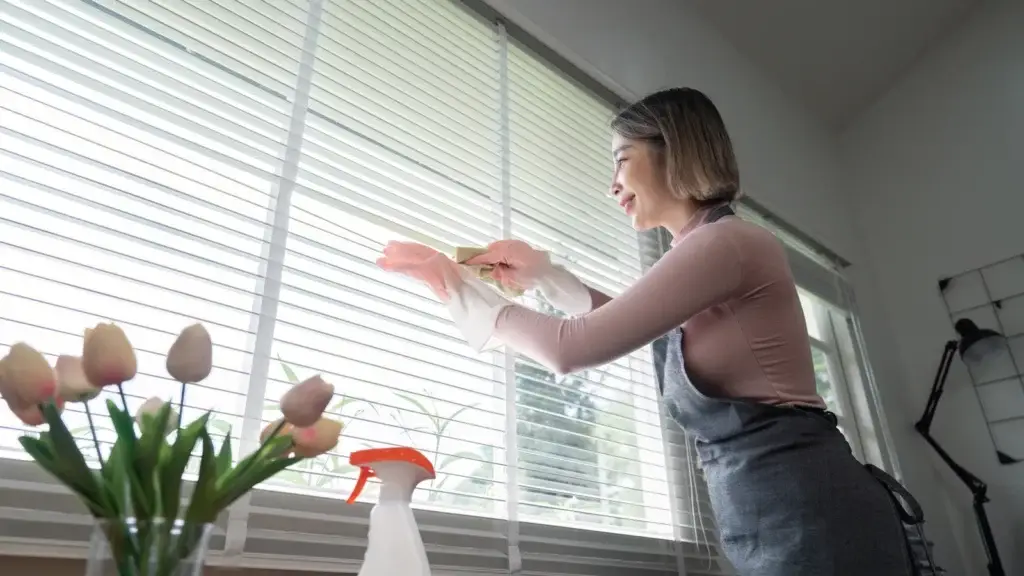
The method that works in a bedroom will leave a kitchen blind looking worse than before you started. And if the blind is old enough to have started yellowing, the wrong technique can snap a slat before you have finished the first row.
There are two variables that decide the correct approach: the type of soil on the slats, and the age and material of the blind itself. Get either wrong and you either waste your time or damage something.
Short Answer
Close the slats into one flat face and run a vacuum upholstery brush or microfibre cloth top to bottom. This is the complete job for most bedroom and living area blinds. For kitchen grease, open the slats flat and wipe each one individually with a cloth dampened in warm soapy water, wrung nearly dry. Timber blinds are dry-only. If a blind has yellowed or gone stiff, inspect each slat before applying pressure. The sections below explain why each step works and when to do something different.
Dry Dust Versus Greasy Dust: The Difference for Kitchen Blinds
For bedroom and living area blinds, the dust is made of loose particles that lift off with dry dusting or from a cloth slightly dampened with water. The particles have not bonded to anything.
Kitchen blinds are different. During cooking, oil produces tiny grease droplets that become airborne and settle on nearby surfaces, including the slats directly above and beside the cooktop. On a blind, that oil film mixes with ambient dust. Over time the grease partially polymerises, the dust particles become embedded in it, and the surface takes on a dull, slightly sticky feel that dry dusting will not shift. Running a standard duster across it simply smears the film and may leave the slat looking worse.
The correct chemistry is alkaline. Alkaline cleaners work by saponification: they break the ester bonds in fat molecules into water-dispersible compounds that can then be wiped away. At household scale, warm water with a small amount of dish detergent is enough for most kitchen blinds. For heavier build-up on aluminium slats, a sugar soap solution applied with a wrung-out cloth is more effective. Apply with a damp cloth, never a wet one, and dry each slat immediately after wiping.
The Fastest Dusting Method That Does Not Bend the Slats
The technique that cleans fastest and bends the fewest slats works in two steps.

Step 1: close the slats. Use the tilt rod to rotate the slats into one overlapping flat face. This creates a single continuous surface you can work across efficiently.
Step 2: vacuum or wipe top to bottom. Run the vacuum’s soft brush attachment down the flat face, top to bottom. Rotate the slats to the opposite angle and repeat for the back face. Done. The same principle works with a microfibre cloth folded into a firm pad, but a vacuum is faster on a blind with many slats.
The move that bends slats is applying lateral point pressure to the middle of a slat with a round or cylindrical duster while the slat is closed. The slat is only supported at its cord holes at each end; push it sideways at the centre and it flexes. The closed-face vacuum method applies even distributed pressure across the whole surface simultaneously rather than a point load.
For a quick wipe without vacuuming, fold a microfibre cloth into quarters and hold it between your index finger above the slat and your middle finger below. Both faces are cleaned in a single pass, working along the slat, not across it.
Washing Slats: When It Is Worth It
Full washing removes kitchen grease and accumulated grime that a damp cloth in place cannot shift. It adds about 30 to 40 minutes to the job for an average blind and is worth doing for kitchen blinds that have not been cleaned in six months or more, or for any blind ahead of a final inspection.
The method that avoids warping: take the blind down and lay it flat on a clean surface or in the bathtub. Wipe each slat with a cloth dipped in warm soapy water and wrung nearly dry. PVC slats can soften and warp in heat, so use warm, not hot, water. Do not fill the bath hot and submerge the blind.
Lay the blind flat in the shade to air-dry. Do not lay a wet PVC blind in direct sun: the exposed upper face heats up faster than the shaded underside, and the uneven temperature difference can cause bowing before the material has set.
Aluminium slats handle water at any temperature and can be wiped more vigorously.
Faux-Timber and Real Timber: Different Rules
Real timber venetian blinds should not be treated the same way as aluminium or PVC. Timber is a porous material; even a small amount of standing moisture can cause the slats to swell, warp, and the lacquer finish to delaminate. Timber blinds are dry-clean only. Lightly dampen a cloth, wring it out as much as you can, wipe along each slat, then follow immediately with a dry cloth. Never submerge timber slats, never use a steam cleaner, and never spray any product directly onto the slat.
Faux-timber blinds use a PVC core with a timber-look surface finish. The PVC itself handles moisture, but the printed or vinyl finish can lift at the edges if the blind is soaked. Treat them like PVC: damp cloth wrung out, not wet, followed immediately by a dry cloth.
To identify which type you have, hold a slat to the light. Timber has visible grain and a lacquer sheen. PVC is uniform in colour, slightly matte, and thicker. Aluminium is thin, springy, and cold to the touch.
| Material | Dust | Damp wipe | Submerge | Steam |
|---|---|---|---|---|
| Aluminium | Closed face, vacuum | Yes, any temp | Yes, flat | No |
| PVC / faux timber | Closed face, vacuum | Yes, warm only | With care, warm only | No |
| Timber | Closed face, vacuum | Barely damp, dry immediately | Never | Never |
The Ladder Tape: The Part That Decides the Result
Every venetian blind hangs on a ladder: two cords, or on wider 50mm blinds a woven fabric tape, running down each side with the slats sitting in the rungs. It is the component that decides whether a deep clean was actually a success.
The tape is fabric. Soak it in a full bath and it holds water long after the slats are visibly dry, then dries with a tide mark that does not come out. Vacuum the tape with the soft brush attachment and spot-clean along its length with a barely damp cloth. Do not soak it. If the tape already has a dark tide mark or the fabric has frayed, that is a replacement job, not a cleaning job.
The UV-Degradation Problem: How to Spot a Brittle Blind Before You Start
This is the check that turns a routine clean into a contested liability question.
UV from sunlight breaks down the plasticiser compounds in PVC over time, causing the material to become progressively more rigid and then brittle. Urgent Pro’s damage claims framework treats plastic vertical slats as reaching the end of their useful life at about 5 to 7 years and venetian slats at about 8 to 10. Once plasticiser has degraded significantly, a slat that once flexed without snapping may crack under ordinary cleaning pressure.
The visible signs: yellowing or cream discolouration on slats that were once bright white; a chalky or powdery surface that does not wipe clean; slats that feel noticeably stiff when you try to tilt them. Blinds in north-facing windows with direct afternoon sun can show these signs in five or six years. Blinds in a south-facing study with minimal sun exposure may still look fine at twelve.
Before cleaning a blind that shows any of these signs, operate the tilt mechanism once slowly and watch for resistance. Inspect the cord holes at each end of two or three slats for hairline cracks. If you find either, photograph the blind before you clean it and use lighter pressure throughout. A degraded slat that snaps during cleaning raises a disputed-liability situation, and documented evidence of pre-existing brittleness is what resolves it.
Cords, the Tilt Wand, and the Australian Safety Standard
Wipe the tilt wand with the same cloth you used on the slats. It is the part everyone touches and nobody cleans, and in a kitchen it accumulates the same grease film as the slats.
Cords can be wiped with a cloth dampened with a small amount of detergent, run along the cord’s length. Do not bleach cords: bleach degrades the cord fibres at the point of load, where the damage is invisible until the cord snaps.
If you unhook the cord cleat or cord guide to clean behind it, it must go back in the correct position before you leave the room. This is not optional.
Under the Competition and Consumer (Corded Internal Window Coverings) Safety Standard 2014, a corded blind must be installed so that a loose cord cannot form a loop 220 mm or longer at less than 1,600 mm above floor level. The ACCC’s 2019 review of the standard found 21 known child deaths from corded window coverings between 1999 and 2018. Consumer Protection WA, NSW Fair Trading, and Product Safety Australia all publish guidance on this standard. If a cord guide or cleat on any blind in the property looks loose, report it to the property manager rather than leaving it refitted loosely.
What Agents Check at Final Inspection
Blinds are part of the standard inspection scope at the end of a tenancy. The check covers three things. First, are the slats free of visible dust and grease? Agents typically run a finger along two or three slats near the centre of the blind, where dust accumulates fastest. Second, do the mechanisms operate? The tilt and raise/lower functions are tested; a blind that worked at entry but not at exit is likely to be noted against the tenant unless the entry report shows it was already faulty. Third, are the slats intact? A cracked or missing slat is noted as damage.
For the full picture of what agents inspect across every room, the article on how property managers apply cleaning standards at exit inspections covers the detail by state. For windows and blind-specific inspection detail, what agents check on blind slats, cords and window tracks sets out exactly what gets noted and what does not.
Blinds are included in what a standard house clean covers through the Urgent Pro network. If the grease build-up is significant, or the blind is old enough to need careful handling, a house cleaning service through the Urgent Pro network includes providers who work through blinds systematically, with an arrival inspection and a photographic note for anything that looks fragile.
When Replacement Makes More Sense Than Cleaning
If a blind is at or past the UV-degradation threshold described above, and slats are already showing hairline cracks at the cord holes, cleaning will not resolve the problem before an exit inspection. A cracked slat noted at inspection is a damage claim. A replacement aluminium blind on a standard single window costs significantly less than a contested bond deduction. It also removes the liability question before it starts.
FAQs
Can you wash venetian blinds in the bath?
Aluminium and PVC venetian blinds can be laid flat in a bathtub and wiped down. Use warm water only, not hot, and a wrung-out cloth rather than submerging and soaking the blind. The ladder tape must not be soaked. Timber venetian blinds must never be submerged or exposed to standing moisture.
How often should venetian blinds be cleaned?
Bedroom and living area blinds benefit from a light dust every one to two weeks to prevent build-up compacting. Kitchen blinds accumulate grease faster and need a damp wipe monthly in an actively used kitchen. A full wash is worth doing every six to twelve months, or before a final inspection.
What is the easiest way to dust venetian blinds?
Close the slats into one flat face using the tilt rod, then run a vacuum soft brush attachment top to bottom. Rotate to the other angle and repeat. This takes about two minutes for a standard blind and applies even pressure across every slat simultaneously, which is why it does not cause the edge bending that cloth-and-finger methods can produce on the leading slat.
Are venetian blinds checked at a final inspection?
Yes. Agents check whether slats are free of dust and grease, whether the tilt and raise/lower mechanisms work correctly, and whether any slats are cracked or missing. The standard is that the blinds are returned in the same condition as at the start of the tenancy, allowing for fair wear and tear.
Do old blinds need to be cleaned differently?
Yes. Blinds that are yellowing or feel stiff to tilt have UV-degraded PVC that is more brittle than new material. Operate the tilt mechanism once before cleaning and inspect the cord holes on a few slats for hairline cracks. Use lighter pressure throughout and photograph the blind before you start. If slats are already cracking, replacement before the exit inspection is usually the lower-cost option.
What should I check before cleaning a corded blind?
Confirm the cord cleat or cord guide is firmly fixed before and after cleaning. Under the Competition and Consumer (Corded Internal Window Coverings) Safety Standard 2014, a loose cord must not be able to form a loop of 220 mm or longer at less than 1,600 mm above floor level. If the cleat is loose or missing, it needs to be fixed before the blind is left unattended. For rental properties, report it to the property manager.