
There is a consequence that most “How-to” guides neglect. The grit that accumulates in a sliding door track does more than just make the door stiff. The rollers beneath the door are steel-bearing rollers in a plastic or nylon housing and, over time, the housing becomes grooved from the abrasive action of the sliding door rubbing against the grit that is packed in the track. This grooving causes increased friction and eventually the door begins to catch and drag. A general cleaning of the tracks will usually fix this issue, but not permanently.
Urgent Pro’s house cleaning service treats door tracks along with other surfaces. Providers also tackle door tracks during an in-home cleaning. For customers who wish to clean the tracks between service appointments or prior to an upcoming home inspection, here’s how it’s done:
What is in Sliding Door Tracks
Indoor tracks collect dust, hair, pet hair, soil, and fine debris from carpet or flooring. The tracks in the kitchen and dining area collect food and grease. All this debris is compacted by the door rolling on the tracks, and turns loose dust into an adhesive substance that is not easily removed with a vacuum.
Outdoor and patio door tracks collect grit, leaves and other yard debris. In coastal suburbs, tracks also collect salt residue, which corrodes the roller bearings and track frames faster than dust alone. This is why tracks are worth cleaning every two months in coastal areas, every two to three months elsewhere.
What you need before you start
These are the things you’ll need to collect before starting. The list is in the order they’ll be used: dry tools first, wet tools second.
- Stiff-bristled brush or old toothbrush
- Vacuum cleaner with crevice or narrow nozzle attachment
- Two cloths (a damp and a dry one)
- Mild dish soap (for kitchen tracks with grease)
- Silicone-based lubricant
Have lubricant ready for the last step. WD-40 is not recommended for this task; why is explained in Step 5.
The five-step cleaning sequence
Step 1: Dry loosen before anything else
Use a stiff brush to break up compacted material along the base of the groove. Work in short strokes, starting from one end and ending at the other.
Do not add water or cleaner to the track at this step. Water in the presence of dust will create a thick paste that will bond to sides of the channel and be harder to remove.
Step 2: Vacuum loose material
Use your vacuum with the crevice nozzle and run it along the track in both directions to remove the loose material.
If your vacuum nozzle is too wide to reach the profile of the track, use a cardboard tube from a toilet paper roll and flatten one end slightly. Then slip it over your vacuum nozzle and it will mould to the track to pick up debris.
Step 3: Damp wipe
Dampen a cloth with plain water and wipe along the base and sides of the track channel. This removes surface dust and grime without getting the track channel saturated. For kitchen tracks that have grease, use a small amount of dish detergent on the cloth first, and then do a damp wipe to remove the grease.
Do not pour water directly into the track. Water in the channel can collect and pool at the bottom, where it rusts the roller bearings and swells the timber surrounds.
Step 4: Dry thoroughly
After the damp wipe, you must immediately dry the track with a clean cloth. Leaving the track to dry on its own can cause the timber surrounds to swell and the roller bearings to rust. Make sure the track is fully dry before doing anything else.
Step 5: Lubricate
After the track is fully dry, you must lubricate the track channel and roller wheels at the bottom of the door with a thin layer of silicone. This reduces the wear on the track, and also repels the dust that gets stuck between the cleans.
Do not use WD-40, or any other oil-based lubricant, to service windows or door tracks. Oil attracts and holds dust, which will wear rollers and shorten the life of the track. Providers on the Urgent Pro cleaning network are required to use silicone track lubricant and not WD-40, when servicing tracks as part of a booked cleaning service.
WD-40 Specialist Long-Lasting Grease Spray is different to the original WD-40, and is a lubricant used by some tradespeople. From a maintenance perspective, a dedicated silicone lubricant is the easier option to use.
The five steps to servicing window tracks are covered in the blog post What agents check for windows and tracks at a final inspection. It gives a more detailed account of the checks agents carry out for doors and window tracks.
Once the track is clean and lubricated and the door slides well, check for track movement by opening and closing the door fully. If it catches or drags after a complete five-step clean, the rollers are the likely culprit, not the track.
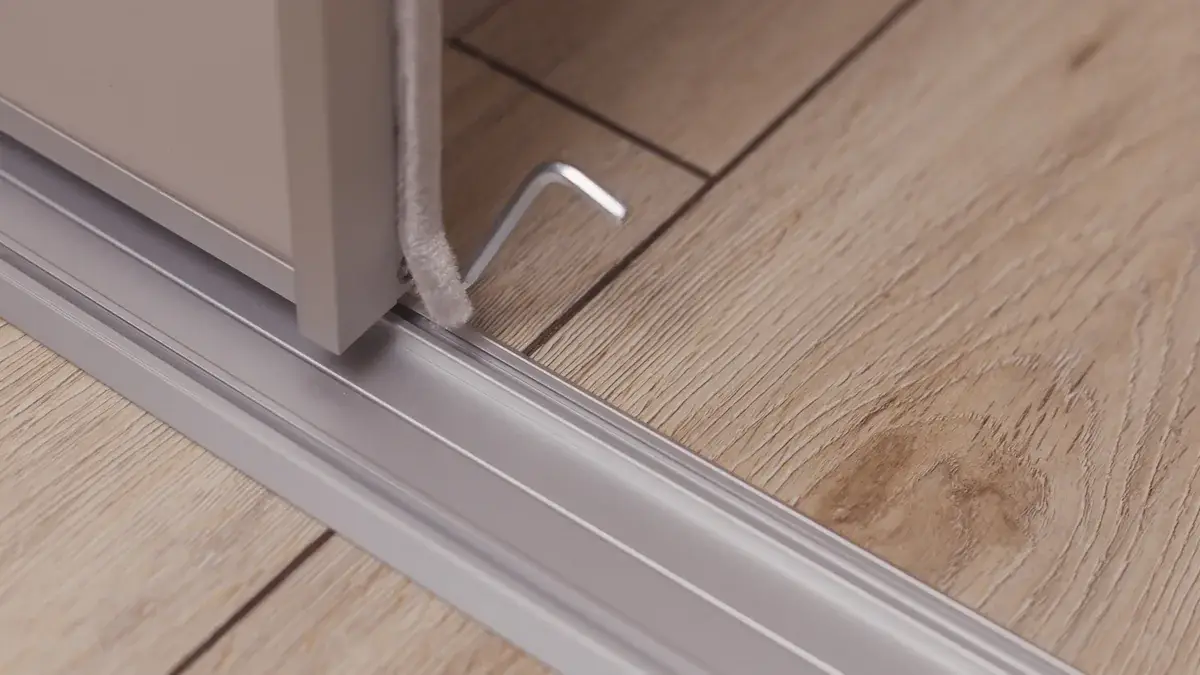
Almost all sliding door rollers are adjustable. Look for a small hole in the lower corner of the door panel. Use a screwdriver or Allen key, depending on the door, in that hole to raise or lower the door to a level position. If the door doesn’t roll evenly in the frame, check if it catches or drags. Replacing rollers is often unnecessary.
If the rollers are worn, they need replacing. Replacing rollers is handyman work, and Urgent Pro handyman jobs start from $220.
New roller bearings in a dirt and grit filled track will also re-introduce dirt and grit to the track, so the process is futile.
What a Standard House Clean Includes explains what cleaning services cover and what surfaces and fixtures a standard booking includes, and provides examples to illustrate when an additional routine visit and a maintenance task complement each other.
Final Inspections
The WA Property Condition Report (Form 1, required under the Residential Tenancies Act 1987) and the QLD RTA Exit Condition Report (Form 14a, under the Residential Tenancies and Rooming Accommodation Act 2008) both require the property manager to document, room by room, any item that is not clean, working and undamaged. Agents assess doors for clean, working and undamaged, so a door that drags can be noted.
The cleanliness of the track is assessed as well. The cleaning standards agents apply at a final inspection covers what is assessed by a property manager across a property.
Consumer Protection WA publishes guidance on the property condition report process and what Form 1 covers at consumerprotection.wa.gov.au/property-condition-reports.
Keeping tracks clean between full cleans
Each step of the reset procedure described above should be executed whenever the sliding door doesn’t operate smoothly. Something that helps avoid the need to execute the full reset is performing a quick dry brush and vacuum of each track every two months in coastal areas, every two to three months elsewhere. This two-minute task prevents heavy compaction from forming and keeps the door operating smoothly. The full five-step sequence is worth doing one to two times a year, and more often in coastal suburbs, where salt builds up in the track.
Outdoor sliding doors accumulate more dust and debris than indoor doors. Most of this occurs in autumn when outdoor construction and gardening activities kick off. A good rule of thumb is to do a quick check after the autumn leaves have dropped and after any windstorms that blow in dirt and debris.
An inexpensive addition to an outdoor sliding door, a door brush seal, reduces the amount of debris that falls directly into the track, and is a good addition to any door that leads outside to a garden or courtyard.
Frequently asked questions
What tools are best for this job?
A stiff brush or old toothbrush to help dislodge dirt and debris, a vacuum with a crevice tool to get the dirt and debris, a damp cloth to wipe down the track, and a silicone lubricant for the last step. A toilet paper tube can help the vacuum hose reach even tighter spots if the rigid vacuum tool can’t get there.
Is it OK to use WD-40 on sliding door tracks?
WD-40 can help make a track slip for a while, but it’s a bad long-term solution because WD-40 attracts fine particles and quickly causes the same abrasive wear to resume. For a long-term solution, use a silicone lubricant. A lot of tradespeople use WD-40 Specialist Long-Lasting Grease Spray for the same purpose, but it can still attract fine particles and a dedicated silicone product is simpler for home use.
Why does the door still catch after I cleaned it?
If the door catches or drags after cleaning and lubricating, the rollers are most likely the issue. Check the rollers by adjusting the door via a small adjustment screw at the base of the door panel. If the rollers are worn, they need to be replaced.
Do I need to take the door off to clean the tracks?
No. You will only need to take the door off to clean the tracks if you are doing a deep clean or need to replace the rollers. Sliding the door to both ends will allow access to the full length of the track.
Do sliding door tracks get checked at a final inspection?
Yes, door tracks get tested as part of the door operation test. The agent will slide the door open and closed to complete the condition report. Any door that drags or catches will get documented as both a cleaning and maintenance item. A door that does not slide freely can be noted as a working-order issue, and the dirty track is a cleaning issue.