

A fridge compressor keeps its lubricating oil in a small reservoir at the base of the housing. When the fridge is upright, gravity holds that oil exactly where it belongs. Tilt the fridge too far and the oil can migrate into the refrigerant lines. Start the compressor before the oil has found its way back, and the damage can be permanent.
Most of what you need to know about moving a fridge safely comes down to that one engineering fact.
Short Answer: Yes, the Fridge Stays Upright
Keep the fridge upright. After upright transport, let it settle before you plug it in; some manufacturers say about two hours. If it had to travel on its side, follow the manufacturer’s manual: 24 hours upright is the conservative rule. Also, if there are obstructions during a move like stairs, a wide fridge, or a tight doorway, house removalists through Urgent Pro have the proper equipment to help, and know the rules concerning fridge placement.
Before the Move: Empty, Defrost and Secure
Before moving day, you need to remove the food and defrost the fridge. Work from the moving house checklist to determine when the prep window is. Keep in mind that it needs to be done well in advance of the truck arriving.
On the morning of the move, you will pack the perishable food in a cooler with ice and make other arrangements to transport the food. Plan to buy fresh food after the move.
Defrost if necessary. Most Australian fridges are frost-free. Leave unplugged for 12 to 24 hours prior to moving day, to give the drip tray enough time to fully dry the interior. Sealed fridges with moisture inside quickly develop mould. If you see visible ice in your freezer, you have a manual defrost model. Leave unplugged for at least 24 hours before moving day to completely melt the ice, using towels to catch the water.
When completely dry:
- Remove any removable shelves or bins, and wrap them in your preparation for moving day. Loose internals rattle and break in transit.
- Tape or strap doors shut.
- Secure the power cord to the back of the unit so it can’t get caught underfoot on the stairs.
Protecting the Floors: What Goes Wrong and How to Prevent It
On wheels, a fridge is still a risk to floors. The wheels on residential fridges are small and not designed for regular use. Floor damage is more common on timber and floating floors, as the contact patch is very small and the full weight of the fridge is focused in a tight point load. No matter the floor type, something as small as a grain of sand caught between a wheel and the floor will scratch it on the way past.
The fix is a rolling track. Place two sheets of plywood or thick cardboard from the fridge’s position to the exit. Lift or tilt the fridge slightly to slide the first sheet under the base, place the second sheet in front of it, and leapfrog the rear sheet as you go. Plywood distributes the load across a wider area and eliminates the risk of grit-and-castor abrasion.
Always move the fridge in short steps, lifting the front edge slightly, and not pushing the back edge. Providers on the Urgent Pro removalist network use padded floor runners for each job, which serve the same purpose.
How to Carry a Fridge Safely
No fridge should be moved a significant distance by hand. Using a trolley removes the injury risk and makes the job bearable. Safe Work Australia’s model Code of Practice for hazardous manual tasks covers lifting, pushing, pulling and carrying, and mechanical aids such as trolleys are general good practice.
Prior to moving day, you need to measure the width of your fridge and all parts of the route, including doorways, hallways, stairwells, and lifts. Most Australian fridges are between 600 and 900mm wide, and a standard interior doorway provides between 770 and 820mm of clear passage, depending on the frame and door stops. A large, side-by-side or French door fridge will not fit through doorways and will need to be moved with the doors removed.
To load the trolley:
- Position the trolley plate fully under the fridge base.
- Keep the fridge as upright as possible and tilt it back only as far as the trolley needs.
- Tighten a strap to the trolley.
- Push the fridge from behind, and pull it from the front, through doorways.
On stairs: one person is on the trolley and the other guides the trolley, one step at a time.
Transport: Upright Versus On Its Side and Why It Matters
It is important to transport a fridge upright. The reason for this is compressor oil. If a fridge is tilted too far, the oil can flow through the suction line and clog the coils, and the fridge may no longer work.
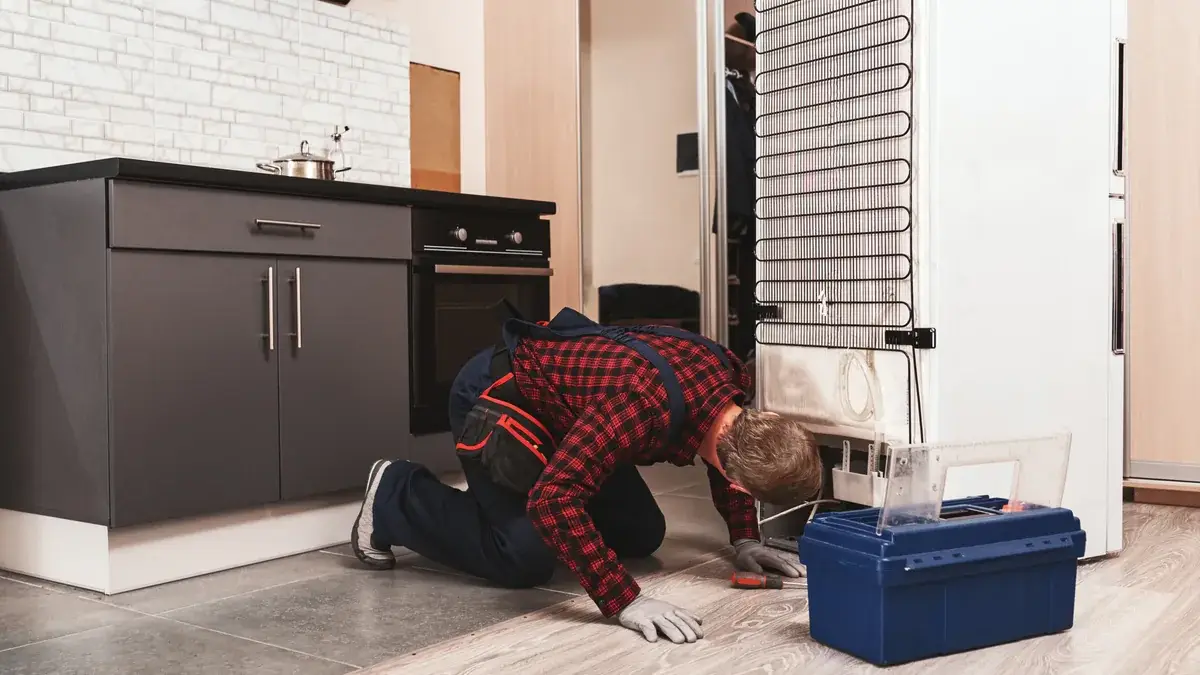
There are three things that can happen when a compressor is switched on before the oil has returned. The compressor will run too hot and wear out quickly due to lack of lubrication. The oil can also block the refrigerant coils to cause the compressor to cycle constantly and the refrigerator to never cool. Lastly, if the oil pools in the compressor cylinder, it will cause liquid slugging. When liquid is compressed, it causes an extreme increase in pressure which can destroy the compressor.
Compressor damage from these causes is documented across the Urgent Pro removalist network. It is often caused by tilting the fridge too far and plugging it in before the oil has returned. Under the removalist damage terms, compressor damage after the fridge was transported upright and left to stand for the advised time is excluded from a warranty claim. Where the provider laid the fridge down or failed to advise the standing time, the claim is covered. For more information about removalist liability, transit cover and related topics, see how removalist liability and transit cover work.
If it is really not possible to transport a refrigerator in an upright position, check the manual for which side is safe. Strap it securely so it does not shift during transport.
After the Move: Standing Time, Switch-On and Settling
- Level and position the fridge first. Before anything else, level and position the fridge, making sure to leave the recommended clearance on the sides and back according to the manufacturer’s installation instructions; most require some space for air flow. A fridge that is pushed up against something will work harder over time. Level the fridge using the adjustable feet and make sure there is no rocking, as a rocking fridge will not close the door seals fully.
- Wait before plugging in. If the fridge travelled upright, let it settle before you switch it on; some manufacturers say about two hours. If it had to travel on its side, follow the manufacturer’s manual: 24 hours upright is the conservative rule, and it is the standard Urgent Pro uses. In all cases, leave the fridge door slightly ajar while it stands to prevent mould building up on the seal.
- After switch-on. Allow several hours for the fridge to fully cool down to its operating temperature before placing food inside. Refrigerated food should not be placed in the fridge right away, as it will make the compressor work harder. Listen for any irregular noises from the compressor for the first 24 hours. Abnormal noises, or a compressor that runs continuously, should be reported to the manufacturer before food is placed in the fridge.
When to Hire a Removalist?
It’s not too hard to move a fridge yourself if it’s a ground-floor move, you have two people, a decent trolley and a vehicle that keeps it upright. Call in professional local removalists if any of the following is true:
- There’s one or more flights of stairs.
- It’s over 80kg.
- You need to take the doors off to get it through the doorway.
- Your vehicle can’t keep it upright.
Whoever you hire, check their insurance and ask for references from recent jobs.
If you’re concerned about cost, it is worth noting that while the cost to move a white good is higher than the normal removalist rate, the cost to repair a timber floor or replace the compressor in a fridge is significantly more.
For a more extensive look at what items removalists in Australia will and won’t take, see what removalists in Australia won’t move.
FAQs
Does a fridge have to stay upright when moving?
Yes, due to compressor oil. In the upright position, gravity keeps the oil in its reservoir. If the fridge is tipped too far, the oil can migrate into the refrigerant lines, and starting the compressor without lubrication can cause it to fail. If you have to lay it down, check the manual for which side is safe and let it stand upright for 24 hours before plugging it in.
How long before I can plug in a moved fridge?
After upright transport, let the fridge settle before plugging it in; some manufacturers say about two hours. If it had to travel on its side, follow the manufacturer’s manual: 24 hours upright is the conservative rule and the standard Urgent Pro uses. Providers on the Urgent Pro network advise customers of the standing time.
How do I stop the fridge door opening during a move?
Seal the door seams with packing tape and back it up with a moving strap. Remove all inner shelves and drawers because loose internal components can shift and open the door.
What do I do with fridge food on moving day?
Put perishables in coolers with ice packs and move them with you on the day. You can buy more fresh food after you move in. Frozen food lasts longer in a cooler with ice than perishables, so try to keep your frozen food cold and plan to top up fresh produce at the new address.
Will removalists move a fridge?
Yes, most will. Usually there is a per-item surcharge for the special equipment or handling needed to move the appliance. Providers on the Urgent Pro network supply moving blankets and a purpose-built trolley, transport the fridge upright, and advise how long it should stand at the new location before use.