
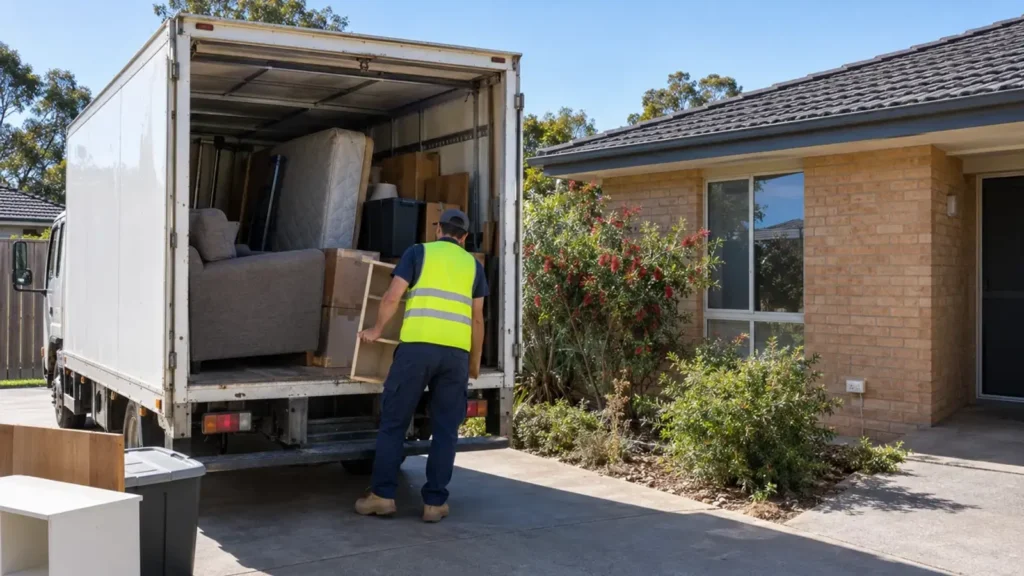
Skip bins and rubbish removal services are both commonly used to dispose of large quantities of waste. This post covers when to use each service and how much they cost.
Skip Bin Hire Costs
Standard skip bins measure 3 to 4 metres long. Smaller skip bins are available but often cost more per cubic metre. Skip bins typically range in price from $260 to $360 for a standard-sized bin over a 2 to 3 day hire period. These are indicative market rates only and are not Urgent Pro pricing.
Advantages of skip bin hire
- Can be used to dispose of most types of general waste
- Generally cheaper per cubic metre when you have the time and capacity to load the bin yourself
Disadvantages of skip bin hire
- Placement on a public road or council verge requires a council permit
- Heavy, bulky, or awkward items can be difficult for one person to load without assistance
- Hire company collects the bin on a fixed schedule, which may not suit all timelines
Rubbish Removal Costs
Rubbish removal through Urgent Pro starts from $220 per job for a small load at standard metro access. Rubbish removal is charged based on the volume and type of waste removed, with the provider doing the loading.
Advantages of rubbish removal
- Handles large waste items including furniture, white goods, and bulky household goods
- Can be used where council limits or access conditions make skip bin placement impractical
- No council permit required
- Provider does all the loading
Disadvantages of rubbish removal
- Restricted waste types (asbestos, chemicals, gas bottles) cannot be accepted regardless of method
- Cost scales with volume and item type, and may increase for restricted waste such as e-waste
You can load a skip bin yourself over the course of days or weeks. A rubbish removal service is used when there is an existing load to be removed, or when there are constraints on the access window or location. Most people can work out the right answer in under a minute with a clear framework.
A skip bin is charged based on size and hire period. The hire company is responsible for disposal and charges based on the size of the bin rather than how full it ends up. A skip bin must be collected before the end of the hire period.
A rubbish removal service is charged based on the volume of the load and is used when a load must be removed promptly. The verified rubbish removal services on Urgent Pro’s network load and transport all waste to a licensed transfer station. You do not need to load anything yourself.
Before comparing cost or timing, it is worth noting a third option that most comparisons skip over. Most Australian councils run free bulk waste collection services, sometimes called hard rubbish collection, on a scheduled basis each year. The collection limits vary between councils, but for a standard household clean-out where the timeline is flexible, checking your council’s bulk waste collection schedule before booking a skip bin or rubbish removal service can save the entire cost.
When Rubbish Removal Is the Better Choice
The Load Already Exists
If a collection of waste is already sitting there, the best option is a rubbish removal service because the job is completed in a single visit. A skip bin makes less sense here because it involves a delivery window, a fill period, and a collection window before the waste actually leaves the property.
You Have a Deadline to Meet
One of the clearest examples of when a rubbish removal service is better than a skip bin is when tenants need to clear a rental property ahead of a final inspection. A rubbish removal provider can clear the entire property in a single visit, leaving it ready for the agent. A skip bin left on the property during the inspection window creates access and presentation issues. For a full guide to what is expected at a property clearance, see clearing a rental property before the inspection.
Access Is Restricted
Due to the way skip bins are delivered and collected, there are situations where they cannot be placed on a property at all. Apartment buildings, very narrow properties, and inner-city sites without a driveway cannot provide the clearance needed for a skip delivery truck. If the bin needs to sit on a council verge or road, a council permit is required.
Rubbish removal vehicles are typically smaller and have better access than skip delivery trucks. They remove all waste from the property in a single visit and leave nothing behind, which matters on shared driveways, in strata buildings, and on streets with permit parking.
Someone Else Is Doing the Heavy Lifting
Heavy and bulky items are often the reason skip bins end up only partially filled. Skip bin users are responsible for physically loading every item into the bin by hand, including sofas, mattresses, white goods, and anything on an upper floor or in a back yard. Without a team of helpers, this can be the limiting factor before cost is even considered.
Rubbish removal providers load everything, including items from upstairs rooms, garages, and back yards. This is often the entire reason people book a rubbish removal service rather than hiring a bin.
The nature of rubbish removal also means providers can handle mixed loads flexibly. Household waste, furniture, and garden waste can all go in the same collection. Skip hire companies typically have stricter rules about waste types, with heavy materials like soil and concrete often excluded or attracting surcharges.
Some providers also sort at the point of loading, setting aside usable items for charity and separating recyclables before the load reaches the facility. A skip load is generally sorted at the transfer station after collection, which can be harder on furniture and household goods that were in working condition.
When a Skip Bin Makes More Sense
You Have the Time, Driveway Access, and Can Do the Loading
Skip bins are cheaper per cubic metre of waste if you have the time and physical capacity to fill them yourself. That cost advantage narrows when you add permit fees for on-street placement, the time required to load the bin, and any access constraints at your specific property. For someone with a wide driveway, a few days to fill the bin, and helpers available, a skip bin can be the more cost-effective option.
Heavy and Single-Stream Waste
The cost of a skip bin can be comparable to rubbish removal when the waste is a large, heavy, single-stream load such as concrete from a demolition or soil from an earthworks project. Rubbish removal for very large single-stream loads may require multiple collections, which increases the total cost. Single-stream loads can also be recycled at lower cost at specialist facilities.
You Want to Work at Your Own Pace
A skip bin is often the better option when there is no hard deadline and you want the flexibility to load the bin gradually. A container that sits on the property until it is full removes the need to coordinate a collection window around your schedule.
What You Will Pay
Rubbish Removal
Rubbish removal through Urgent Pro starts from $220 per job for small loads at standard metro access. Difficulty of access, volume of the load, the presence of restricted waste types such as e-waste or white goods with refrigerant gases, and the need for a two-person crew for heavy items all increase the price above the minimum rate. The price includes all costs: the provider’s labour for loading, the vehicle, and disposal at a licensed transfer station.
Skip Bins
Urgent Pro does not provide skip bin hire. The prices below are indicative market estimates for skip bin hire across Australian cities and do not reflect Urgent Pro pricing.
| Bin size | Typical use | Indicative market range |
|---|---|---|
| 2 cubic metres | Small household cleanout | $250 to $350 |
| 4 cubic metres | Medium household clearout or light renovation | $350 to $500 |
| 6 cubic metres | Larger renovation or landscaping project | $450 to $650 |
| 8 cubic metres and above | Large renovation or commercial clearout | From $600 |
These estimates depend on your location, the waste type, the hire period, and whether a council permit is required. For indicative pricing across all Urgent Pro services, see Urgent Pro’s service pricing.
Hidden Costs on Both Sides
For skip bins: Council permits for on-street placement typically cost $60 to $160 depending on the council and the approval lead time. Weight surcharges apply when heavy materials like soil or concrete exceed the bin’s weight limit. Late return fees apply if the hire period runs over. Driveway damage from the bin’s weight is the customer’s responsibility where the surface is not suitable.
For rubbish removal: Volume estimate creep is the most common surprise. What looks like a small load during the booking conversation can become a larger load once the provider sees the actual pile. Providing an accurate volume description upfront avoids this. Restricted waste types including e-waste and white goods with refrigerant attract surcharges for specialist disposal. Carry surcharges apply where items must be brought out from inside the property rather than collected from a kerbside or driveway pile.
Your Time Has Value
Skip bins are cheaper per cubic metre if you can fill the bin yourself and have suitable access. That calculation changes when you factor in how long loading actually takes. A large skip bin filled over a weekend represents several hours of physical work. If that time has commercial value, the cost gap between a skip bin and a rubbish removal service narrows considerably.
What Neither Option Covers
Both rubbish removal services and general skip bins exclude the same category of waste: materials that require specialist licensed disposal.
This includes asbestos and asbestos-suspect materials, which require a licensed asbestos removalist under Safe Work Australia guidelines regardless of quantity. It also includes paint, solvents, chemicals, gas bottles, medical waste and sharps, and large quantities of batteries.
E-waste (computers, monitors, televisions) and white goods with refrigerant (fridges, freezers, air conditioners) can be collected by a rubbish removal service but require specialist disposal routes and attract surcharges. Many are also accepted free of charge at council e-waste collection points. Melbourne residents can find detailed guidance on responsible disposal options, including council e-waste routes and transfer station locations, in the Melbourne rubbish disposal guide.
For national guidance on prohibited waste categories and current waste classification rules, Australia’s environment and water department and state environment protection authorities are the relevant primary sources.
Some Jobs Need Both
Some jobs require both options. A builder running a skip bin on site for continuous demolition waste still books a rubbish removal service for the old sofa, fridge, and appliances left by the previous occupant. Those items are exactly what skip bins handle worst: large, bulky, single pieces that need a crew and a vehicle rather than a bin that sits in the driveway for a week. Rubbish removal and skip bin hire each have items they handle best, and for large jobs both may run at the same time.
Which Option for Which Job
| Job | Better choice |
|---|---|
| Single item or small load | Rubbish removal |
| Full property clearance before inspection | Rubbish removal |
| Restricted access or apartment | Rubbish removal |
| Deceased estate with furniture and personal effects | Rubbish removal |
| Renovation debris over 1 to 2 days | Rubbish removal |
| You have time, driveway access, and can do the loading | Skip bin or compare quotes |
| Ongoing renovation with continuous debris | Skip bin |
| Large earthworks or landscaping project | Skip bin |
| Standard household clear-out with no time pressure | Check council bulk waste collection first |
To book rubbish removal through Urgent Pro, written confirmation is provided before any provider attends. Verified providers carry $10M public liability insurance and hold licensed disposal facility relationships.
FAQs
What is the difference between a skip bin and a rubbish removal service?
A rubbish removal service charges a set price that includes the provider’s labour to load the waste, the vehicle, and disposal at a licensed transfer station. Skip bin hire charges for the bin and the collection. The customer loads the skip bin themselves or arranges for someone else to load it. The main practical difference is who does the loading and how quickly the waste leaves the property.
Is a permit required for skip bin hire?
A skip bin placed on any part of a public area, including roads and footpaths, requires a council permit. Processing times and fees vary. A skip bin placed wholly within your own property boundary does not typically require a permit. Confirm with the hire company before booking, as permit costs and approval lead times can influence which option is more practical for your situation.
What is the free option most people overlook?
Most Australian councils offer a scheduled bulk waste or hard rubbish collection service, typically once or twice per year. If you do not need to dispose of waste urgently, it is worth checking your local council’s bulk waste collection schedule. Some services have limits on the amount accepted, but for a standard household clear-out timed to the schedule, this option costs nothing.
Can rubbish removal handle the same volume as a skip bin?
Yes, for the majority of domestic jobs. A single rubbish removal collection can handle a volume comparable to a 4 to 6 cubic metre skip bin. For very large volumes, multiple collections or a custom quote may be needed, but for most household clearances the volumes are comparable. The key difference is that with rubbish removal, the provider loads the waste and it leaves the property in the same visit.
What waste cannot go in either a skip bin or a rubbish removal service?
Both options exclude asbestos and asbestos-suspect materials, hazardous chemicals, gas bottles, medical waste, and large quantities of batteries. E-waste and white goods with refrigerant can be collected by a rubbish removal service but attract surcharges for specialist disposal. These items cannot go in a general skip bin. Asbestos requires a licensed removalist regardless of which disposal method is used.
How do I know which is cheaper for my specific job?
For small to medium loads where the waste already exists, rubbish removal is often comparable or cheaper once permit costs, loading labour, and the value of your time are factored in. Skip bins are generally cheaper per cubic metre for large volumes where you have the time, driveway access, and physical capacity to do the loading yourself. Getting written quotes for both options before committing is the most reliable way to compare for your specific job.