
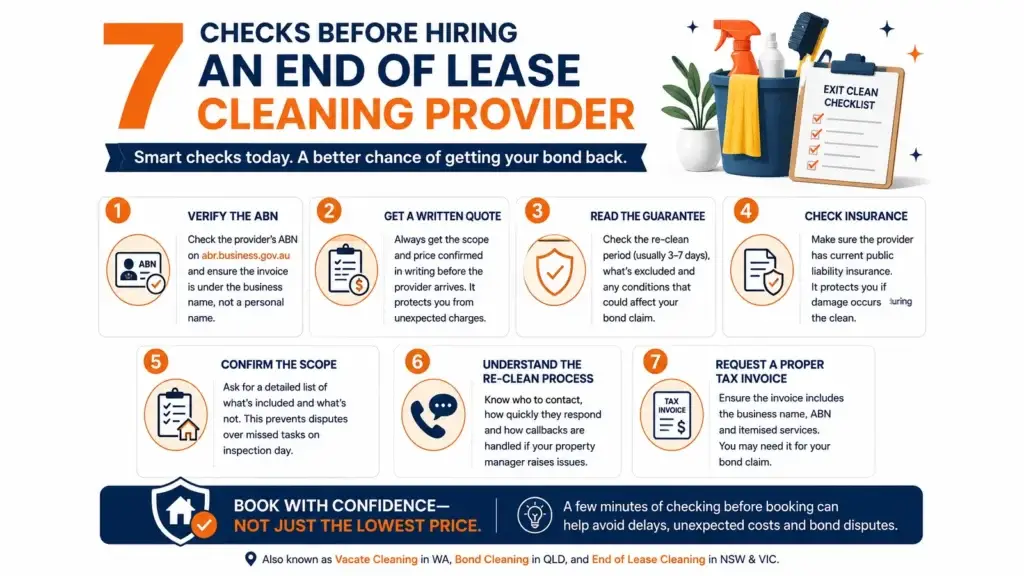
Most tenants pick an exit clean service provider the same way they pick a tradie for anything: they search, compare prices, and book the one that looks reasonable. That works fine for a standard job. It does not work well for an end of lease clean, where the stakes are higher, the timing is fixed, and a single missed item can cost you part of your bond.
This guide covers the seven checks that most tenants skip, and explains what actually goes wrong when they do not run them. If you have not settled whether to hire at all, whether a professional clean pays off is the calculation to run first.
In Western Australia, this service is called a vacate clean. In Queensland, it is a bond clean. In New South Wales and Victoria, end of lease cleaning is the standard term. The checks below apply regardless of which state you are in.
1. Confirm the ABN and Check What Name It Is Registered Under
Every legitimate cleaning business operating in Australia must hold an active Australian Business Number. That part most people know. What many tenants do not know is that the ABN must be registered under the business name, not the operator’s personal name.
This matters because your property manager or agent will typically ask for a tax invoice as part of any bond claim or dispute process. If that invoice shows an ABN registered under a personal name rather than a business name, your agent may question its legitimacy. Understanding how bond disputes are decided makes it clearer why the paperwork carries this much weight. Complaints lodged with state tenancy authorities have documented exactly this scenario, where a tenant’s bond claim was complicated not by the quality of the clean, but by paperwork that did not hold up.
Before you book, ask for the provider’s ABN and check it against the Australian Business Register at abr.business.gov.au. Confirm the registered name matches the business name on the invoice you will receive.
2. Ask for a Written Quote Confirmed Before the Provider Arrives
A verbal quote is not a quote. It is a starting point for a conversation that may go differently on the day.
One of the most frequently reported complaints across Australian tenancy forums and consumer review sites involves a provider who quotes one price over the phone, then arrives at the property and claims it is dirtier than described, demanding more money before work begins. In some documented cases, providers threatened to leave unless the tenant paid the higher amount, knowing the tenant had a fixed key-return deadline and no time to rebook.
The protection against this is simple: get the scope and price confirmed in writing before the provider arrives. A written confirmation means there is a record of what was agreed. If the provider attempts to charge more on the day, you have documentation and a basis to push back under Australian Consumer Law, which requires a variation to be agreed before additional charges apply.
When booking an end of lease cleaning service through Urgent Pro, the quote is confirmed in writing before any work begins. If the actual scope differs on the day, the provider must contact Urgent Pro and obtain customer approval before additional charges proceed. Any variation over $200 requires written customer sign-off.
3. Read the Guarantee Conditions Before You Sign, Not After
The phrase “bond back guarantee” appears in the marketing of almost every cleaning company that targets tenants. Very few of those companies explain what the guarantee actually covers.
The loopholes that appear most often in real complaints follow a pattern. The guarantee covers one re-clean attempt only. The claim window is 24 hours from the end of the clean, which expires long before most agents schedule their inspection. The guarantee is voided if you booked carpet steam cleaning through a third party, or it excludes areas the provider flagged as already damaged before the job started. Taken together, those conditions can make a guarantee functionally worthless, and tenants typically discover this only when they try to use it.
Before you book, ask for the guarantee conditions in writing. The specific questions to ask are: how many re-clean attempts are covered, what is the claim window, does the window start at the end of the clean or at the agent’s inspection, and does using a separate carpet cleaner void any part of it.
The 14-day re-clean warranty offered through Urgent Pro on bond and end of lease cleans runs for 14 days from completion, not 24 hours. The conditions are documented and available before booking.
4. Understand What Public Liability Insurance Actually Covers
Most guides tell tenants to check that the provider is insured. Few explain what that insurance does and does not cover.
Public liability insurance covers third-party property damage or injury caused by the provider while on site. If a cleaner cracks a window or floods a bathroom, the provider’s public liability insurance is the mechanism for recovering that cost. Urgent Pro requires all providers on its network to hold a minimum of $10 million public liability cover, with a current Certificate of Currency sighted before activation.
What public liability insurance does not cover is the quality of the work itself. A provider can hold full insurance and still deliver a clean that fails the agent’s inspection. Insurance and workmanship are separate questions.
A note on police checks: police checks are standard for NDIS and aged care cleaning, but they are not a universal requirement for general residential cleaning providers. A company advertising police-checked cleaners for a standard end of lease job may be padding its credibility, or it may be a genuine NDIS-registered operator. Ask which applies.
5. Get the Full Scope in Writing, Including What Is Not Included

The single most common chain of failure in end of lease cleaning runs like this: tenant assumes carpet steam cleaning is included, provider does not include it, agent fails the property on carpet condition, provider declines to return because carpets were never in scope.
Carpet steam cleaning is not automatically included in an end of lease or vacate clean. It is typically a separate booking. In Queensland, many leases additionally require a licensed pest control treatment, particularly a flea treatment if the property housed pets. If a tenant assumes pest control is bundled with the bond clean, they may lose bond money on that item even if the clean itself passes inspection.
Before you book, confirm in writing what is included room by room, what is explicitly excluded, and what is available as an optional extra. Pay particular attention to carpet cleaning, oven interior, range hood filters, window tracks, and external windows.
Urgent Pro’s cleaning services use a written scope confirmed before the provider arrives, so there is no ambiguity on the day about what was agreed.
6. Confirm How Re-Cleans Are Handled and Who You Contact
When something goes wrong after an end of lease clean, time is the critical factor. A tenant typically has a narrow window between the clean and the final inspection, and a further window between the inspection and when the bond claim closes. If you spend two days trying to reach a sole trader who is not answering their phone, that window can close before the issue is resolved.
Ask before you book: if my agent raises an issue at the inspection, who do I contact and what happens next? A credible provider will give you a clear answer. An evasive or vague answer at this point is a sign worth taking seriously.
On a marketplace platform, the answer to this question is the platform, not the individual provider. When a warranty claim arises through Urgent Pro, the customer contacts Urgent Pro directly. Urgent Pro then coordinates with the provider to organise the necessary rectification. If the provider cannot or will not return, Urgent Pro arranges an alternative provider or processes a refund. The customer does not have to chase the cleaner directly.
7. Check That the Invoice Will Be Accepted by Your Agent
Your property manager will likely want a copy of the cleaning invoice for the tenancy file. In some states, an invoice is required as supporting documentation if you need to dispute a bond claim. The invoice needs to hold up.
A legitimate tax invoice for a professional cleaning service must show the provider’s business name, ABN, and itemised services with GST identified separately. A handwritten note, a receipt without an ABN, or an invoice showing an ABN registered under a personal name have all appeared in documented complaints where agents refused to accept them.
When you book through Urgent Pro, the booking confirmation shows the assigned provider’s name and ABN. The tax invoice issued after the job shows the provider’s name and ABN, with Urgent Pro identified as the authorised agent. Your rights under the Australian Consumer Law apply in addition to the Urgent Pro service warranty and cannot be excluded. For a plain-English summary of those rights, see the consumer guarantee information in the customer hub.
Frequently Asked Questions
Does an end of lease clean include carpet steam cleaning?
Not by default. Carpet cleaning is usually a separate booking from the main end of lease or vacate clean. Always confirm in writing whether carpet steam cleaning is in scope before you book. If your lease or your agent’s checklist requires professional carpet cleaning, book it as a separate item and keep the receipt.
What does a bond back guarantee actually cover?
It varies by provider, and the fine print matters more than the headline. Most guarantees cover a single re-clean attempt within a short claim window, typically 24 to 72 hours from the end of the clean. Some are voided by using a third-party carpet cleaner or by not purchasing optional extras. Ask for the conditions in writing before you commit.
Can I get my bond back if the cleaning company does a poor job?
The bond decision is made by your lessor or property manager, not by the cleaning company. A provider can deliver a poor clean and still decline to admit responsibility. Your protection is a written scope confirmed before the clean, a documented re-clean window, and your rights under the Australian Consumer Law, which entitle you to a service delivered with due care and skill.
Do I need to be present during the clean?
Most providers do not require you to be present, but you should confirm key access arrangements in your booking. Common options are a key left with the provider, a key safe, or collection from the agent’s office. Confirm the specific arrangement in writing, because a provider who cannot access the property on the day may charge a lockout fee or cancel the booking.
What happens if my agent raises issues after the clean?
Contact whoever you booked through, not the provider directly. The sooner you report the issue, the better. If the problem is within the warranty window and falls within the original scope, the provider should return to rectify at no charge. If the provider refuses or cannot be reached, a structured warranty through a booking platform gives you a documented escalation path rather than a one-sided dispute with a sole trader.