
For many renters, the bond is the single largest sum of money that hinges on the final inspection passing. According to the Australian Bureau of Statistics, 31% of Australians rent, and each of them asks themselves the same question at lease end: is professional cleaning worth the expense, or can you save money by cleaning yourself?
The answer, for most rentals, is that a professional clean costs less than 20% of the bond it protects. Whether that ratio works to your advantage depends on the size of your rental, your state, and what your local agent expects to find. Here is how to work through the maths.
What Is Your Bond Worth in Cash?
In most Australian states, the bond equals four weeks’ rent for unfurnished properties and is held independently by the relevant authority: the Residential Tenancies Authority (RTA) in Queensland, the Bond Administrator within Consumer Protection in Western Australia, Rental Bonds Online under NSW Fair Trading in New South Wales, and the Residential Tenancies Bond Authority (RTBA) in Victoria.
Weekly rents differ depending on the city and size of the property. The table below shows four weeks’ rent across the cities where Urgent Pro operates:
| Property size | Weekly rent range (indicative) | Typical bond (4 weeks) |
|---|---|---|
| 1-bedroom unit | $350–$550 | $1,400–$2,200 |
| 2-bedroom house or unit | $480–$720 | $1,920–$2,880 |
| 3-bedroom house | $580–$950 | $2,320–$3,800 |
These ranges are indicative. Your bond reflects what you paid at the start of the tenancy and is stated in your lease.
Cleaning disputes are by far the most common reason a bond is not fully refunded. The RTA Annual Report 2023–24 shows cleaning accounted for 21.4% of all bond claim reasons, ahead of rent arrears, repairs, and water charges. A tenant has the greatest influence over their bond outcome through the decision to clean to a satisfactory standard.
What Is the Cost of Professional End of Lease Cleaning?
The terminology differs by state: bond cleaning in Queensland, vacate cleaning in Western Australia, and end of lease cleaning in New South Wales and Victoria. The scope and pricing structure, however, are broadly consistent across the Urgent Pro network.
Pricing is per property, not per hour, and scales mainly with bedroom and bathroom count:
| Property size | Indicative professional clean cost (incl. GST) |
|---|---|
| 1-bedroom, 1-bathroom | From $290 |
| 2-bedroom, 1-bathroom | $350–$480 |
| 2-bedroom, 2-bathroom | $420–$560 |
| 3-bedroom, 2-bathroom | $490–$680 |
| 4-bedroom, 2-bathroom | $580–$780 |
These are floor-up ranges. The actual quote rises with the number of bathrooms, the complexity of the kitchen, outdoor areas, and the condition of the property on the day. Carpet steam cleaning is a separate booking and is not included in these figures.
The minimum floor on the Urgent Pro network is $290 per property, for a small property in standard condition. No provider on the network charges below this.
The Break-Even Calculation
Here is a cost comparison that illustrates the financial logic:
| Property size | Cleaning cost (mid-range) | Bond at stake (mid-range) | Clean as % of bond |
|---|---|---|---|
| 1-bed unit | ~$360 | ~$1,800 | 20% |
| 2-bed house | ~$490 | ~$2,400 | 20% |
| 3-bed house | ~$580 | ~$3,060 | 19% |
The same figures are charted below, with the cleaning cost shown as a share of each bond.
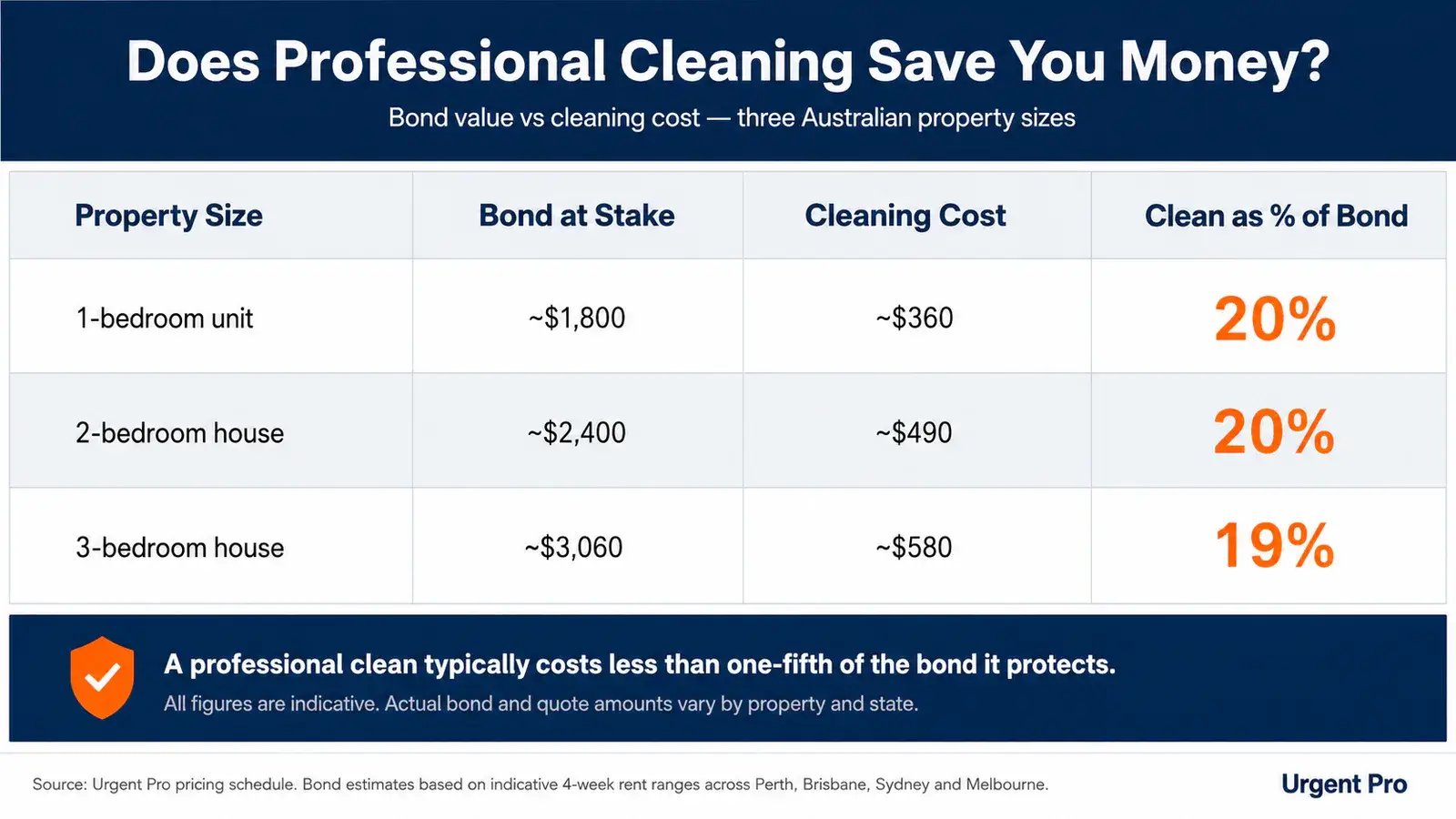
At all three property sizes, the cost of a professional clean is close to one-fifth of the bond. A tenant who loses even that fraction through a cleaning dispute has paid more through the deduction than a professional clean would have cost.
The financial risk from a failed DIY clean rarely stops at a single deduction. The costs tend to arrive in sequence, and they compound quickly.
What a Failed DIY Clean Actually Costs
A failed inspection does not simply result in getting a little less of the bond back. Based on patterns observed across thousands of jobs on the Urgent Pro network, and supported by complaint data from across Australia, a failed DIY clean typically triggers at least two of the following:
The agent hires their own cleaner. When a tenant’s clean fails inspection and there is no time or willingness to redo it, the agent arranges a clean and deducts the cost from the bond. These agent-arranged cleans are routinely priced at a premium: complaints on platforms like ProductReview cite agent-organised cleans at $800 or more for small properties. The tenant pays for a service they did not choose, at a price they did not negotiate.
The bond is partially or fully withheld. Queensland’s RTA data for 2023–24 shows that 57.2% of tenants received a full bond refund, meaning 42.8% did not. Across Victoria in the same period, the RTBA Annual Report 2023–24 shows 64% of bonds were repaid in full to renters, with 10% going entirely to rental providers and 26% split between parties. A failed clean most often lands in the partial split category.
The tenant pays twice. This is the outcome that appears most frequently in negative reviews: the tenant pays a cheap or unverified cleaner, the clean fails, and they then also lose part of the bond. One documented case saw a tenant out of pocket for both $1,768 in cleaning fees and their entire bond, with the cleaning company refusing to refund. The cleaning cost plus the bond deduction can easily total $3,000–$5,000 on a mid-sized property.
A DIY re-clean under pressure. If an agent gives a tenant 24–48 hours to fix the issue before claiming the bond, that timeline is almost impossible to manage well. Work schedules, handover of keys, and the emotional toll of moving mean most tenants cannot deliver a genuine deep clean under that pressure. The window closes and the deduction stands.
What Agents Are Actually Looking For
The reason DIY cleans fail is almost never that the tenant did not try. It is that agents are trained to check specific things that most people overlook or do not consider important.
From Urgent Pro’s network observations and research into agent inspection patterns across Brisbane, Melbourne, and Sydney, the items that most commonly result in a fail are:
- Oven interior: The oven is the most common reason for a failed inspection. Carbon build-up on oven walls, baked-on grease on racks, and the state of the door glass are all examined closely. A DIY clean using supermarket products rarely produces the result a professional oven clean does.
- Shower grout and screen: Soap scum on glass and mildew in grout are inspected in detail, particularly in bathrooms in humid cities like Brisbane and the Gold Coast.
- Window tracks: Most tenants wipe down the window glass but do not touch the tracks. Agents check tracks routinely, particularly in properties with aluminium-framed sliding doors.
- Range hood filter: Grease-saturated filters are a fail in almost every case. They are also one of the first things a professional cleaner addresses and one of the last things a DIY cleaner thinks to check.
- Exhaust fan covers: Dust-clogged exhaust covers in bathrooms and kitchens are a standard inspection point that DIY cleans routinely miss.
A professional provider working to inspection standards has a checklist that covers all of these by default. A DIY clean, however thorough, tends to address what is visible and miss what requires a specific technique or product knowledge.
The Guarantee Difference
One factor the break-even calculation does not fully capture is what happens when something is missed.
On the Urgent Pro network, bond cleaning and vacate cleaning bookings carry a 14-day warranty. If the agent flags an item within that period, the provider returns to address it at no additional charge. The 14-day window aligns with the typical timeframe for a final inspection to occur.
A DIY clean carries no warranty of any kind. If the agent finds something, the tenant is wholly responsible for fixing it on whatever timeline the agent sets.
Guarantee wording varies between providers, and what to check in the guarantee is worth reading before you book rather than after.
This cost does not appear in the break-even table, but it materially changes the risk profile of the decision. With a professional clean, the risk of a missed item moves to the provider for the warranty period.
When a DIY Clean May Be Sufficient
There are situations where a professional clean is not necessary.
A strong DIY clean is a reasonable option when a small, well-maintained property has been kept in good condition throughout the tenancy. If the property is genuinely in excellent shape, the agent is known for a lighter-touch inspection approach, and the tenant has the time, the right products, and the right equipment, the risk is lower.
The complication is that most tenants overestimate the standard of their own clean and underestimate the thoroughness of what agents check. The research is consistent: tenants regularly describe a clean they believed was thorough, while agents regularly disagree.
The DIY calculation also shifts when comparing a 1-bedroom unit in good condition (where the bond is lower and the clean is physically manageable) to a 3-bedroom, two-bathroom house with a double garage and an outdoor entertaining area. At that scope, a professional clean is both more thorough and substantially faster, so the result is more reliable.
If you do go the DIY route, a detailed bond clean checklist is the closest thing to the standard an agent will actually inspect against.
What This Looks Like Across Each State
The terminology and the bond authority differ by state, but the financial logic does not change:
| State | Service term | Bond authority | Bond dispute path |
|---|---|---|---|
| QLD | Bond cleaning | RTA: bonds lodged and disputed via the RTA portal | Dispute via RTA conciliation, then QCAT |
| WA | Vacate cleaning | Bond Administrator (Consumer Protection) | Decided by the Commissioner for Consumer Protection (from March 2026), then Magistrates Court on appeal within 7 days |
| NSW | End of lease cleaning | NSW Fair Trading (Rental Bonds Online) | Dispute via NSW Fair Trading, then NCAT |
| VIC | End of lease cleaning | RTBA; Consumer Affairs Victoria | Dispute via Consumer Affairs Victoria, then VCAT |
Cleaning is the most common reason for bond claims across all states. The bond cleaning service available in Brisbane and the end of lease cleaning available in Sydney and Melbourne operate to the same inspection-standard checklist because agent expectations in those cities are calibrated to the same baseline.
The state authority websites are the definitive source for current bond rules, maximum bond amounts, and dispute processes. Always check the relevant authority before making any decision based on bond amounts.
Does Professional Cleaning Save Money at the End of a Lease?
The maths tells a clear story. A professional end of lease clean on the Urgent Pro network costs roughly one-fifth of the bond it protects. Cleaning disputes are the most common reason bonds are withheld or partially claimed. A failed DIY attempt triggers a chain of costs (agent-arranged re-cleaning at premium prices, bond deductions, and the time cost of managing the fallout) that routinely exceeds the original professional fee by a significant margin.
The situations where a DIY clean is a sound financial decision are narrow: a small property, an excellent condition, an agent with lighter expectations, and a tenant with professional-grade time and equipment. In most Australian rental scenarios, that combination does not exist.
The bond amount, not the cleaning quote, answers the question of whether paying for a professional clean saves you money.
FAQs
Are you legally required to hire a professional cleaner at the end of a lease?
In most Australian states, you are not legally required to hire a professional cleaning service at the end of your tenancy. What you are required to do is return the property in a similar condition to when you moved in, fair wear and tear excepted. Whether a DIY clean meets that standard is what the agent decides at final inspection. If it does not, the bond deduction process starts.
What happens if the agent rejects my DIY clean in Queensland?
In Queensland, if the agent is not satisfied with the condition of the property, they can make a claim against the bond through the RTA. The RTA offers a free dispute resolution service before matters escalate to QCAT. If the cleaning was genuinely insufficient, the claim will likely succeed and cleaning costs will be deducted from your bond. The RTA publishes its current process at rta.qld.gov.au.
Does professional cleaning guarantee I get my full bond back?
No. A professional clean gives you the best possible chance of passing the cleaning component of a final inspection, but a bond can also be claimed for rent arrears, property damage, water charges, or re-letting costs. These are separate from cleaning. No responsible cleaning service can guarantee a full bond return because they cannot control every variable the agent assesses.
What is typically not included in a standard professional end of lease clean?
Carpet steam cleaning is almost always a separate booking. External windows above ground level, full wall washing beyond spot-cleaning, garage floor scrubbing, and pest control are typically variations or separate services. Always confirm what is included when you receive your written quote, before the job begins.
How much does carpet steam cleaning add to the cost?
Carpet cleaning is priced separately and depends on the number of rooms and the condition of the carpet. On the Urgent Pro network, carpet cleaning starts from $156 per job. Many agents and lease agreements require a professional receipt for carpet cleaning at end of tenancy, so combining a carpet clean with your end of lease clean and keeping both receipts is the safest approach.