
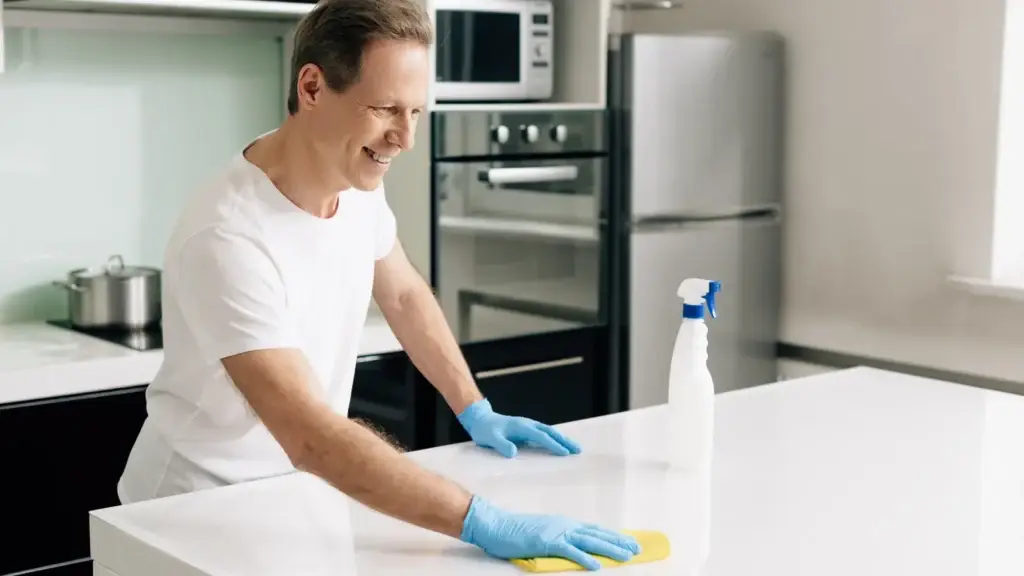
In Australia, the term domestic cleaning is used by the general public to describe the service. At this stage of the research process, the customer is comparing prices, add-ons, and protection.
House cleaning will be used for the remainder of this article.
What Domestic Cleaning Includes: Service Summary
A basic house cleaning service includes surface and floor cleaning, as well as dusting of fixtures. It does not include cleaning of oven interiors, steam cleaning of carpets, or hard-to-reach cleaning. Prices for a standard house cleaning service start from $186 for a small maintained property, and may vary depending on the size and condition of the property as well as additional services requested.
These are the inclusions for the minimum rate, room by room:
Kitchen: Wipe-down of benchtop, splashback, sink and tapware, stovetop, microwave, and fronts of cupboards. The interior of the oven is not included at the minimum rate. It requires a separate booking, or it may be added on for an additional cost.
Bathrooms: Shower tiles and screens, tub and tapware, toilet, vanity, mirror, and floor mop.
Bedrooms and living areas: Vacuum of carpets and hard floors. Dusting of skirting boards, shelves, and other surfaces within reach, door faces and handles, light fittings and ceiling fans, and power-point covers.
General: Removal of cobwebs within reach, emptying of internal rubbish bins, and a floor mop.
The word that best describes the scope of work covered in all the above points is ‘accessible’. This means work carried out on surfaces reached at normal height within the rooms booked. Anything outside the confirmed scope is either a variation, priced and approved before work begins, or a separate booking. A full reference of room-by-room inclusions can be found in the room-by-room standard clean inclusions.
What a Standard Clean Does Not Include
These are the main sources of misunderstandings in bookings. Items excluded from a standard clean include:
- Interior oven glass and racks (a booking add-on)
- Interior of the fridge (add-on or separate booking)
- Interior of cupboards and drawers (add-on or separate booking)
- Window cleaning (beyond accessible glass at ground level)
- Wall washing or spot-cleaning
- Steam cleaning carpets
- Exterior of the property (includes balcony, courtyards and garages)
- Mould removal and treatment of grout
- Any other areas not mentioned in the booking confirmation
Of all the exclusions, carpet steam cleaning is the most misunderstood. Vacuuming is part of a standard clean. Steam extraction is not. If both are required on the same day, they must be booked and paid for separately.
If you are nearing the end of your tenancy and need to understand when a lease clause means professional carpet cleaning is required, this is covered in our article on end of lease carpet cleaning requirements.
Standard Clean vs. Deep Clean: What’s the Difference?
It’s not about how clean the house looks to determine whether it’s a standard or deep clean. It’s about the scope of the job.
A standard clean is maintenance work. It is carried out regularly to clean a home to an agreed level. A deep clean is carried out less frequently to clean areas that accumulate dust and grime over many months. A deep clean takes 1.5 to 2 times longer to complete than a standard clean and is usually done at the same location.
Typically, households needing a new regular cleaner usually require a deep clean to get their home to the level they want it to be at, before regular cleans are done to maintain that standard. Many regular cleans flow into deep cleans because they are not able to cover all areas of the home in the time allotted for the clean. This is evident from the thousands of cleans managed annually through the Urgent Pro marketplace.
A guideline: a deep clean is required if there is three months’ worth of build-up in the bathrooms of a home. Full details on deep cleans and standard cleans are available in deep clean versus standard clean explained.
Before booking a cleaner, questions like “How long have you been doing this?” and “Do you bring your own supplies?” are reasonable, but they don’t necessarily answer the real question on your mind: “What happens to my home if something goes wrong?”
The most important questions are: what verification has been done, is the provider insured, and what happens if the job is not done or something in the house gets damaged?
Providers on the Urgent Pro network must pass five mandatory checks to be allowed to take a booking: have a valid ABN with GST, have a Public Liability Insurance policy for a minimum of $10 million, provide government-issued photo ID, have the right to work in Australia, and have relevant licences and qualifications for the service. For handyman and in-home cleaning services, where the provider will have unsupervised access to the property, a Nationally Coordinated Criminal History Check is also required.
What a Police Check Covers and Why It Matters for In-Home Work
The Nationally Coordinated Criminal History Check (NCCHC) is a police check administered by the Australian Criminal Intelligence Commission (ACIC). It searches all criminal records in Australia. NCCHC applications are made through an ACIC-accredited body or a police agency. The NCCHC is the highest standard criminal history check available to the general public, and a provider who has completed a legitimate NCCHC has been checked against records from all eight Australian jurisdictions. For more information on the National Police Checking Service and how it works, see the National Police Checking Service at acic.gov.au.
A related question comes up regularly: does a domestic cleaner require a Working with Children Check when they enter a home where children live?
A domestic cleaner is not required to have a WWCC when they enter a home as a domestic cleaner, provided they do not offer any additional services to the children. The NSW Office of the Children’s Guardian states that “informal domestic work at a home where there are children” is not considered child-related work, and therefore, the employer of that worker is not required to complete a WWCC check. Similar South Australian law states that “personal or domestic arrangements or services or activities where contact with children occurs incidentally” are not defined as child-related work.
The reason for this is that the cleaner is not providing any service to the children. The contact a cleaner may have with children is only incidental to the service they provide. This is different from, for example, an agency-provided babysitter (WWCC required) or a school cleaner (WWCC required). The NSW Office of the Children’s Guardian has a role-by-role guide which outlines when a WWCC is and is not required.
Public Liability Insurance
A $10 million Public Liability Insurance policy covers negligently caused claims by a third party for injuries suffered by a person in or on the insured property, and for physical damage to the property caused by the insured.
There are a couple of things to know before problems arise.
- Public liability policies cover incidents to third parties (i.e. the general public) and do not extend to a cleaner’s own injuries. Independent contractors are responsible for their own WHS and personal accident insurance. There are a number of situations where a cleaner could injure themselves at your property. The extent of your liability will depend on the personal accident insurance the cleaner holds, if any, and the conditions of the property at the time the cleaner was injured.
- In relation to property damage, the public liability policy will not cover damage to property in the care, custody and control of the cleaner at the time of the loss. This cover is typically referred to as a ‘Care, Custody and Control’ extension and is available as an optional addition to the policy. Faulty workmanship itself (i.e. failure to clean to the standard agreed) is also generally excluded from public liability insurance policies. These types of claims are better made under a contractual warranty.
Urgent Pro’s service warranty for standard house cleaning provides a 24-hour re-clean for items within scope, if there has been an error in the standard of cleaning or items were missed.
Agency, Independent, or Marketplace: What Changes for You
There are three main ways to book domestic cleaning services in Australia. Which one you choose makes a big difference to your legal liability.
- Agencies. Generally, liability is passed on to the provider. The cleaning provider takes responsibility for the employment, training, insurance and supervision of the domestic cleaner, and has indemnity insurance to cover the booking agency. Agencies usually only accept responsibility for services booked through their agency. It is important to ask for a copy of their terms and conditions and indemnity or insurance policy.
- Independent. Generally speaking, you are responsible for everything (insurance, employment, training, supervision, etc.) and the independent cleaner has no indemnity insurance to cover you as the person engaging them.
- Marketplace. You may share liability. The terms and conditions of the marketplace will often mean you share liability with the provider (like Urgent Pro).
A cleaning agency employs cleaners as staff. As their employer, the agency meets obligations such as providing workers’ compensation insurance, paying payroll tax, and directly managing the cleaners. The agency is responsible and accountable for the cleaners’ actions. The agency passes on its costs and responsibilities to the client.
A private or cash arrangement means that you have a direct relationship with an individual cleaner. The cleaner may not be insured. Any claim for damages arising out of the cleaner’s actions (including injury) is between you and the cleaner. A cleaner’s injury on your premises may bring additional exposure. Under Australia’s harmonised workplace health and safety laws, Safe Work Australia confirms that a person who controls a property and engages workers such as a cleaning service has WHS duties to maintain a safe workplace. With a cash arrangement with an unverified, uninsured individual, you leave yourself exposed to WHS obligations and other liabilities until a claim is made.
A marketplace or booking platform operates in the middle of the other two. The platform ensures providers meet a minimum standard for insurance and professional conduct. The provider remains an independent contractor. A booking confirmation provides the name and ABN of the provider. The booking service collects payment and provides a warranty for the service. The booking service becomes the single contact point for service concerns and provides service assurance. At the cleaning services booked through Urgent Pro, before a provider is confirmed, we set the same standards and require the same assurances for house and other cleaning services.
For expectations around scope and property preparation for a booking, see how to prepare before a cleaner arrives.
FAQs
What is the difference between a domestic clean and an end of lease clean?
A domestic clean is maintenance cleaning of an occupied home. An end of lease clean is done to a higher standard on a vacated property. An end of lease clean includes tasks a standard clean does not, for example the insides of cupboards and ovens, window tracks and frames, and built-ins. The two services are of a different standard, scope and price and are not interchangeable.
How much does a domestic clean cost in Australia?
A maintained one-bedroom apartment cleaned fortnightly costs less than a four-bedroom house that needs an initial deep clean. House cleaning prices in Australia start from $186. For more information on what factors contribute to the cost of house cleaning in Australia, see the full house cleaning cost breakdown.
Can I ask the cleaners to do extra tasks on the day?
The price and approval of a variation protects both the customer and the cleaner from a dispute about what was agreed. A cleaner cannot perform a deep clean at the same rate as a standard clean.
Does anyone need to be home during the clean?
Usually no one is home during the booked cleaning time. The key, lockbox codes and building entry arrangements should be confirmed and communicated via the platform before the scheduled time. Urgent Pro should be notified of any changes to access as soon as possible, but no later than the scheduled start time.
What happens if I am not happy with the result?
A standard house clean includes a 24-hour warranty. This means that if anything that was agreed to be cleaned was missed or was not cleaned to the agreed standard, Urgent Pro will arrange for a re-clean free of charge within the 24-hour warranty period. To arrange the re-clean, contact Urgent Pro between 8:00am to 6:00pm Monday to Friday, and 9:00am to 4:00pm on Saturdays. The warranty only applies to the tasks agreed to and confirmed prior to the start of the cleaning.