
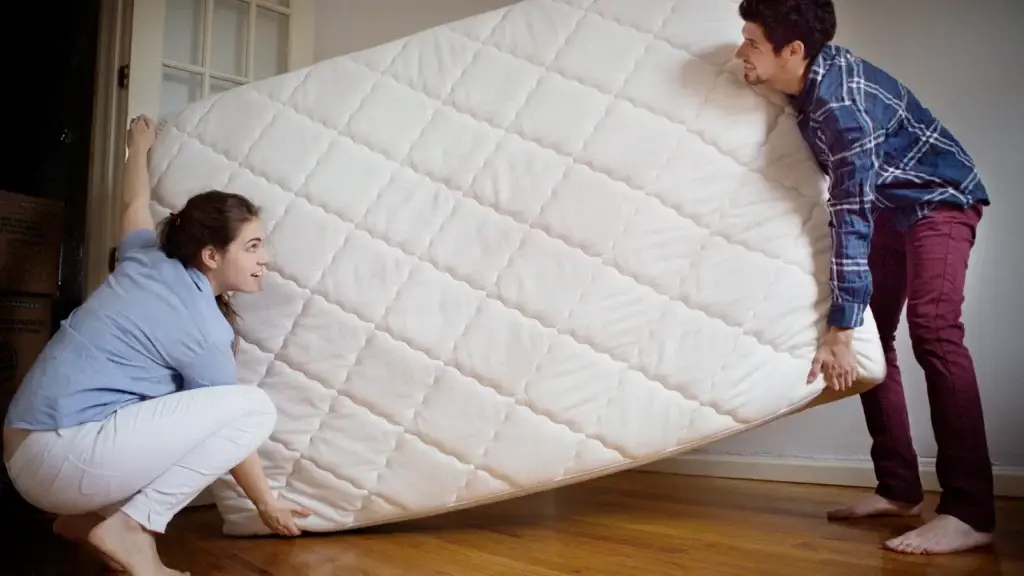
When transporting a mattress, one of the biggest mistakes people make is folding it. While it may seem easier to transport a large, bulky mattress by folding it in half, this puts an excessive amount of stress on one part of the internal structure of the mattress and can damage it permanently. While the damage may not be readily apparent, you could end up with a damaged mattress and not realise it until you try to use it. Instead, a mattress should always be transported in the flat position or the upright position.
One of the most difficult things when transporting a large mattress is trying to turn it to move it through doorways. One way to make it easier is to have two people tilt it up on its side and then move it to a doorway. From there, you can repeat the process to move it through the next series of doorways and around the corners of the room.
Should you move or replace the mattress?
Before lifting a finger, it is worth asking: is it actually worth moving? The weight of a queen mattress is between 24 and 74 kg. Moving it requires two people, adequate transportation, planning around doorways and stairs, and a significant amount of time. If the mattress is more than eight years old or shows visible sag or movement of the springs, it may be quicker and cheaper to have a new mattress delivered to your new location than to move the old one.
If it is in good condition, move it. If not, Urgent Pro’s verified local removalists can be booked online and will take care of your mattress as part of a full household move. The remainder of this guide covers how to move the mattress yourself, from wrapping through to setting it up at the other end.
Which mattresses can be folded (and which absolutely cannot)
Rollable foam mattresses, sold compressed as a bed-in-a-box product, are the only type that can safely be folded or rolled. For every other type, folding risks permanent damage.
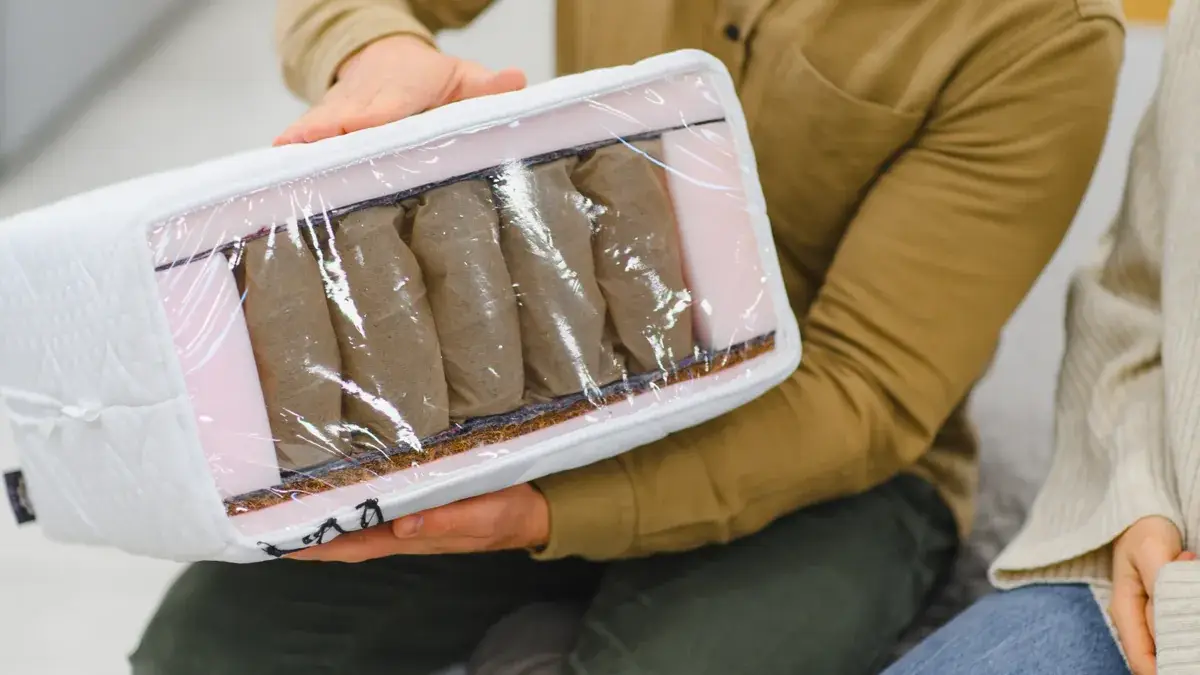
What makes this particularly important for memory foam: memory foam is viscoelastic polyurethane, designed to deform slowly under even pressure and heat, then return to its original shape. Intact cell walls make this possible. Folding fractures those cell walls at the fold line, and the layers of foam separate from each other. The damage is often internal and invisible when you unfold the mattress. Soft spots appear under body weight when the fractured cell walls are no longer able to support the load.
Folding is mechanically different from the slow gradual compression used when a new mattress is shipped in a box. With gradual vacuum compression, there is no point of stress concentration, and the cell walls take the force evenly. Folding does not work this way, regardless of how briefly the mattress stays in that position.
| Mattress type | Safe to fold? |
|---|---|
| Spring (bonnell, pocket spring) | No. Permanently kinks and bends the coil structure. |
| Memory foam | No. Fractures cell walls at the fold line. |
| Latex | No. Cracks the latex layers. |
| Gel foam | No. Breaks the gel layer bonding. |
| Hybrid (foam plus coils) | No. Risks both the coil and foam layers simultaneously. |
| Rollable foam (bed-in-a-box) | Yes, if originally shipped rolled and rated for it. |
Wrapping the mattress
Strip the bed. Vacuum the mattress. Let it air out for a couple of hours to let any moisture or odours escape. Do not seal a mattress that has any dampness in the fabric.
Wrap the mattress in a plastic mattress bag before it leaves the bedroom. Mattress bags are sold at moving supply stores, hardware retailers and online. Use a bag rated at least 3 mil thick. Thinner plastic tears on the first door frame and offers no real protection. Seal the open end with packing tape.
Once wrapped, handle the mattress carefully: plastic becomes slippery on timber and tile floors, which matters when you are trying to control a heavy load through a narrow hallway.
If there is a gap of more than a few days between your move-out and move-in, remove the mattress from the sealed plastic bag and store it in a breathable cover instead. Sealed plastic in a warm, humid Australian summer, especially in Queensland or coastal New South Wales, traps moisture and can cause mould to grow and a musty odour to permanently penetrate the foam. Any mattress stored between properties should go into a properly air-conditioned space, not a garage or outdoor storage unit.
How much does a mattress weigh?
Mattress weight varies by type and construction. Here is the weight range for a queen-size mattress in Australia:
| Mattress type | Typical queen weight range |
|---|---|
| Innerspring | 29 to 55 kg |
| Foam / memory foam | 24 to 53 kg |
| Latex or hybrid latex | 33 to 74 kg |
Weights from Australian retailer product specifications including Harvey Norman (Sealy), Costco Australia (Koala, Sealy Posturepedic) and manufacturer pages (Sleeping Duck, Peace Lily, Quokka). Individual products vary; check your mattress specification before moving day.
Safe Work Australia’s hazardous manual tasks code asks you to weigh posture, distance and how often you lift, not just the weight. A mattress carried through a doorway is a hazardous lift. Two people are needed for anything larger than a single mattress, at any weight in the ranges above.
Carrying a mattress safely
Doorways
Stand the mattress on its edge and lean it slightly toward you to make it narrower. The person at the top should guide it, and the person at the base should manage it. Clearly communicate which direction you will turn before turning. Do not rush through doorways. Clear the hallway and make sure all doors are fully open before you begin. If a door frame has no clearance even with the mattress standing on its side, the frame may need to be temporarily removed, which is far better to plan in advance than discover mid-carry.
Staircases
The upright approach works on staircases the same way it does in a doorway. One person is at the top, the other at the base, moving it one step at a time. On an L-shaped or curved staircase, tilt the top edge gently toward the ceiling to navigate the turn. If the mattress cannot be manoeuvred without bending, do not force it. Contact a removalist to assess whether it needs to be taken from outside the property rather than through the interior. A bent mattress is a damaged mattress.
Moving it without help
A single or twin mattress can be managed by one person with care and planning. A queen, king or heavy hybrid mattress needs at least two people, with three making the job considerably safer.
If you genuinely have no help and need to move a mattress across a flat surface, lay two or three flattened cardboard boxes on the floor and slide the mattress across them. Cardboard slides well on both carpet and hard floors and lets you push a wrapped mattress without dragging it. This works within a room or along a short hallway; it is not a substitute for a proper two-person carry on stairs.
A flat trolley or furniture dolly helps over longer flat distances. Stand the mattress upright on the trolley and use a strap to keep it from falling.
Mattress handles are useful for repositioning and short adjustments. Do not use them as the primary support for a full carry. The handles are stitched to the cover, not the internal structure, and are not designed to bear the full weight of the mattress in a hanging lift.
Transporting the mattress
In a moving van or ute
A covered moving van is the right vehicle. Lay the mattress flat against a wall, secure it with ratchet straps, and do not stack heavy items on top of it. Lying flat, a mattress arrives in the same condition it left.
For a ute, a mattress can stand upright in the tray. Use ratchet straps to hold it in place. Rope does not work: it loosens under vibration during transit. A mattress carried this way must not be able to shift during the drive. If it will not stand fully upright in the tray, lay it flat and strap it across the full width.
A single or twin mattress can fit in most cars if the back seat folds flat. Larger mattresses need a van or a ute.
Moving a mattress on a roof rack
A roof rack is not suitable for a mattress if it can be avoided. It will expose the mattress to wind force at road speed, which bends and compresses the internal structure in ways similar to folding. Beyond the structural risk, an unsecured or poorly restrained load is an offence under road traffic law in every Australian state and territory (in NSW, rule 292 of the Road Rules 2014), even when nothing falls from the vehicle.
The National Transport Commission’s Load Restraint Guide for Light Vehicles sets out what “properly secured” means in practice, and it is the guide that state road authorities such as Western Australia and Victoria point drivers to.
Fines for an unsecured load start at about $150 in Western Australia and run to several hundred dollars in other states, often with demerit points. The amounts change every 1 July, so check your state’s transport authority before you travel. In Victoria, a severe breach results in court action rather than an infringement notice.
ACT Policing reported that in 2022 a driver was fined $598 and lost a demerit point for carrying a mattress on a car roof. Police stopped the driver because the mattress was lifting from the roof at speed and other drivers would not pass the vehicle. The driver was also directed to arrange alternative transport before continuing.
If you are still deciding, the removalist service on the Urgent Pro network operates across all five cities and can move a single mattress as part of a booking. If you need a covered vehicle anyway, a removalist quote takes five minutes and is worth comparing against trailer hire plus the legal risk of an open load.
Setting up the mattress at the new address
Memory foam and latex mattresses that have been transported cold or kept compressed may take a few hours to return to their full shape and firmness. This is normal. Do not judge support or comfort until the mattress has fully settled at room temperature.
If you notice any unusual issues after the move, for example sounds from springs that were not there before, or soft spots that did not previously exist, note them and take photos immediately. Post-move damage is easiest to identify and report on the day of arrival.
Getting rid of your old mattress
Mattresses cannot go in standard wheelie bins. Many councils collect mattresses as part of a hard rubbish or bulk waste collection, usually requiring an advance booking. Good-condition mattresses can be donated to some charities. They can also be taken to the tip with a suitable vehicle. A booked rubbish removal service can collect a mattress without requiring you to be home on a specific council collection day.
The Urgent Pro guide to disposing of an old mattress in Australia breaks down the fastest option depending on your location and how much time you have.
For the broader context of the move, the Urgent Pro moving house checklist covers the full sequence from weeks before moving day to the day itself. For the logistics of packing, including furniture and boxes, see how to pack a house for moving. When a full household move feels beyond what you can manage alone, verified local removalists through Urgent Pro are bookable online across Perth, Sydney, Melbourne, Brisbane and the Gold Coast.
Frequently asked questions
Can you fold a mattress to move it?
You cannot fold standard mattresses to move them. Folding concentrates stress at the fold line: for foam mattresses, cell walls fracture; for spring mattresses, coils kink permanently; for latex mattresses, the layers crack. The damage is often internal, so when the mattress is unfolded, it may look fine. Soft spots and loss of support can appear anywhere that was under stress, sometimes weeks after the move. The only type of mattress that can be folded is one sold and shipped as a bed-in-a-box product.
Should a mattress be wrapped for moving?
Yes, to protect it from moisture, dirt and staining during transport. It should be wrapped in a thick, 3-mil plastic mattress bag, sealed at the open end with packing tape. If a mattress needs to be stored between properties for more than a few days, switch to a breathable cover. Sealed plastic in a warm, humid Australian summer traps moisture and can lead to mould growth and permanent odour.
How heavy is a queen mattress in Australia?
Many people are surprised by the weight. A queen foam or memory foam mattress starts at around 24 kg. A hybrid or latex queen can reach 74 kg. Even at the lighter end, the size and awkward shape of the load makes it a two-person carry for anything larger than a single.
Can a mattress go on a roof rack?
It should not. Wind force at road speed can deform the internal structure of the mattress. An unsecured or poorly restrained load is also an offence in every Australian state and territory. Fines start at about $150 in WA and run to several hundred dollars elsewhere, so check your state’s transport authority. The right option is a covered van, or upright and properly strapped in a ute tray.
How do you move a mattress without help?
A single or twin mattress can be managed alone by standing it upright and sliding it across flattened cardboard boxes on the floor. Queen and king mattresses need at least two people to carry safely, particularly on stairs. A flat trolley or furniture dolly helps over long flat distances. Do not attempt to carry a queen or larger mattress down stairs without a second person.
Can a memory foam mattress be rolled or compressed for moving?
Only if it was originally shipped rolled from the manufacturer as a bed-in-a-box product. Memory foam that arrived as a flat mattress has already expanded to its full shape, and the cell structure is set. Attempting to re-compress or fold it creates the same stress-concentration problem as folding. Move it flat or upright.
What if I need to get rid of the old mattress?
A mattress cannot go in a standard wheelie bin. Options include council hard rubbish collection, charity donation if the mattress is in good condition, tip drop-off or a booked rubbish removal service. A booked service is generally fastest and does not require you to be home on a specific collection day.