
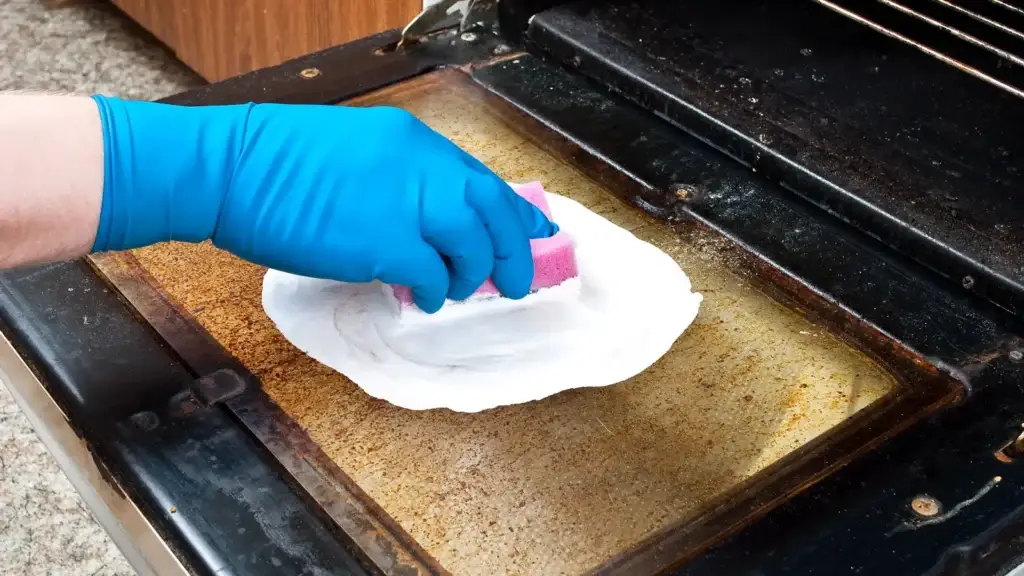
Baking soda paste cleans fresh to moderate oven grease if it sits for a full twelve hours, but no chemical-free method shifts black, carbonised deposits: those need a professional clean or a pyrolytic oven cycle.
Technically, everything is a chemical. Water is a chemical. Baking soda is a chemical. When people search for how to clean an oven without chemicals, what they really mean is: without commercial caustic cleaners, the ones that require gloves, a ventilated kitchen and a wait before you can cook again.
The chemistry that makes baking soda effective on recent oven grease is fundamentally different from that of sodium hydroxide-based cleaners, and the gap between them is what determines when the DIY method stops working.
The DIY method also has a practical limit: when the build-up is heavy, it is not a substitute for a professional house cleaning service that includes oven cleaning.
The short answer
Baking soda paste and steam work on fresh to moderate oven grease. Neither will remove black, carbonised deposits. If the deposit has not softened after a full twelve-hour paste, it is likely carbonised. Only a professional clean or a pyrolytic oven cycle can remove it.
Why People Avoid Commercial Oven Cleaners
Most commercial oven cleaners sold in Australia list sodium hydroxide as their active ingredient. The workplace exposure standard for sodium hydroxide is a peak limitation of 2 mg/m³, listed in Safe Work Australia’s workplace exposure standards. Safety data sheets for these products specify chemical-resistant gloves, eye protection and adequate ventilation during use.
There is also a practical food safety concern. Manufacturer instructions uniformly advise thorough rinsing of all interior surfaces before the oven is used again. Any caustic residue left in corners or around the door seal will smoke and off-gas at preheat temperatures. If you have come into contact with caustic soda, the Australian Poisons Information Centre is available 24 hours at 131 126.
This does not make baking soda the superior choice for all grease. Baking soda works on grease that has not yet fully carbonised, where the alkali can still access the fatty acid residue and bring about a chemical reaction. For heavily carbonised deposits, it will not work.
What Baking Soda and Steam Actually Do to Grease
Repeatedly exposing cooking fat to high oven temperatures triggers pyrolysis, a process in which organic material breaks down to carbon char. The dark, hard, crusty residue in your oven is not fat. It is carbon char, and carbonised deposits do not respond to baking soda, however long it is left.
This is why pyrolytic self-cleaning ovens cycle at around 500°C to convert the carbonised deposits to fine ash. At that temperature the carbon no longer adheres to the oven surface and can be wiped away. Baking soda at pH 8.3 to 9 cannot replicate it.
Steam relies on heat to soften and hydrate surface grease enough to be wiped away. It faces the same constraint against carbonised material: it cannot break the chemical bonds in the carbon char at normal cooking and cleaning temperatures, and cannot return the residue to a state where it can be wiped away.
The Baking Soda Paste Method: Sequence and Timing
This method works best on fresh to moderate build-up, where deposits are brown to dark rather than hard and black. If the oven has not been cleaned in several years and the interior shows thick black layers, consider a professional clean instead before spending an afternoon on a paste that will not shift the worst of the build-up.
What you need: approximately 180 to 200 g of baking soda; enough water to make a paste; a damp cloth or sponge; white vinegar in a spray bottle; rubber gloves; a melamine foam cleaning eraser (optional but useful).
- Remove the oven racks and set them aside.
- Mix the baking soda with enough water to reach the consistency of peanut butter.
- Apply the paste to the oven walls and floor. Do not cover any of the heating elements and, on fan-forced models, do not cover the fan.
- Leave for at least twelve hours, or overnight. Caustic cleaners at pH 13 react much faster than baking soda at pH 8.3 to 9. Given time, however, the reaction occurs and the grease breaks down. Cutting the dwell time short means the reaction is incomplete and the result will be disappointing.
- Wipe down the paste with a damp cloth. The paste will have turned brown or grey as it absorbs the grease. Several cloths will be needed. Rinse and repeat until all paste is gone.
- Spray any remaining paste with diluted white vinegar. White wine vinegar also works. The acid reacts with the alkaline residue and lifts it.
- For any marks that remain, a melamine foam eraser used with light pressure works well without scratching the enamel.
One warning worth noting: paste that is not completely wiped away will dry and flake off the next time you preheat the oven, sticking to the surface and creating fresh residue for the next clean. Remove all paste before using the oven again.
The Steam Method: What It Works On and What It Does Not
Add water to an oven-safe dish and place it on the lowest rack. Heat the oven to 200°C and leave it for twenty to thirty minutes. The steam will soften recent cooking residue and light grease.
Steam can be used to soften cooking residue before applying a baking soda paste, or to maintain an oven that is already in acceptable condition. It is effective at loosening surface grease and recent cooking splatter.
It cannot remove carbonised deposits. If there are still hard, black areas on the interior after a steam cycle, those areas are pyrolysed material. They will not respond to steam regardless of how long you run the cycle. The issue is not time; it is the strength of the chemical bonds in the carbon char.
Racks, Trays and the Grill Element
Oven racks: Place them in the laundry trough or bathtub with hot water, half a cup of baking soda and a squirt of dish soap. Leave them to soak for at least four hours. Alternatively, add one or two dishwasher tablets to the hot water in place of the baking soda. Dishwasher tablets are formulated to dissolve baked-on food at high temperatures and may be more effective for heavily soiled racks. Scrub with a non-scratch scourer after soaking.
Glass door: Apply a baking soda paste and let it sit for one to two hours. Wipe with a damp, non-scratch cloth. Use a razor blade held at about a 20-degree angle to remove carbon build-up on the inner glass surface. Pull in one direction and test in a small corner first. The same care applies to a glass cooktop, covered in cleaning a glass stovetop without scratching.
Grill element: Do not submerge it, apply paste directly to it, or scrub it. Wipe accessible surfaces gently with a barely damp cloth. The element self-cleans to some extent during normal use.
The Honest Limit: What No Chemical-Free Method Can Shift
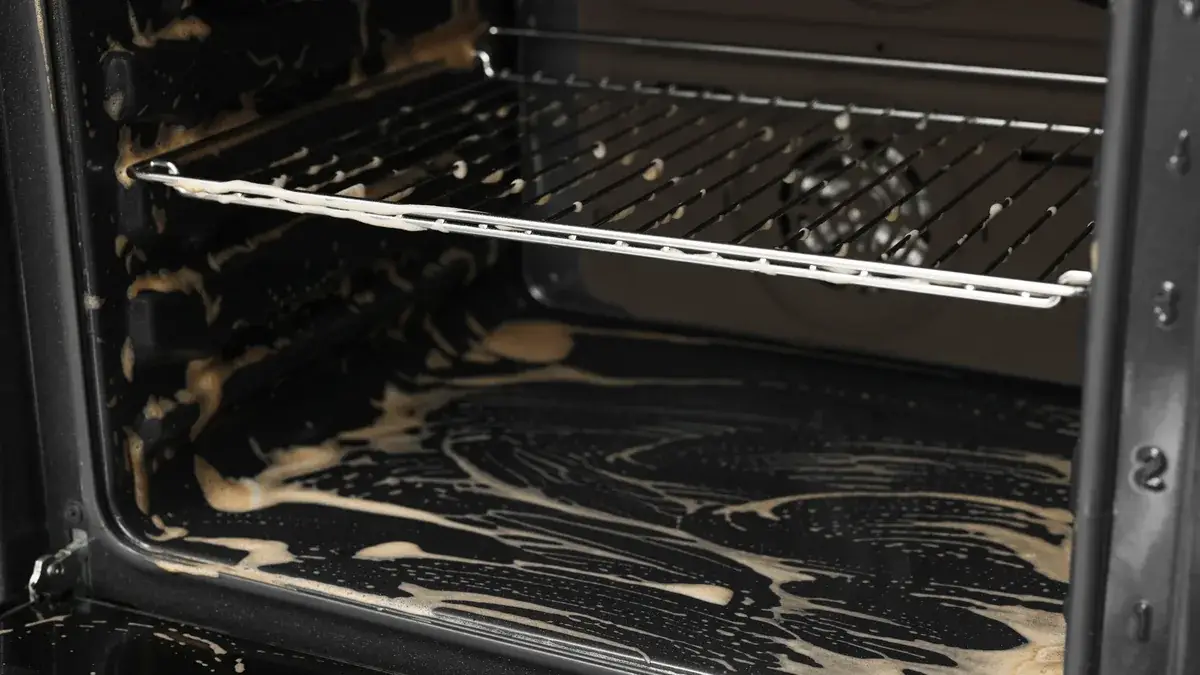
This is not a limitation of the baking soda method. It is a fact that no domestic DIY method will resolve heavily carbonised oven build-up. If the deposit has not softened after a full twelve-hour paste application, it is likely carbonised and more time will not change that.
When to Book a Professional Oven Clean
Practically speaking, if the paste has had its full twelve hours and the result is still clearly unsatisfactory, stop. The carbonised material will not respond to more time. Providers on the full cleaning services network use higher-concentration alkaline products alongside mechanical techniques that shift build-up domestic methods cannot.
A standalone oven clean starts from $186, with the final price determined by the size and configuration of the oven and the extent of the carbonised build-up.
There are a couple of things worth knowing about how oven cleaning relates to other bookings:
A standard house clean does not include the oven interior by default. If you want it cleaned, it needs to be added as a variation to the booking. Confirm it is part of the scope before the provider arrives. For a full picture of what a routine house clean covers, that breakdown is covered separately.
An oven clean is included in the standard scope for a bond clean, vacate clean or end of lease clean. For what agents check in the oven and the standard they apply, see the dedicated article.
To book a standalone oven clean or a full house clean, Urgent Pro connects customers with verified independent providers from $186.
FAQs
How do you use baking soda to clean an oven?
Mix approximately 180 to 200 g of baking soda with enough water to form a thick paste. Apply it to the interior of the oven, avoiding the heating elements. Leave for at least twelve hours, ideally overnight. Wipe with a damp cloth, spray with diluted white vinegar to lift any remaining paste, and wipe clean. All paste must be removed before using the oven again, as dried residue will harden and adhere to the surface during preheating. This method works on fresh to moderate grease build-up. It will not remove hard, black carbonised deposits.
How long does it take to clean an oven by hand?
For moderate build-up, the method takes twelve to fourteen hours of paste dwell time plus thirty to sixty minutes of active wiping and rinsing. For heavy build-up, the method may take several applications and may fail entirely if the residue has carbonised. A professional typically completes a domestic oven clean in forty-five to ninety minutes, using commercial-grade products and technique regardless of the level of build-up.
Can you use steam to clean the oven?
Yes, for light to moderate build-up. Place an oven-safe dish filled with water in the oven, heat to 200°C and leave for twenty to thirty minutes. Open the oven and wipe the interior while it is still warm. Steam will not remove carbonised black deposits. For those, only a professional clean or a pyrolytic oven cycle will work. Steam works well as a maintenance step between deeper cleans.
Does baking soda scratch the oven surface?
Not when used as a paste. The cleaning action is primarily chemical rather than mechanical. Avoid applying baking soda to catalytic lining surfaces (the flat, dull grey or dark textured coating in some ovens that facilitates self-cleaning), as even mild abrasives degrade the coating over time. For stubborn marks, a melamine foam eraser used with light pressure is a safe option after the paste and vinegar steps.
How often should I clean the oven?
Wiping the oven after messy cooking sessions prevents grease from polymerising and building up. A baking soda paste deep clean every three to six months keeps the oven in a state where the DIY method remains effective. Once a year is the minimum for anyone who cooks regularly. The longer it goes between cleans, the more likely the residue is to have carbonised and the harder it is to restore the oven. Placing a tray under anything likely to spill is the single most effective maintenance habit. For what a full final inspection covers when you are moving out, the inspection standards article covers the complete scope agents apply.
Urgent Pro is a digital marketplace and booking agency. It connects customers with verified independent local service providers. The provider’s name and ABN appear on your tax invoice. Payment is collected by Urgent Pro as authorised agent on the provider’s behalf.