
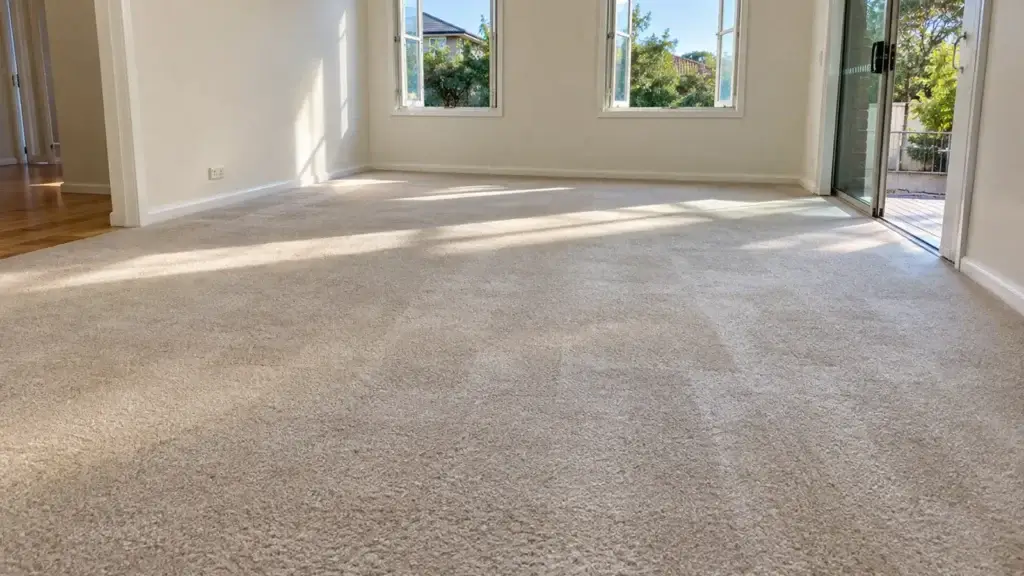
It is important to understand how long it takes for a carpet to dry after it has been cleaned professionally. The primary reason is how long you must wait before the final inspection can take place. The carpet must be completely dry for the inspection. The second reason concerns wool carpeting. Wool takes a significant amount of time to dry, and depending on how wet it is, it may take longer than 24 hours to fully dry. The third reason is high humidity combined with inadequate ventilation. This combination can prolong drying time considerably.
Most professional carpet cleaners report that it takes between 4 and 8 hours for carpet to completely dry after cleaning. Drying time can also vary based on how soiled the carpet was and how much water was used during the clean. If the carpet has wool fibres, it will take a longer time to dry.
In Australian rental properties, evaporative cooling systems are common and can affect indoor humidity levels, which in turn affects carpet drying time. Carpet cleaning providers report that 48 hours is typical for Melbourne in winter. There are many variables as to why a carpet takes a long time to dry.
Carpets that were over-wetted during cleaning, or dried in a room with poor airflow, can still be damp well past 48 hours. That is part of why the warranty window is longer than the typical dry time, and not in itself a sign something went wrong.
Where drying is taking longer than expected, ensuring proper ventilation is the first priority. Urgent Pro lists verified carpet cleaning providers across all five Australian cities. With unvetted carpet cleaners, prices, wait times, and quality of work vary greatly. Industry wait times for professional carpet cleaning can run 7 to 10 days during peak periods, so booking ahead matters.
Cleaning Method
While customers often refer to hot water extraction as steam cleaning, the process works by injecting water into the carpet pile and retrieving it through aspiration. Moisture remains in the carpet if the extraction process is inadequate. Methods using minimal moisture include dry-chemical and encapsulation cleaning types. These allow use of the carpet even before it is completely dry.
Be aware that the choice of cleaning method affects more than just cost. For additional information about each method, the fibre types each suits, and a comparison of the two approaches, see how steam and dry cleaning methods compare.
Carpet Fibre Type
Moisture evaporates readily from synthetic fibres such as nylon, polyester, and polypropylene, and hot water extraction on a synthetic carpet dries within a few hours. Natural fibres (wool, jute, sisal, seagrass) take much longer.
Wool fibre, in particular, is prone to colour and texture changes when an inappropriate cleaning product is applied. It is important that your cleaning provider is made aware of the fibre type of your carpet before work begins.
Carpet Pile Depth and Thickness
Thick carpets, regardless of fibre type, take longer to dry. Moisture becomes trapped in older, compressed foam underlay. Moisture-resistant underlay, by contrast, is designed to prevent moisture retention. Moisture that becomes trapped in foam underlay can wick upward through the carpet backing as the pile dries.
The condition of the carpet at the time of a tenant move-out can have a significant impact on any discussion about replacement costs. Deep-pile carpets can retain a significant amount of moisture that is difficult to detect from the surface. In contrast, a low-pile carpet dries relatively quickly and is less likely to cause drying concerns at inspection. What the condition report tracks matters at end of tenancy, because an agent comparing the exit condition to a documented starting state of a deep-pile carpet has different expectations than one reviewing a low-pile replacement.
Air movement and low humidity are the most critical factors in the evaporation of moisture from carpet. Cross-ventilation can dramatically reduce drying time. Opening a single door is less effective than creating a through-breeze, because air moves from one room to the next rather than flowing across a single large surface area. With a fan directed at the carpet surface, moisture will evaporate more quickly.
Upholstered furniture placed directly on the carpet retains moisture beneath it. The person booking the service should ensure furniture is removed from the carpet before the provider arrives.
Humidity, Season, and City
As reported by the Bureau of Meteorology, seasonal variations in humidity across different Australian cities mean that drying times vary considerably by location. Understanding these variations is important when scheduling a carpet clean around a property inspection.
During Melbourne’s cooler months, indoor humidity rises and natural ventilation is limited, particularly in older multi-storey homes with carpeted bedrooms. Older properties in Melbourne may take as long as two days for cleaned carpet to dry fully. Even in summer, when evaporation is fastest, drying may still take longer than 24 hours in poorly ventilated rooms. As noted by Consumer Affairs Victoria, moisture control is a key element of habitable property standards. The same principle applies to post-clean drying conditions.
In Perth, located in Western Australia’s south-west, the hot dry climate makes it the fastest of the five cities for carpet drying. Brisbane and the Gold Coast present the opposite challenge: subtropical humidity during the wet season keeps ambient moisture levels high, which slows evaporation even when the temperature is warm. Moisture in the air means that even with high temperatures, carpet can take a long time to dry in these cities.
For Perth tenants sequencing their vacate clean, drying time, and final inspection, the vacate cleaning steps for WA tenants covers the full process with timing guidance.
Spring and Autumn tend to bring more consistent drying conditions. The longer, more humid days of summer can push drying times toward the higher end of the range.
Bast fibres such as jute and sisal retain more water, become heavier, and take longer to dry. Thin-pile or low-pile carpet dries quickly. Heavily soiled carpets require more water during cleaning, which extends drying time. Extremely soiled carpets may indicate that years have passed since the last professional clean. Adjust your expectations for drying time accordingly.
In normal indoor conditions, a professionally cleaned carpet takes 4 to 8 hours to dry. Humid conditions push that out, and poor ventilation or a machine with insufficient extraction can leave carpet damp for considerably longer.
Wool and other natural fibres take longer to dry than synthetic carpet. The handling is the reason: wool requires pH-neutral products and lower water volumes, and that gentler treatment is what extends the drying time. There is no reliable hour figure that separates the two, so treat wool as longer than synthetic and give it room in your timeline rather than working to a fixed number. If you are unsure what your carpet is, say so at booking and the provider will spot-test before applying anything.
This is also why the carpet cleaning warranty runs for 7 days from the date of service rather than tracking the typical drying window. The carpet dries over roughly 6 to 48 hours, and residual moisture, wicking, and residue effects can keep surfacing across that whole cycle. A stain that looked gone when the provider packed up can reappear a day or two later as moisture in the underlay wicks back up through the pile. A warranty that expired the moment the carpet felt dry would close before the most common complaints have had a chance to show up, so the window is deliberately wider than the drying time.
Timing Carpet Cleaning Around the Inspection
There are real time constraints when tenants schedule carpet cleaning before a bond, vacate, or end-of-lease inspection. The timing is often poor because the carpet needs time to dry, and that window is not always factored in.
Two problems arise if a carpet is still damp at an inspection. The first is musty odour. Industry complaint records document a case where a tenant failed a final inspection because the carpet was still damp and had developed a smell, despite having been professionally cleaned. The second is mould. Mould growth is a condition finding that would be documented by the real estate agent and may result in a claim against the bond.
Allow at least two days between the clean and the inspection. If there is no natural airflow in the room and it is winter, three days may be needed for the carpet to be completely dry. For more information about what each state requires at the end of a lease, see when end-of-lease carpet cleaning is required and how the laws apply in your state.
Over-Wetting
Over-wetting occurs when the technician applies more water to the carpet than the equipment is designed to remove. It is an error, and does not reflect the work of a competent, well-equipped technician. Symptoms include water pooling against skirting boards, carpet that feels saturated rather than simply damp, and carpet that remains wet well beyond the expected drying window.
Having wet carpet long after the technician has left is not just an inconvenience. Moisture promotes the growth of mould and other undesirable organisms. It may also cause stains to reappear as the carpet dries. To address these concerns, Urgent Pro provides a warranty. If visible stains or residue reappear within 7 days of the clean, a re-attend is covered at no additional cost. For vacate, bond, and end-of-lease cleaning across all five cities, Urgent Pro’s end-of-tenancy cleaning network provides verified providers with written confirmation before any job begins.
How to Dry Carpet Faster
- Do not allow furniture to be placed on the carpet before it is fully dry. This can result in moisture marks and uneven drying. Be especially careful in high-traffic entry areas.
- Open windows and doors to help speed the drying process.
- Point standing fans at the carpet surface to disrupt the damp air that sits above the fibres. Ceiling fans alone do not move enough air at carpet level to significantly speed drying.
- If the humidity outside is higher than the humidity inside, run the air conditioning in fan mode to lower indoor humidity and speed up the drying process.
- If the humidity outside is lower than the humidity inside, open windows to allow drier air in.
- Do not walk on the carpet in outdoor shoes once it has been wet-cleaned. Soil from outdoor shoes will be pushed further into the damp fibres.
Steps 2, 3, and 4 can be combined for maximum effect, particularly for end-of-lease cleans in winter or poorly ventilated rooms. To book carpet cleaning through Urgent Pro, include details about the room ventilation and carpet type when enquiring so the provider can give accurate drying advice upfront.
FAQs
Can I walk on carpet immediately after it has been cleaned?
You can usually walk on it in clean socks or bare feet a few hours after hot water extraction. Soil from outdoor shoes can stick to damp fibres and undo part of the cleaning job. Avoid outdoor shoes on recently cleaned carpet until it is completely dry, and make sure the carpet is fully dry before returning furniture to its position.
Why does my carpet smell bad after it has been cleaned?
A bad smell after cleaning is usually caused by too much moisture left in the carpet and underlay. Moisture, combined with embedded dirt and dust, creates conditions for bacteria and mould to grow. Leaving a window open during and after a cleaning helps prevent the musty odours that come from prolonged dampness.
Why are there stains on my carpet after it has been cleaned?
Stain reappearance after a carpet clean is called wicking. Where staining returns due to soiling embedded in the underlay rather than the pile, it is outside the warranty scope. Stain reappearance caused by the provider’s method or care is covered under Urgent Pro’s 7-day re-clean warranty.
How long should I wait between the carpet clean and the inspection?
Allow at least two full days between the carpet clean and the inspection to ensure the carpet is fully dry. In locations such as Melbourne during winter, or in rooms without windows or natural airflow, allow three days. If the carpet is still damp during the inspection, it may be noted as a condition issue. Carpet that remains damp for more than 48 hours also carries a mould risk.
Is there a difference in drying time for carpets of different thicknesses?
Yes. Thin, low-pile carpet dries much faster than thick, plush carpet. A thick carpet also retains moisture for longer, and if it sits on older compressed underlay rather than modern moisture-resistant underlay, drying will take considerably longer. With thick carpet in a room with limited ventilation, allow additional time before the inspection to ensure the moisture has fully dissipated.