
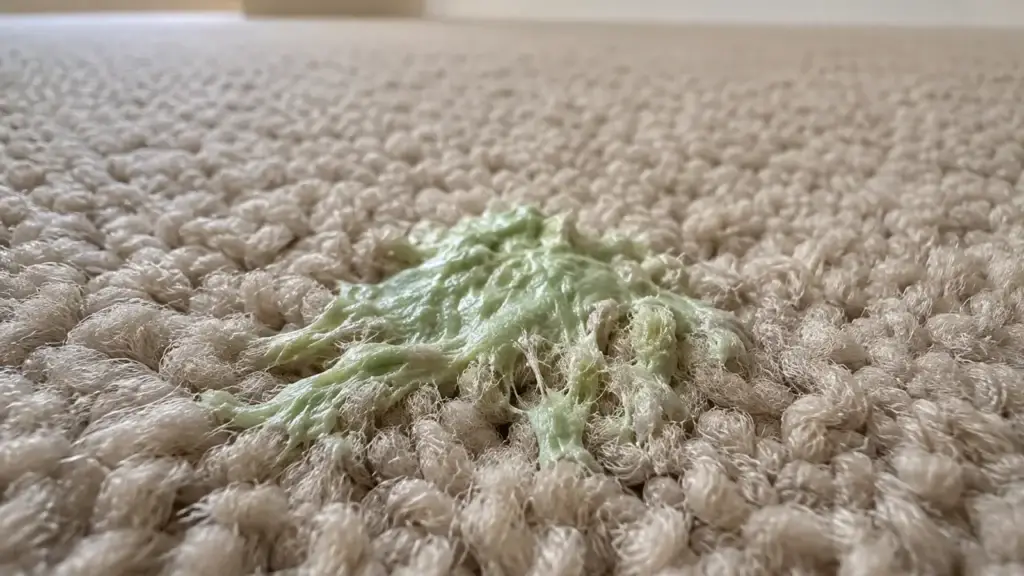
Gum and wax come out of carpet the same way: make them hard and brittle first, then lift them off with a blunt edge. Reaching for a sharp blade before the gum has hardened is how carpet pile gets cut.
Press a sealed bag of ice onto the gum for several minutes. The real test is whether the gum is hard when you press it through the bag. Then break it away with a butter knife or credit card and vacuum the pieces before they warm up. Expect to repeat the freeze once or twice. Wax lifts the same way, with one extra decision covered below: whether your carpet can take an iron.
Chewing gum is polyvinyl acetate, a polymer with a glass transition point of around 28 degrees Celsius. Above that temperature it is sticky, and below it the polymer shifts to a brittle state. At body temperature, gum sits above the glass transition point, which is why heat does not work. Below 28 degrees, gum shifts to the glassy state. Ice at 0 degrees brings it well below that point. This is the entire science behind the method.
How to Remove Chewing Gum from Carpet
Step 1: Freeze the gum
Place ice in a sealed plastic bag on the gum for several minutes, pressing it firmly against the gum. You want the cold to fully penetrate the gum. Do not use loose ice because the meltwater will get the carpet wet and make the next steps harder.

The real test is whether the gum is hard when you press it through the bag. It should be completely hard and unyielding, not sticky or pliable.
Step 2: Break and lift
You want to break away pieces using a blunt edge, like a butter knife or credit card. Work from the outer edge inward with short strokes, like you are breaking a twig. Be patient, as the centre may still be sticky or pliable. This should happen easily if the gum is hard enough.
Using a sharp edge will cut the carpet pile, and this damage will not repair itself. The only safe method is to use a blunt tool and lift at a low angle.
You need to act quickly and vacuum the fragments before they warm up and become sticky again. Gum left on the surface will re-adhere to the carpet fibres as the temperature rises.
If the gum softens while you are removing it, you will need to re-freeze it for a few more minutes to harden it before continuing.
Once the bulk of the gum is removed, you will see a sticky residue remaining. A citrus-based solvent or eucalyptus oil will lift the residue. Blot with a dry towel afterwards.
Methylated spirits can also be used to remove the residue, but be sure to test it on a hidden area first to check for colourfastness, especially on delicate or synthetic fibres.
How to Remove Candle Wax from Carpet
What makes carpet fibre type important for wax removal?
Polypropylene carpet begins to deform at 100 to 120 degrees Celsius. A domestic iron on a synthetic or medium setting reaches that temperature range. Applying a warm iron to polypropylene pile risks fusing or glazing it permanently. Polypropylene is common in rentals. If you are renting and unsure about your carpet type, assume it is polypropylene and follow the solvent method described below.
Nylon carpet can tolerate the iron method on the lowest heat setting, no steam. Wool needs professional cleaning for wax, because both heat and solvents can damage or break down wool fibres.
| Carpet Fibre | Iron Method | Safer Alternative |
|---|---|---|
| Nylon (common) | Yes, lowest heat setting, no steam | Dry-cleaning solvent |
| Polypropylene (common in rentals) | No, risk of glazing the pile | Dry-cleaning solvent only |
| Wool | No | Professional cleaning |
| Berber loop pile (any fibre) | No, risk of fusing the loops | Dry-cleaning solvent |
| Unknown fibre | No | Dry-cleaning solvent |
Step 1: Let it harden, then chill it further
Do not touch liquid wax. Let it cool and harden on its own first. Once it has set, place ice in a sealed plastic bag on the wax for several minutes to make it more brittle. Use the same tactile test as with gum before attempting to lift.
Step 2: Break and lift the bulk
Once hard, use a spoon or blunt knife to crack and lift the wax. Start from the edges and work your way inward. Never use a sharp edge. Vacuum up the wax pieces before moving on, because loose pieces left on the surface can re-melt and work back into the pile.
Step 3a: Absorb the remainder with an iron (nylon cut-pile only)
The iron-and-paper method lifts wax residue from nylon cut-pile carpet. Set the iron to its lowest heat setting, no steam. Cover the wax spot with plain white paper or a plain paper towel and pass the iron over it a couple of times. As the paper becomes saturated with wax, replace it with a fresh section. Continue until no more wax transfers. A paper towel absorbs the wax more quickly than plain paper and is less likely to tear.
Do not touch the iron directly to the carpet fibres at any point.
Step 3b: Solvent method for polypropylene (and as an alternative to the iron)
A hairdryer held at a distance on a low heat setting is a gentler option for polypropylene. Keep the dryer moving at all times and blot immediately as each small section of wax softens.
Alternatively, test a dry-cleaning solvent on a hidden patch first, then apply it to the wax residue using a clean cloth, working from the outer edge inward. Follow the label: allow it to dwell as directed, blot with a clean cloth, and rinse with cold water. Repeat if residue remains.
Removing Coloured Wax Stains
Plain wax (ivory or white) usually lifts without leaving any colour. If the wax is scented or coloured, a dye shadow can remain in the fibres even after the wax itself is completely gone.
Candle wax stains on nylon carpet are similar to fabric dye stains. If the candle wax contains colour or fragrance, treat with 70 per cent isopropyl rubbing alcohol. Test it on a hidden area of the carpet first. Apply to a clean white cloth and blot the stained area, working from the outer edge inward.
Candle wax stains on polypropylene carpet are physically absorbed rather than chemically bonded, making them more responsive to solvent treatment. Treat with isopropyl alcohol first.
If a stain remains, 3 per cent hydrogen peroxide can be tried as a next step on nylon or polypropylene, but it can change colour, so test it on a hidden patch first.
When a dye stain does not lift after two careful attempts, it is time to call a professional. Pushing further with stronger chemistry risks permanently setting the stain or causing colour damage that is harder to fix than the original mark. Professional carpet cleaning through Urgent Pro connects you with verified independent local providers who can assess the stain and apply the right treatment. Understanding the difference between hot water extraction and dry carpet cleaning also helps set realistic expectations for what each method can and cannot lift.
When to Call a Professional
Some situations are best handed to a professional from the get-go. Here are the clearest examples:
- Gum has been walked across a wide area or has been embedded for weeks.
- Coloured wax has left a dye stain that does not lift after two careful attempts with rubbing alcohol.
- Carpet looks matted or distorted after a hot tool was applied to it.
- The carpet is an antique, a hand-knotted piece, or a valued wool rug.
Standard carpet in a rental home can be assessed by a verified professional through Urgent Pro. They can tell you whether the damage has gone beyond what cleaning can fix and can also help with routine house cleaning if you are preparing for a final property inspection.
Gum and wax show up frequently on pre-inspection cleaning jobs alongside other stain categories, because the same time pressure that causes someone to miss a wax drip tends to cause them to miss other stains as well. The carpet cleaning service covers stain pre-treatment as part of the standard scope.
Frequently Asked Questions
Is freezing gum on carpet a myth?
No. Chewing gum is made of polyvinyl acetate, a polymer that shifts from sticky and flexible to hard and brittle around 28 degrees Celsius. Ice at zero degrees brings it well below that point, which is why the method works. Place ice in a sealed plastic bag on the gum for several minutes. The real test is whether the gum is hard when you press it through the bag.
How do you get wax out of carpet without damaging it?
Do it in two stages. The first stage is mechanical: break off as much hardened wax as you can with a blunt knife after treating the wax with ice. The second stage is heat extraction, but only if the carpet is eligible. For nylon cut-pile carpet, place a sheet of plain white paper over the wax residue and run an iron on its lowest heat setting, no steam, over it, changing the position of the paper frequently. Do not use the iron on polypropylene carpet. Use a dry-cleaning solvent instead. If the wax contains dye, address the dye stain separately after all the wax is removed.
Can a warm iron damage carpet?
Yes, depending on the fibre type. Polypropylene carpet begins to soften and deform at around 100 to 120 degrees Celsius, and a domestic iron on a low synthetic setting reaches that range. Polypropylene carpet, common in rentals, should never have an iron used on it. Nylon can tolerate an iron on its lowest setting, with care, and wool needs professional cleaning for wax. Always use paper as a barrier and keep the iron moving.
Will coloured candle wax leave a permanent stain?
Not always. It depends on how concentrated the dye is and what fibre the carpet is made of. On nylon, dyes can bond to the fibre through ionic attraction, which means they may need professional removal. On polypropylene, the dye is physically absorbed rather than chemically bonded, making it more likely to respond to household solvents. A dye stain that does not lift after two careful attempts with isopropyl alcohol should not be pushed further with stronger household chemicals.
How do I identify if my carpet is polypropylene?
Look for a carpet specification sheet in the tenancy agreement or property management files, or ask your property manager. Polypropylene is a common budget choice in rentals. It is usually harder underfoot than nylon and may have a faint sheen in some cuts. If in doubt, skip the iron entirely. The solvent method is safer for most fibres, but test it first and call a professional for wool.