

Window tracks harbour the most loss. This includes window tracks specifically, where grit builds up and dries, causing a residue that compacts further into the groove when wiped rather than being removed.
Window tracks are among the most challenging areas at final inspections. Agents are required to check window tracks as part of their assessments and have very little leeway in interpreting the results. Generally, tracks must be assessed as clean in order for the bond to be released. A bond clean through Urgent Pro covers all tracks, including window tracks, as part of the standard scope. For more information on the full scope, see the room-by-room Queensland bond cleaning checklist.
Single-storey houses and townhouses with multiple sliding doors are common in Queensland, which explains the higher number of bond disputes caused by window tracks compared to other states. Over the course of a lease, grit and dirt collect in the drain holes of sliding door tracks. Tenants are often unaware that tracks form part of the bond cleaning scope, which is also why window tracks consistently appear in what most often causes bond deductions across Queensland.
What Agents Check at Every Window Opening
An item appearing on the exit condition report means an agent found a failure with that part during their inspection. Agents verify each of the following seven elements for every window opening. If the agent finds a failure with any one of these, the window is deemed to have failed and is recorded on the exit condition report.
| Surface | What agents check | Most common miss |
|---|---|---|
| Glass face (inside) | Smears, streaks or dried water marks | Cleaning with a cloth that redistributes marks rather than removing them |
| Track channel | Grit, paste residue, mould | Vacuuming only, leaving compacted debris in the channel |
| Track corners | Packed grit that a cloth misses | Treating the track as a flat surface rather than a recessed channel with corners |
| Drain holes | Blocked debris, compacted grit | Never checking them |
| Sill | Dust, grit, surface staining | Treating the sill as optional because it sits below eye level |
| Flyscreen mesh | Dust embedded in mesh on both sides | Cleaning only the glass-facing side |
| Flyscreen frame | Dust along frame edges and corner joints | Treating the screen as just the mesh, without wiping the frame separately |
From an agent’s perspective, a cleaned window is not the same as a window that passes inspection. A passed inspection requires all seven elements to be in order. Window elements must also be correct alongside kitchen and bathroom items, which is why the window area carries more weight at final inspection than most tenants expect.
What the Track Inspection Actually Reveals
The exit condition report records whether each window is clean or not. If an agent finds grit in a track corner, they record that failure regardless of the state of the glass.
A thorough track inspection enables an agent to identify and record any corrections required, ensuring the report is completed accurately. A track that has been properly cleaned shows no dirt or grit. A track that has been surface-wiped shows a greyish, powdery residue. A track that has not been addressed at all shows clear grit and debris.
There are several reasons track corners and drain holes become filled with grit and dirt. The most common is incorrect cleaning procedure. Water actually makes grit and dirt sticky and paste-like, causing it to adhere more firmly to track corners and drain holes. In track corners, removing the dry debris first with a stiff brush is more effective than applying water directly. Black specks on the base of track corners are mould, and if corners and drain holes are not cleaned as part of a bond clean, mould can become an additional problem.
The condition of drain holes and corners reflects the overall condition of the track. Agents performing an exit condition report examine the corners specifically rather than just the centre channel, because grit accumulates in the corners even when the main channel has been wiped. The presence of blocked drain holes is also recorded, as a blocked drain is a reportable track failure.
More detail on how agents in Queensland complete the exit condition report is available in our guide to the Queensland exit condition report. The Residential Tenancies Authority of Queensland also provides guidance on bond claims and end-of-tenancy obligations for tenants and property managers.
Blinds at Final Inspection
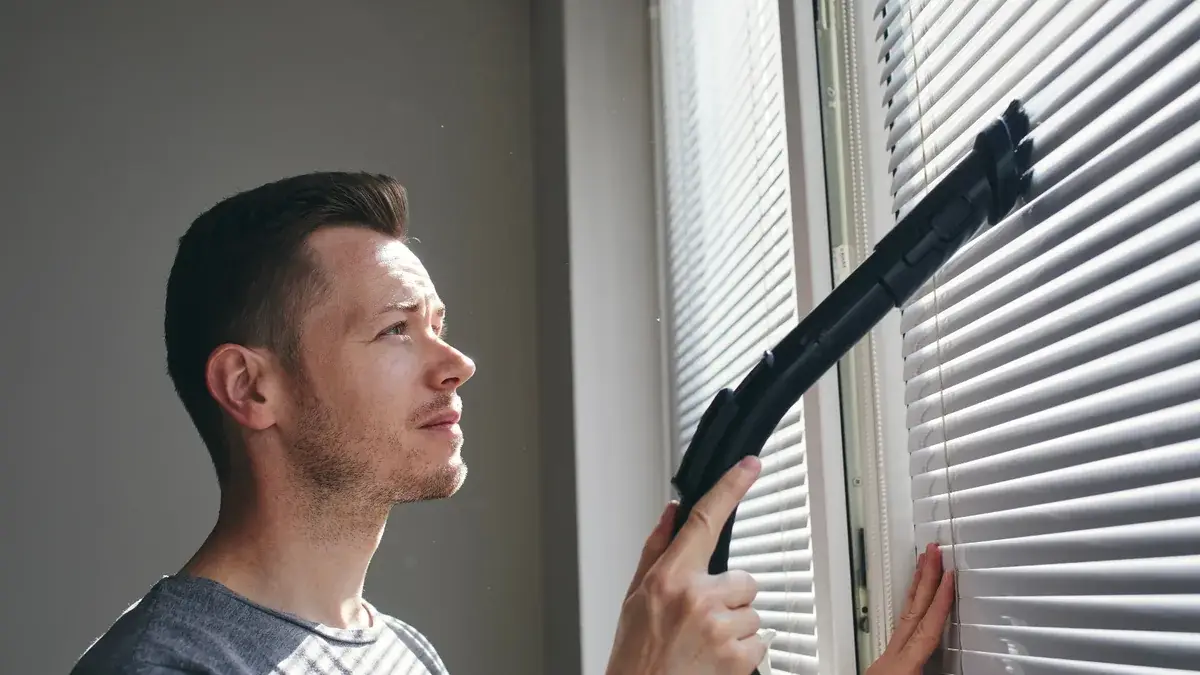
There are three areas of a blind that are subject to final inspection, and a property manager will check all three.
Slats or vanes. Dust and other debris collects on the top of each vane and is often missed during cleaning because it is not visible when the blind is fully closed. The dust is removed by wiping each vane individually, top and underside. The agent may physically test whether cleaning has been done by running a finger along the top surface of a slat.
Headrail, cord and wand. The top of the headrail is also subject to dusting. The cords and wands of the blinds accumulate grime over the period of a tenancy from daily handling.
Fair wear and tear versus staining. The difference between normal wear and tear and staining is often the deciding factor in blind disputes. Normal use may result in fading and colour shifts due to sun exposure. Tenants are required to clean blinds, not to restore them to their original colour. Vertical blinds that have yellowed from long sun exposure are considered fair wear and tear and do not need to be replaced. Blinds should be free of dust and removable stains. Grease and other stains that were not present at the start of the tenancy should be removed by the tenant before the final inspection.
Where a blind is stained or damaged beyond what normal use would produce, the condition report describes the condition of the blinds at the beginning of the tenancy. Compensation can be claimed only for deterioration beyond that starting point, and only for the remaining useful life of the blinds, not their full replacement cost. The Residential Tenancies Authority also provides further guidance on fair wear and tear for rental properties.
Flyscreens: The Most Commonly Skipped Surface
Flyscreens are skipped most often during window cleaning for one of two reasons. They are out of sight when a window is closed, or they require a more detailed process to clean than simply wiping glass.
To thoroughly clean flyscreens, a vacuum should be used first to remove dust and debris from the mesh. Where the screen is removable, it should be taken from its frame for this step. The frame should then be wiped clean separately. Forcing debris through the screen by scrubbing is not necessary and can distort the mesh. The correct approach is to lift the debris from the screen rather than push it through.
Frame. A dirty frame is immediately noticeable when an agent runs a finger along the frame edge, or when the mesh is examined under direct light. The edges of the frame and corner joints are collection sites for dust and are wiped separately from the mesh.
Inspection of sliding door flyscreens follows the same method as for window screens: the frame and mesh are checked as separate surfaces, and both accessible sides of the screen are assessed. Many Queensland properties have flyscreen doors on sliding door openings, which are treated the same way.
The Correct Cleaning Order
For tracks: remove dry debris first, then damp-wipe. Applying water before removing dry debris turns grit into paste, making it significantly harder to remove from corners and drain holes.
Sills and frames are wiped before glass. Wiping a sill after the glass is done risks splashing water back onto the glass.
Wipe glass from the inside first, then the outside for lower, accessible windows.
Take a photograph of each window before you leave. At a final inspection, an agent may photograph windows from outside in natural daylight, where every streak shows. Your own photo taken from the same angle, on the same day, is evidence of the window’s condition at the time you handed back the property, and is the fastest way to dispute an exit condition report item that you know was not a problem at the end of your tenancy.
FAQs
Is cleaning window tracks required for a bond inspection in Queensland?
Yes. In Queensland, window tracks are named specifically on the exit condition report. In Brisbane and on the Gold Coast, they are among the top five most commonly contested items during a bond inspection for cleaning. Tracks are checked by an agent running a finger along the channel and into the corners to detect any buildup.
During a bond inspection, what do agents look for on blinds?
Agents look for dust on the top surface of each slat and on the headrail, as well as stain buildup on the vanes. Damage from the sun and fading are considered fair wear and tear. Stains and grease buildup that were not present at the start of the tenancy need to be removed by the tenant before the final inspection.
Do flyscreens get cleaned as part of the standard bond clean in Queensland?
Yes. During a standard bond clean, both the mesh and the frame of the flyscreens are cleaned. Check your provider’s scope before booking. Flyscreens are included as standard in all cleaning services on the Urgent Pro network that cover a full bond clean.
What happens if window tracks do not pass the exit inspection in Queensland?
The agent records the failure on the exit condition report. You then have the right to clean the tracks to the required standard before the property is officially returned. The landlord also has the right to arrange cleaning and recover the cost from the bond. The condition documented in the entry condition report determines the standard required.
Are upper-storey windows part of a bond clean in Queensland?
Windows that cannot be safely accessed for cleaning are not part of the bond clean scope. Windows at ground level are included. The condition of the property when it was first delivered to the tenant determines the standard required at the end of the tenancy.