

9.8 million people, 40.7 per cent of the Australian population, changed their address in the five years before the 2021 Census, and 3.8 million people, 15 per cent, moved in the single year before it, according to the Australian Bureau of Statistics. There aren’t many mistakes that haven’t already been made when this many people move house in any given year. This checklist was built to help you avoid them.
Short answer: Book your removalists by week four, because end-of-month slots and Friday slots are the first to go. Confirm access to the new and old properties by week two. Notify utilities, internet and government agencies by week four at the latest. Pack an essentials box in week one, loaded last so it comes off first. Do the final walkthrough at the old property before the truck leaves, and take photos.
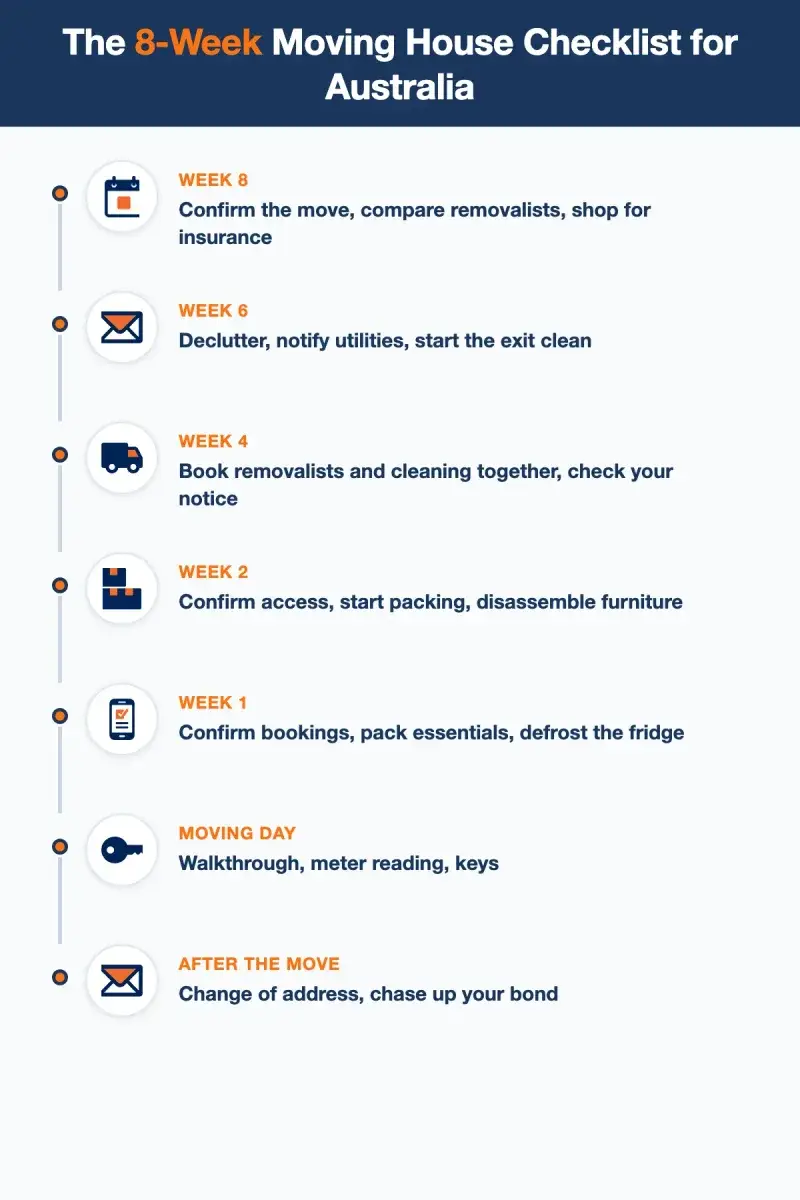
Week 8: Confirm the move, compare removalists, and start shopping for insurance
Once the move date is locked in, start getting quotes. Availability is tightest in the last week of every month, when most leases change hands and the majority of removalist bookings are made, so book early. The Urgent Pro network offers local jobs starting from $220 per job (GST-inclusive), with scalability for truck size, crew, and distance. This is a careful estimate and by no means a final price.
The insurance discussion leads on from the price comparison game. When considering which companies offer the best value, it’s essential to confirm which, if any, insurance is included in the removalist fee. Most businesses offer public liability insurance to cover damaging a client’s property while the removalists are on the insured third party’s premises. Public liability insurance does not cover your belongings while in transit; that’s an additional insurance policy with an important gap to know about, and a reputable removalist on the Urgent Pro network is one of the rare businesses to carry both. The network’s verified providers also hold a correct vehicle driving licence class and public liability insurance of at least $10 million per occurrence.
You should also check your home and contents policy before moving day rather than after. ASIC’s Moneysmart advises that you should provide as much detail as possible and include things like serial numbers, receipts, and warranties. You should also take photos of each item and room, and date the photos. Most people finally do this task when they move, so don’t leave it to the last minute or treat it as an afterthought.
Week 6: Declutter, notify your utilities, and start the exit clean
Every professional packer agrees that anything you plan on throwing away is the last thing you should pack. Sorting and organising everything will lead to fewer boxes, less waiting, and less work for you in the long run.
Go room by room and put everything into one of three piles: keep, donate or sell, and throw away. Anything you plan on donating is usually one quick phone call away from having a pick-up service booked. The bulky waste option with your local council usually takes at least two weeks’ advance notice to book a pick-up slot. You should also call your removalist to make sure you know what you are and are not allowed to bring on the moving van. Across all removal companies, gas bottles, paint, flammable liquids, and live plants and animals are usually excluded.
This is the time to start the utility transfer for both addresses. Electricity and gas retailers need advance notice to disconnect the old property and connect the new one on the right date. Residents of New South Wales, the ACT, Queensland, South Australia or Tasmania can use the free Australian Energy Regulator’s Energy Made Easy tool, which allows comparison of every offer in the area before you transfer your plan across. Victoria and Western Australia have their own separate energy retail frameworks, so residents there should use their own state’s comparison service instead. For rental properties, water is typically managed by the landlord or the strata, so confirm where the responsibility lies before assuming it’s your task to oversee it.
Internet should be a line item on its own. nbn advises that a minimum of four weeks’ notice should be given prior to moving. Check the technology available at the new address. Contact your preferred service provider to schedule a connection and notify your existing provider of the disconnection date. On moving day, leave behind any equipment supplied by nbn. It won’t work anywhere else and is registered to the specific property. If you accidentally pack it, nbn will return it through Australia Post at no charge to you.
If you’re renting, this is also the week to start thinking about the exit clean. Whatever you call it where you are, property managers call it professional end-of-tenancy cleaning across the country, though the correct service term differs from state to state.
| Service term | State | Additional notes |
|---|---|---|
| Vacate cleaning | WA | The actual term used by WA agents and tenants |
| Bond cleaning | QLD | A QLD-specific term, not used elsewhere |
| End of lease cleaning | NSW and VIC | The term used in both states |
“Bond,” as the money held by your state’s tenancy authority, is the correct term everywhere. Only the name of the service differs by state.
Week 4: Book removalists and end-of-tenancy cleaning together, and check your notice
At a minimum, you must lock in your removalist by this fourth week. This is also the time to book your exit clean if you’re renting, and there’s a solid reason for booking both of these together rather than booking the exit clean after the removalists have finished.
For the most part, property managers want to inspect an empty property to see the true standard of the clean, meaning the clean usually has to happen after the furniture is gone and before the final inspection. Booking both jobs, removalists and the exit clean, on the same or consecutive days keeps the gap between move-out and inspection as short as possible, without the cost of a second access visit. Before confirming the exit clean, make sure both teams are on the same page about timing. There are checks before booking an exit clean that are far easier to run now than to fix later.
If you’re a tenant, this is also the week to check your own notice obligations. Notice periods in Australia aren’t as straightforward as one number per state, because they depend on several factors: whether the tenancy is fixed-term or periodic, who is giving notice, and the reason. A “14 to 21 days” figure quoted online is more than likely wrong for your specific case. Review your lease agreement yourself, and contact the relevant authority for the state where your lease is located: NSW Fair Trading, Consumer Affairs Victoria, the Residential Tenancies Bond Authority in Victoria, the Residential Tenancies Authority in Queensland, or Consumer Protection in Western Australia.
This week is also a good time to start the government and financial address changes listed in the change of address checklist below, because most of them require some lead time.
Week 2: Confirm access, start packing, disassemble the large furniture
Access is hands down the biggest factor behind moving disputes in the industry. Removalists quote based on the information they’re given. There may be stairs, a long carry, restricted parking, or an apartment booking that requires a lift. Notify them of these details in advance instead of on the day of the move.
Under the standard removals terms, anything discovered on the day that wasn’t declared, such as an extra flight of stairs or a heavier load than stated, counts as a variation. Small changes can be approved on the spot, but anything over $200 needs your written approval before the crew proceeds. Declaring access correctly avoids that conversation entirely.
Begin packing by clearing the least-used and largest rooms first: the linen cupboard, the garage, the spare room. A few packing habits genuinely reduce damage and injury:
- Wrap individual fragile items in newspaper or butcher’s paper
- Pack plates on their sides
- Make sure every box can be lifted safely by one person
- Use spare linen and towels as padding around fragile items
- Photograph the back of your TV and any other multi-cable setup before you disconnect it, so reconnecting at the new place is a five-minute job, not a guessing game
- Disassemble and break down furniture that the removalist isn’t handling, and keep all the hardware for each piece in a labelled bag taped to that piece
- Label each box by destination room, not by contents, since this speeds up the unpacking process
Week 1: Confirm bookings, pack the essentials box, defrost the fridge
Call your removalist and cleaner to confirm booking details, including arrival windows and payment. Also confirm access at your new address.
It’s always best to have a box that stays with you and doesn’t travel on the moving truck. At your destination it should be the first box off the truck. It should have everything you may need right away: phone charger, medications, a change of clothes, toiletries, basic tools, a kettle and mug, along with important paperwork like your lease and the keys to the new property.
It’s extremely important to defrost the fridge and freezer at least 24 hours before moving day. Moving companies say it’s one of the biggest causes of delays on moving day. Back up any important records you keep on your computer, just in case you need to access them the night before moving day.
Moving day: meter reading, walkthrough, keys
Before the truck leaves the old address, walk through with the removalist. Take photos of the state of the property, room by room, to document its condition before the removal. It may seem like a hassle, but it protects you if the property owner later claims damage from the move that in fact existed before it.
If you’re responsible for the meter readings, read the meters at both addresses and take a timestamp photo of each. Take the old property’s garage remote and all keys, fobs and security cards with you.
What to check before unpacking
Find the fuse box, the water mains shutoff, and the gas shutoff. Confirm the hot water system is working properly. If there are visible issues with the property, note them on the delivery paperwork before the crew leaves.
Visible damage needs to be reported to the removalist the same day, while damage discovered after you start unpacking has a seven-working-day window to be reported. Both timeframes only work in your favour if you documented the property’s condition on the way out.
You may also need to register for council rubbish and recycling bins if the previous tenant’s bins aren’t transferred to you. Some councils require new bins to be formally registered.
The change of address checklist
This is the part people leave half-finished for months, mostly because it’s scattered across a dozen different logins rather than one list. Split it into what has a real deadline and what doesn’t.
Government records that impose a real deadline:
- Services Australia: when you change address, you need to notify Services Australia within 14 days, whether or not you’re currently receiving a payment, since Centrelink and Medicare need to be able to reach you
- Electoral roll: you have 21 days to notify the Australian Electoral Commission of your address change, though the Commission requires you to have lived at your new address for a full month before you can update your enrolment there
- Driver’s licence and registration: state authorities, Service NSW, VicRoads, Transport and Main Roads in Queensland, or the Department of Transport in WA, each set their own process, and there’s usually a fee for a new card
- Your ATO details can usually be updated together with Medicare and Centrelink in a single myGov session, since myGov lets you share one address update across your linked services
Other financial and insurance providers:
- Bank and super fund
- Home and contents insurance, and car insurance, since your premium is address-related, and not updating it can affect a future claim
- Employer payroll, for pay slips and tax purposes
Personal and household:
- GP, dentist and vet
- Children’s school or childcare provider
- Subscriptions, streaming services and loyalty or airline programs
- Mail redirection with Australia Post, set up before your old address goes to a new tenant, for a chosen period covering post and eligible parcels
Working through this list in the order above, deadlines first, is what actually gets it completed, rather than letting it trail on for months as each missed update turns up.
Booking removalist services early takes the pressure off the rest of the list, rather than trying to do all of it in the final week.
After the move: chasing up your bond
If you had an exit clean and inspection done at your old property, this is also the week to follow up on your bond. How quickly it’s returned depends on your state’s tenancy authority, and whether the agent has lodged any claim against it, not on how well the property was cleaned. Every state has its own tenancy authority that manages the process for lodging or disputing a bond claim. Check its website directly for the latest forms and timeframes, since the paperwork and timelines vary by state. What an agent can actually claim for is measured against what the exit report records, not against how recently the property was cleaned.
FAQs
How much notice do I need to give for booking removalists?
For a local standard move, book by week four. Book well in advance for interstate moves or moves at the end of the month.
What do I pack myself, and what do I leave for the removalists to do?
Most removalists offer a full pack service, but many customers pack most of their items into boxes themselves and leave glassware, artwork and other fragile items to the crew, since specialist boxes and packing help minimise breakage.
Do I need to be present on moving day?
Yes, or you need someone authorised to be there in your place. They’ll need to walk through the property with the removalists to confirm the inventory, sign for delivery, and record any damage before the removalists leave. You shouldn’t sign for a delivery if you’re not sure of its condition.
What items won’t removalists move?
Across the industry, standard exclusions include gas bottles, paint and other flammable liquids, live plants, pets, and valuables such as jewellery or important documents. Heavy specialty items like pianos and safes also need to be declared in advance so the right equipment is brought.
Should I book cleaning and removalists for the same day?
The day after is usually best. This gives enough time for an exit clean, since the property needs to be empty first. Booking the two close together reduces the gap before your final inspection without the cost of an extra booking.
How many people actually move house in Australia each year?
According to the ABS, 3.8 million people, 15 per cent of the population, moved in the year before the 2021 Census, and 40.7 per cent of the population had changed address in the previous five years. It’s one of the most common life events in the country, which is why a proven checklist is more useful than improvising your own.
Do I need to inform my landlord when I hire a removalist?
Booking a removalist doesn’t require landlord notice, but ending your tenancy does, and the notice period depends on your lease agreement and your reason for ending it. Check your lease and your state’s tenancy authority before assuming a standard figure applies.
Do I need to bring the nbn box with me when I move?
No. Equipment supplied by nbn is registered to that specific property and won’t work anywhere else. Leave it for the next occupant, and if you accidentally pack it, nbn will arrange a free return through Australia Post rather than charging you a replacement fee.