
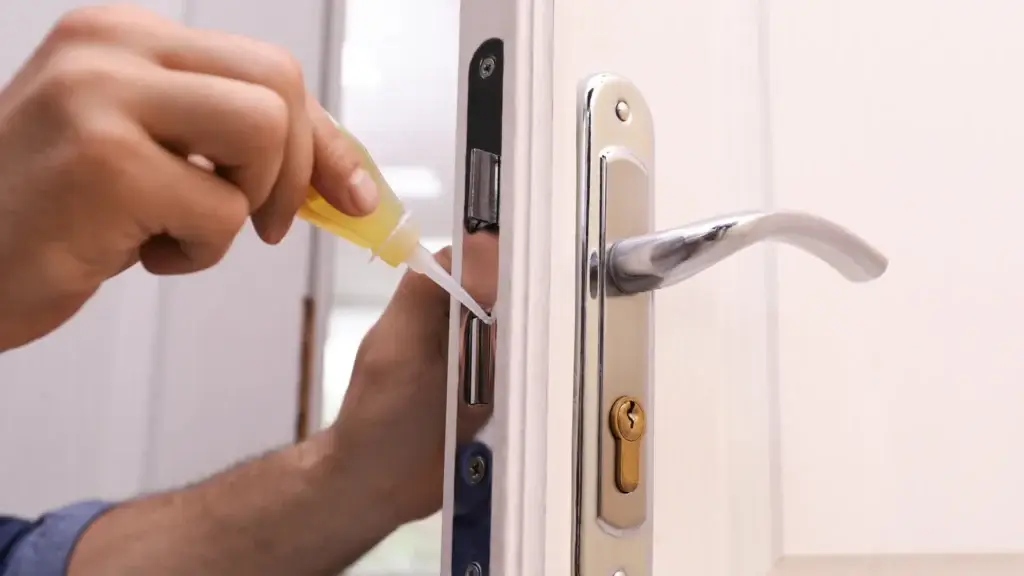
Our customer feedback shows that loose door handles and sticking or misaligned doors are issues consistently noted on exit condition reports by tenants preparing their properties for final inspection.
Door adjustment and handle work are typically ten to fifteen minute jobs for a skilled handyman, across the five cities Urgent Pro covers. A job done well should leave the door closing easily and smoothly, without sticking or binding.
Most issues with door operation can be fixed quickly and inexpensively. Knowing a few basics means you can pick up the right parts from the hardware store and sort it yourself in under 30 minutes. There are three problems covered here: sticking, squeaking, and loose door handles. Each has different causes and a different fix.
Solutions
Start by taking the door off: support the door, tap each hinge pin out with a nail and hammer, then remove the door and lean it against a wall. Check the hinges for sag or loose screws. If the hinge screws or one of the holes has paint build-up, clean it out. If the door is still sticking, sand off the paint build-up. If it is still sticking after that, the timber has swollen from humidity and will need planing.
A sticking door can also be caused by the way it was originally hung, which is often fixed by opening the hinge knuckle and greasing the pin. Loose hinge screws can also cause a sticking issue, which a handyman should be able to fix. The door handle itself can be the source of a sticking problem too. If the handle is stiff and won’t rotate, lubricant can usually fix it. Another cause can be a bent internal spring in the latch mechanism, which a handyman can usually adjust or grease. Dirt or debris caught in a hinge can also cause sticking, and this is simple to fix without needing a handyman.
Looseness is usually easy to fix too. It can mean the door stop is missing a fixing, or that the handle hasn’t been fitted correctly. While a handyman may not always be necessary for these types of repairs, one can always be called on to handle door adjustment.
To free a stiff hinge, support the door, tap the pin out with a nail and hammer, clean the pin and barrel, apply lubricant, and tap the pin back into place. There are also grub screws on some door handles; this can be the problem if the screws are stripped. Loose handles can also be caused by a worn spindle. If the square rod has rounded off, the handle set needs replacing rather than adjusting.
Squeaking: to locate the source of the noise, hold the door in place. If the squeak stops, it’s the hinge. If the squeaking continues, it’s the latch. For handle-area squeaks, hold the rose plate as flat as possible while operating the lever. If the noise changes, the handle itself is the problem.
Loose handle: the handle wobbles independently of the latch, but the door still opens and closes normally.
Won’t latch: the door swings open on its own, or won’t stay closed.
If the problem is beyond a simple fix, door adjustment and handle work are considered standard handyman work across the five cities Urgent Pro covers.
Humidity, sagging hinges, and paint build-up are all common causes of sticking doors, and the most notable difference in seasonal patterns between cities is in humidity.
The Bureau of Meteorology’s climate averages show the seasonal pattern. Brisbane’s humidity is higher in summer and lower in winter. The opposite is true for Melbourne: relative humidity peaks at about 79 to 80 per cent at 9am in June and July and is lower in summer, at about 62 to 66 per cent at 9am from December to February.
Interior doors and frames in Australia are generally made with radiata pine or an MDF core. Engineered timber and MDF can expand and contract with changes in moisture, and solid timber moves too.
Two other causes to check first:
Paint build-up narrows the clearance with each repaint. There is no set rule for how much clearance should remain after repeated repaints, so judge it visually: if the binding point lines up with a thicker painted edge, that’s the cause.
Hinge sag happens when hinge screws loosen and a door drops on the latch side. If the door contacts the frame at the top on the hinge side, and there’s a wider gap at the top on the latch side, that confirms hinge sag. Check for this before assuming a door needs planing; it’s a common cause of sticking that gets mistaken for timber swelling.
Planing is the most permanent fix, so if it’s necessary, remove as little material as possible. Sanding the contact point is a lighter, less permanent option. A door planed during the humid months will be too small in the dry months. Seal exposed timber with primer afterward to stop it reabsorbing moisture.
Rough sounds coming from a hinge mean it needs lubrication. Without it, the metal parts grind against each other and create friction, which eventually produces noise. If misalignment is present, the friction concentrates in one spot and can cause the screw to loosen further. Loose screws can’t be corrected by lubrication alone.
There are many lubricant options at the hardware store, but not all are long-term solutions. Petroleum-based products evaporate over time. A better option is PTFE dry lubricant, which creates a film that’s better suited to a high-traffic door. The film attracts less dust than an oil-based lubricant and holds up for longer.
If lubrication alone doesn’t work, try this: support the door, tap the pin out with a nail and hammer, clean the pin, lubricate it, and push it back into the hinge. Lubricate the barrel of the hinge as well. If the squeaking returns, check the pin for wear and whether any screws have worked loose again.
Loose door handles can be caused by a backed-out fixing screw, a backed-out grub screw, or a worn spindle mechanism. Check which cause is present before making any adjustments.
Loose rose plate screws. On some handles, the fixing screws on the rose plate are exposed. On others, they’re covered by a small cap that lifts off with a flat screwdriver. Tighten evenly. If a screw spins, pack the hole with a toothpick and PVA, or use a slightly larger screw. Avoid overtightening; an unevenly pulled plate can cause fresh binding.
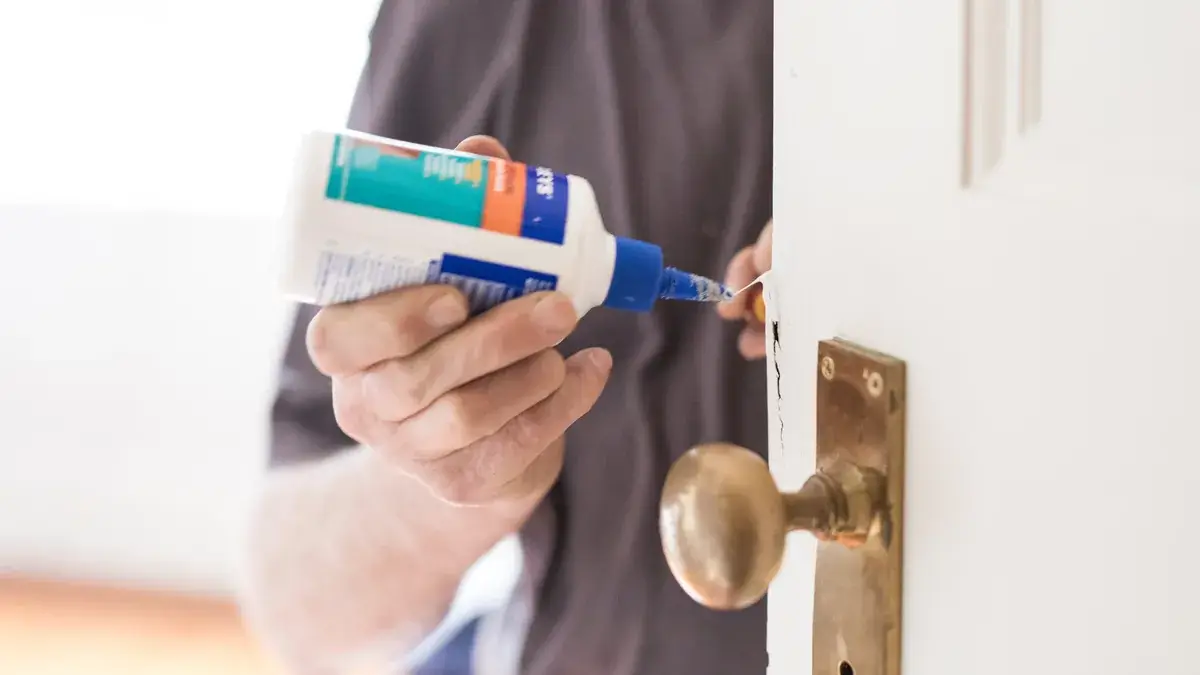
A worn spindle. If the square rod that passes through the latch mechanism has rounded off, the handles can turn without engaging. Replace the handle set, and make sure the new handle matches the dimensions of the old one.
A failed internal mechanism. If the spindle and the screws are both fine, the internal spring or cam has worn out and the mechanism needs replacing.
Doors that won’t latch. If a door swings open on its own, the latch bolt is missing the strike plate opening. This is usually from hinge sag dropping the latch position, or movement in the door frame shifting the strike plate.
To check the offset, mark the face of the latch bolt with chalk, close the door firmly, and see where the mark lands on the strike plate. This shows how much adjustment is needed, and in which direction.
For a small offset, file the inside edge of the strike plate opening in the required direction, then refit and test. For a larger offset, remove the plate, enlarge the mortise with a chisel, refit, and fill the exposed timber before painting. Hinge sag can cause a closed door to fail to line up with the jamb, and is fixed by readjusting the hinge. Rehinging a dropped door will often fix the latch problem on its own.
In Queensland the RTA advises tenants to get the owner’s written consent before carrying out repairs. Tightening a loose screw or lubricating a hinge is minor upkeep that many owners accept, but ask your property manager first if you are unsure. Replacing a handle set, rehinging a dropped door or fixing a latch that no longer works is a repair, and unless you caused the damage it is the owner’s job. For the full state-by-state breakdown, see who is responsible for repairs. If a door problem has turned up on a condition report, it’s worth checking which repairs most often cost tenants their bond and which repairs tenants can legally do themselves first. Check your state tenancy authority for the rules where you live.
When is a handyman needed?
Tightening and lubricating are simple tasks a homeowner can do. Planing a stuck door can easily be done by the homeowner too. Rehinging a dropped door is more difficult, and hiring a handyman to do the job is usually the better call. Other door-related tasks that need a handyman include handle set and lock replacements, and strike plate repositioning.
Verified independent providers on the Urgent Pro network complete door adjustments and handle replacements from $220, depending on the task. Check indicative handyman costs before booking. Door work includes a 14-day workmanship warranty, separate from your consumer guarantee rights under the Australian Consumer Law.
Hinges should be lubricated every six to twelve months, and handle screws should be checked whenever a door starts to feel different.
FAQs
Why is my door sticking?
Doors in Brisbane tend to stick in summer, and doors in Melbourne tend to stick in winter. Hinge sag and timber swelling from seasonal humidity are both common causes, and paint build-up is another. Check for hinge sag first, because it is easy to mistake for swelling.
How do I stop a door squeaking?
Lithium grease, PTFE dry lubricant or silicone spray can be applied to the hinge pin. For a more thorough job, support the door and tap the pin out, wipe it clean, lubricate it and reinsert it. WD-40 is a short-term solution only; it’s a penetrating oil that evaporates and doesn’t leave a protective film.
How much does a door repair cost?
Handyman bookings for door repairs, including rehinging or replacing a lock set, start from $220 per job through Urgent Pro. A written quote confirms the price before any work begins.
Who pays for door repairs in a rental property?
Generally, the owner is responsible for repairs in a rental property. If a hinge is squeaky or a handle is loose from normal wear and tear, that’s the owner’s job. If the tenant or their guest caused the damage, the tenant is responsible. In Queensland the RTA advises tenants to get the owner’s written consent before carrying out repairs, so ask your property manager first, even for minor upkeep, if you are unsure.