
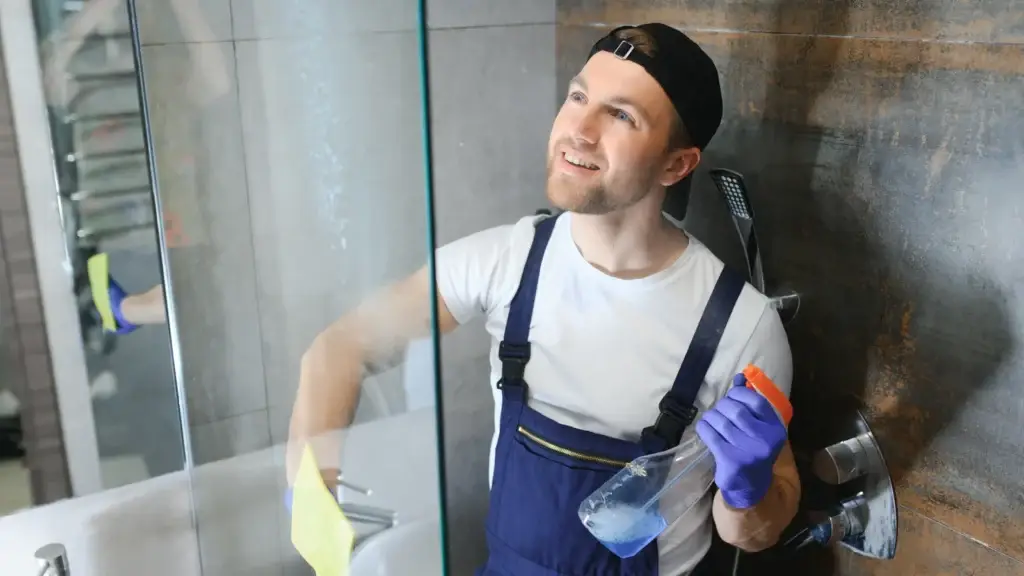
Property managers check shower screens with a torch held at a shallow angle to the glass. In flat bathroom light, the calcium film soap leaves behind is nearly invisible. Against an angled beam, it appears as grey-white haze across the entire surface. A screen you judge spotless after cleaning can fail a final inspection immediately, not from lack of effort, but because the wrong approach was used.
Short answer
Make a 50/50 solution of white vinegar and warm water and spray it on the screen. Leave it for five to ten minutes, making sure it does not dry. Using a microfibre cloth, work the solution across the screen from the top down and rinse thoroughly. If there is really stubborn buildup, a citric-acid based descaler will work better than scrubbing harder. Do not use an abrasive pad or magic eraser on glass.
What soap scum actually is, and why water alone does not shift it
The soap you use in the shower reacts with the calcium and magnesium ions naturally present in tap water and forms metallic salts that are insoluble. The main compound is calcium stearate, with the chemical formula (C17H35COO)2Ca. It is a white precipitate that sticks to glass and is not water-soluble. Rinsing just displaces it. It is for this reason that when you run the shower over the screen and wipe it dry, the film is still there the following morning.
How quickly film builds up is almost entirely dependent on your local water supply. Providers on the Urgent Pro house cleaning service see this directly, working across five cities. Water hardness varies by city. Perth water is hard, and some supplies exceed the 200 mg/L aesthetic guideline in the Australian Drinking Water Guidelines, above which scale can build rapidly in hot water pipes and fittings. Brisbane sits in the middle. Sydney and Melbourne are generally soft. Hard water leaves more mineral deposit, so scum builds faster. Water Corporation publishes suburb-by-suburb water hardness data for WA, along with a clear explanation of why calcium leaves deposits on glass and shower screens.
A Perth tenant and a Melbourne tenant using the same soap and the same shower routine will have screens that look completely different within three months. Switching from bar soap to a liquid body wash or shower gel can also help reduce the problem, because bar soaps have longer-chain fatty acids that react with calcium to form more stearate deposits.
Calcium stearate dissolves with mild acid. Vinegar, which is acetic acid, and citric-acid bathroom descalers react with the calcium component and break the compound apart, allowing it to rinse away. Scrubbing without an acid cleaner moves deposits around but does not remove them.
What makes shower screens fail a final inspection
REIWA’s published guidance on the final inspection lists shower screens as needing to be “maintained and free from dirt and grime.” The inspection method used to test that standard is more instructive than the wording suggests.
Agents check shower screens at eye level and hold a torch at a shallow angle to the glass, raking the beam of light across the surface rather than shining it through. With this technique, agents can pick up calcium film, mineral haze and other residue that is completely invisible under overhead bathroom lighting. A screen that looks clean when you walk into the room may show significant residue when examined from a metre away using this method.
The other main failure point is the frame channel on semi-frameless and framed screens. Calcium deposits build up in the groove where the glass meets the frame, and a cloth slides over that junction without reaching inside. If the channel has not been cleared with a detail brush, the agent will flag the screen regardless of how clean the glass panel is. For the full picture of what agents check across the property, read the final inspection cleaning standard.
The tools that are safe on glass versus the ones that scratch or etch
Safe: a microfibre cloth (lint-free, used wet), a squeegee, or a soft-bristled brush for frame channels and grout lines.
Harmful: magic erasers (melamine foam), heavy-duty scouring pads containing aluminium oxide or titanium oxide, textured mesh sponges and steel wool. All of these remove surface deposits, but melamine foam and scouring pads leave micro-scratches on glass that are permanent, and will degrade any nano-coating on the surface.
Scratches on glass are cumulative. A screen cleaned once with the wrong pad will accumulate deposits faster in subsequent weeks because calcium ions lodge in the damaged surface. The damage itself cannot be undone.
The cleaning sequence for light to moderate buildup
- Rinse the screen with warm water to remove loose debris.
- Generously spray with a commercial citric-acid or phosphoric-acid cleaner, or a 1:1 solution of vinegar and water. Leave it to dwell for five to ten minutes. If the surface begins to dry, re-spray.
- Work the cleaner across the glass in firm, overlapping strokes with a damp microfibre cloth, moving from top to bottom.
- Thoroughly rinse the screen with clean water.
- Squeegee the screen from top to bottom in one full stroke per strip, with slight overlap between passes.
- Buff any remaining moisture with a dry microfibre cloth.
The most common failure at this stage is skipping or shortening the dwell time. Applying a cleaner and wiping immediately gives the acid no time to dissolve the calcium stearate. The effort just moves deposits around, and the screen will look hazy again within a day.
Heavy buildup and mineral staining: what changes
For properties in hard-water areas such as Perth, one light acid exposure is not enough. Apply a commercial descaler and leave it for up to thirty minutes, then repeat the application a couple of times before the final rinse.
Bicarb soda appears in many cleaning guides as a partner to vinegar, and it is worth understanding what it actually does. Bicarb (sodium bicarbonate) has a pH of around 8.3 and is a mild abrasive. It does not chemically dissolve calcium stearate. Applied as a paste and gently worked across the glass, it provides mechanical action to loosen deposits where acid alone has not fully shifted them. Vinegar should then be applied separately, after rinsing the bicarb away, so the acid can work on the remaining deposits without being neutralised immediately. Mixing them together produces carbon dioxide gas that neutralises the acid and leaves a near-neutral solution that has limited effect on mineral deposits. Apply them in sequence rather than combined.
If haze persists after extended acid treatment, the glass may have corroded rather than just accumulated deposits. When moisture sits on glass long enough, it can raise the pH of the water film on the surface to around 9.0. At that level, hydroxide ions attack the silicate network of the glass directly, causing pitting and permanent iridescent discolouration that no cleaning product can reverse.
The practical test is simple: apply acid cleaner, leave it for fifteen minutes, then rinse. If the haze reduces, mineral buildup is the problem and it can be removed with the right product and technique. If the glass stays cloudy or iridescent regardless of what you apply, the surface has been corroded. Understanding which situation you are facing before a final inspection helps avoid surprises. See also when a deep clean is the right call for guidance on assessing what a property realistically needs.
Frameless, semi-frameless and aluminium-framed screens: different approaches
Frameless screens are solid tempered glass with no frame channel, so there are no recesses to collect mineral buildup. However, many newer frameless screens have factory-applied hydrophobic nano-coatings to repel water and slow buildup. Strong-concentration descalers and magic erasers will damage these coatings. Test any commercial descaler at half strength on the bottom edge of the screen first before treating the full panel.
Semi-frameless screens have a top rail and a frame on one or both sides where the glass is held. Mineral deposits build up heavily in the channel where the glass meets the frame, and a microfibre cloth will not reach into that groove. Use a soft-bristled detail brush or old toothbrush to clear those channels before working the glass panel itself.
Aluminium-framed screens: use diluted acid only. A 1:1 vinegar-and-water solution is safe on anodised aluminium. Using an industrial-strength descaler at full concentration can pit or discolour the anodised finish and turn a cleaning job into a damage claim. Always rinse the frame thoroughly after any acid contact and dry it immediately.
How to slow the buildup between cleans
The most effective thing you can do takes twenty seconds after every shower: squeegee the glass. Removing the water before it evaporates prevents calcium ions from concentrating on the surface and forming stearate deposits. In Perth, where some supplies exceed the 200 mg/L guideline, doing this consistently will show a noticeable difference within a week.
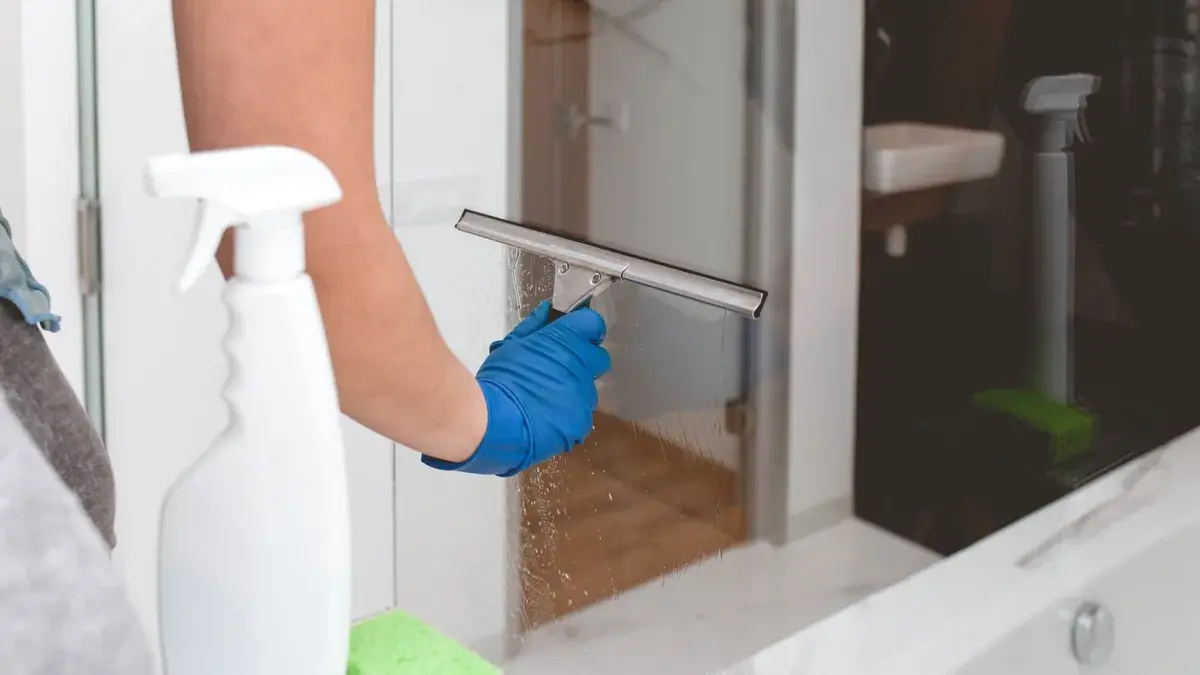
You can also apply a daily shower spray (a dilute citric-acid or surfactant product) after squeegeeing to provide an extra barrier. Switching from bar soap to a liquid body wash reduces the volume of fatty acids available to react with calcium ions. Make sure the bathroom is well ventilated after every shower, running the exhaust fan for at least fifteen minutes, to keep humidity down and prevent mould from establishing in the silicone seals at the base and edges of the screen.
When to book a professional
If the screen has years of accumulated buildup, or if repeated self-treatment has not cleared the haze, the situation is likely beyond the capability of retail products. Providers across the Urgent Pro cleaning services network carry commercial-grade descalers and glass-restoration compounds, and attend final inspections and vacate cleans in Perth, Brisbane, Gold Coast, Sydney and Melbourne.
There is also a documentation reason for tenants who are vacating. If a property manager raises the shower screen at the final inspection, a professional receipt from a verified independent provider with a traceable ABN and job reference is a considerably stronger position than a photograph of your own effort. That documentation helps if the bond is disputed through your state’s tenancy authority. For a full picture of what professional cleaning covers in the bathroom as a standard inclusion, see what a standard house clean covers.
FAQs
Why does white vinegar remove soap scum when water does not?
White vinegar is a dilute acetic acid. Calcium stearate, the main component of soap scum, is insoluble in water but breaks apart in mildly acidic conditions. The acid reacts with the calcium component and releases it from the glass surface, allowing it to rinse away. Water is pH-neutral and has no chemical effect on the compound.
Is soap scum the same as limescale?
While related, they are distinct compounds. Soap scum, or calcium stearate, forms when calcium ions in hard water react with the fatty acids in soap. Limescale, on the other hand, is calcium carbonate, left behind when hard water evaporates without soap being involved. Both require an acid-based cleaner to dissolve, and both accumulate faster in hard-water supplies such as Perth’s.
How do I know if my screen is still dirty or permanently damaged?
Apply an acid cleaner and leave it on for fifteen minutes, then rinse. If the haze reduces or clears, you are dealing with mineral deposits that can be removed. If the glass stays cloudy or shows an iridescent pattern regardless of what you apply, the glass has been damaged by persistent moisture and cannot be repaired with cleaning.
Should I use bicarb soda and vinegar together on soap scum?
Apply them separately, not together. When vinegar and bicarb are combined, they neutralise each other, produce carbon dioxide, and create a solution that has little effect on mineral deposits. The correct approach is to use bicarb as a gentle abrasive paste, rinse it off completely, and then apply vinegar separately to break down the mineral deposits. Used in sequence, the two products do considerably more useful work than when combined.
What is the raking-light inspection method?
This method involves shining a light at a shallow angle to the glass so the beam rakes across the surface rather than passing through it. Surface residue and mineral haze become visible with this technique in a way that is not possible under standard overhead lighting. Property managers use this method routinely at final inspections to check for evidence of calcium buildup that would not be apparent from a normal viewing distance.